About
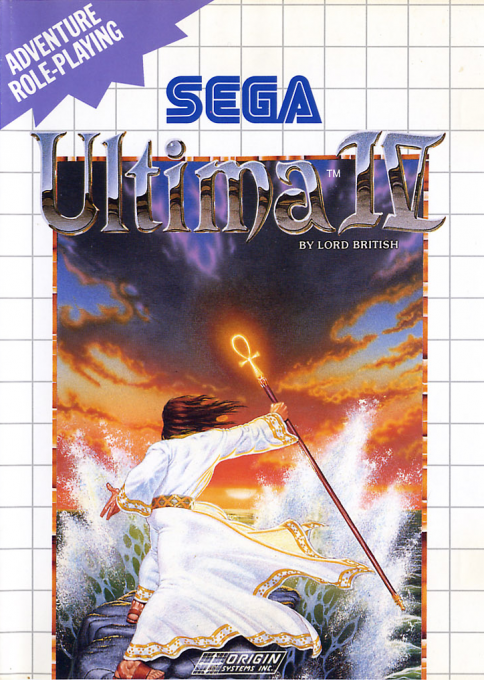
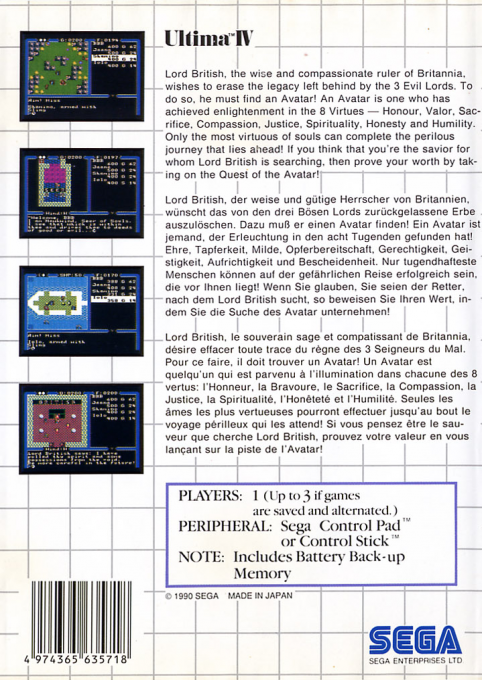
Ultima IV: Quest of the Avatar on Sega Master System brings Origin Systems’ landmark role-playing adventure to Sega’s 8-bit console. Originally released for home computers in 1985, this 1990 Sega-published adaptation is the series’ only Master System appearance. It preserves the journey through Britannia, the world reshaped after the defeat of the Triad of Evil, while presenting its own console-specific take on the game’s visuals, interface, and dungeon exploration. Rather than framing the player as a hero sent to destroy a final villain, the quest asks an ordinary person to become Britannia’s moral example: the Avatar.
That premise is the defining idea behind Ultima IV. Lord British’s realm is at peace, but its people need a model for how to live. At the beginning, a fortune teller’s ethical questions guide the player toward a character class connected to one of eight virtues: Honesty, Compassion, Valor, Justice, Sacrifice, Honor, Spirituality, and Humility. Those virtues are rooted in the principles of Truth, Love, and Courage. The objective is not simply to gain levels and gather treasure, but to understand and demonstrate all eight before reaching the Codex of Ultimate Wisdom in the Stygian Abyss.
Britannia is designed as a broad, open fantasy world. Players travel between towns, castles, villages, shrines, wilderness, dungeons, and seas, assembling a party and pursuing leads in an order that often feels self-directed. Conversation with the inhabitants is central to progress: characters offer names, occupations, rumors, and clues that lead to other people and places. The game’s virtues are also tied to conduct. Giving alms, helping others, fighting with courage, answering humbly, and respecting the innocent can improve a character’s standing, while theft, needless violence, boasting, and other selfish choices can set the quest back.
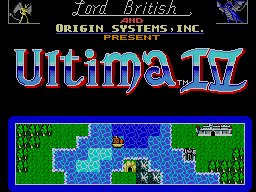
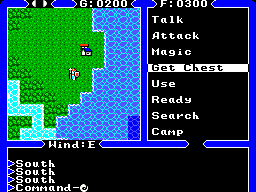
The Master System version retains the game’s turn-based adventuring and party combat while adapting its presentation for a controller. Sega redrew the graphics but generally kept the look and atmosphere of Origin’s computer game, and the port uses a simplified conversation system to make dialogue manageable on a console. Its dungeon areas are shown from a top-down view rather than the first-person-style scenes associated with several computer editions. Unlike the NES adaptation, this release uses the regular Ultima IV background music, giving the Master System cartridge a more direct connection to the computer game’s sound and mood.
Exploration still combines practical role-playing systems with the larger ethical journey. The player can travel on foot, ride horses, sail ships, and use a lighter-than-air vehicle, while weather, terrain, time, supplies, and hostile encounters shape the route through Britannia. Shrines require the proper rune and mantra for meditation, and the seer Hawkwind can assess progress toward enlightenment. Party members represent individual virtues, so recruiting companions such as Iolo, Dupre, Shamino, Mariah, Jaana, Julia, Geoffrey, and Katrina also makes the moral structure part of the adventure’s cast.
Ultima IV was influential because it made morality a game system rather than a decorative story theme. The player is free to explore and fight, but success depends on recognizing that immediate rewards can conflict with the long-term responsibility of becoming the Avatar. That approach separates it from many fantasy role-playing games of its era and makes the search for the Codex feel like the end of a personal trial, not merely the conclusion of a dungeon crawl. Its world also established Britannia as the setting that would define later entries in the series’ Age of Enlightenment trilogy.
For Master System owners, Ultima IV: Quest of the Avatar is a notable late-period role-playing release and an unusual console interpretation of a foundational computer RPG. Sega both published and ported the 1990 edition, keeping the essential quest, virtues, party adventure, and expansive map intact while reshaping the controls and visual presentation for the platform. The result is a distinctive way to experience Richard Garriott’s celebrated design: an adventure in which the measure of the hero is not the evil defeated, but the principles chosen along the way.
Gallery
Details
- Developer
- ORIGIN Systems
- Publisher
- SEGA
- Genre
- JRPG
- Players
- 1
- Release Date
- January 1, 1990
- System
- Master System