About
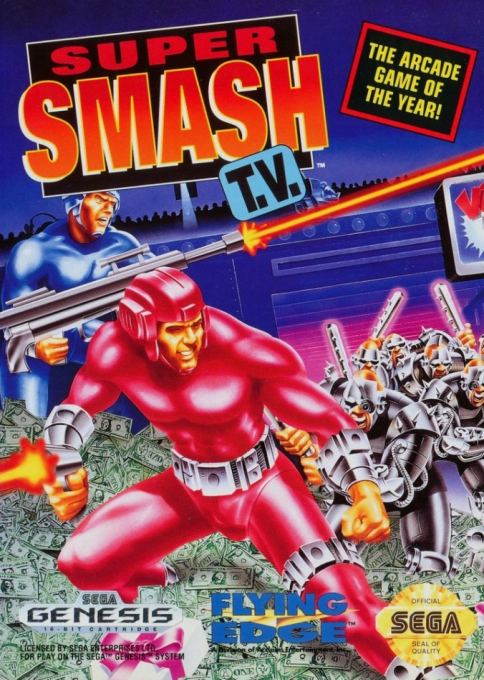
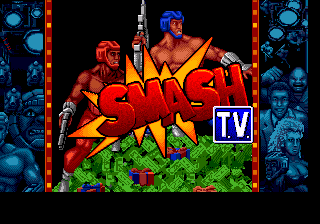
Super Smash T.V. for the Sega Genesis and Mega Drive is a 1992 conversion of Williams Electronics’ 1990 arcade shooter, developed for Sega’s 16-bit console by Probe Entertainment. Under its expanded home-release title, it places one or two contestants inside Smash T.V., a fictional future game show set in 1999. Its world turns televised entertainment into a brutal spectacle: survival is worth cash, household goods, luxury prizes, and the chance to advance to another arena. The premise gives the action a deliberately exaggerated television-show frame, complete with a manic announcer and the uneasy combination of prizes and overwhelming violence.
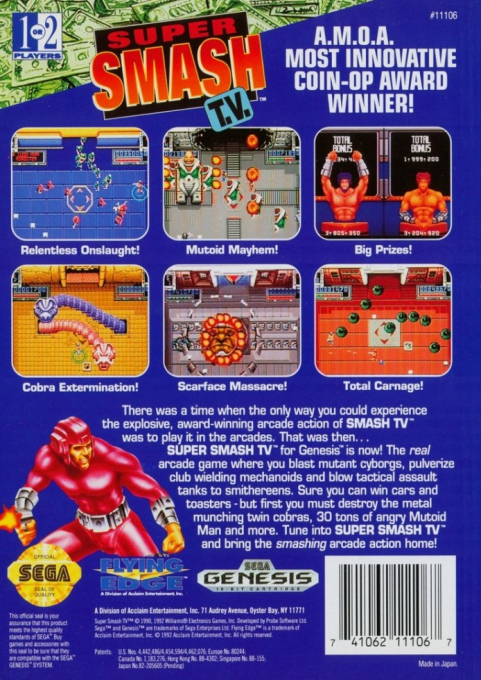
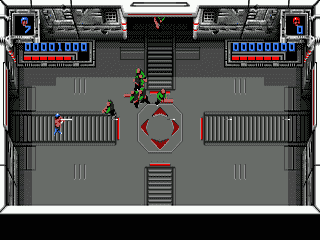
At its core, Super Smash T.V. is a fixed-screen, top-down shooter built around movement, aiming, and constant crowd control. A contestant enters a self-contained room as enemies pour in from openings at the edges, then must clear the attack before moving on. The screen can rapidly become crowded with hostile creatures, armed opponents, and mechanical threats, so positioning is as important as firing. Players can pick up temporary weapons and aids while also grabbing the money and wrapped rewards scattered among the chaos. These pickups make every room a trade-off between reaching for a prize and staying out of danger.
The game adapts the independent movement-and-firing spirit of Eugene Jarvis’ Robotron: 2084 to its game-show setting. Clearing a room opens one or more exits, allowing a route through the studio to be chosen rather than forcing every playthrough down exactly the same sequence. A map between arenas shows the broader layout and points toward the stage’s boss encounter, but completed rooms cannot be revisited. There are three major studios to survive, with boss fights closing out the action, and collectible keys add another objective: gathering enough of them before the final confrontation opens access to the Pleasure Dome bonus area.
The Genesis/Mega Drive version keeps the two-player cooperative option, while its controller arrangements address an arcade design originally played with separate movement and firing sticks. One player can use two Mega Drive controllers to approximate that dual-stick setup; two players instead share the standard single-controller method. That distinction makes the port’s controls part of its identity rather than a simple copy of the cabinet. The game retains the arcade’s rapid room-to-room rhythm, its large enemy waves, its escalating bosses, and the pressure to react quickly when weapons, enemies, and prizes all compete for the same space.
Super Smash T.V. is closely associated with the arcade style that made the original distinctive: compact arenas, immediate action, and a satirical vision of a ratings-driven future. Its 1992 Genesis/Mega Drive release arrived alongside several other home versions, but it is specifically a Probe conversion of the Williams game rather than an unrelated sequel or remake. The game’s mix of cooperative shooting, alternate room routes, prize collecting, and staged spectacle also helps explain its connection to the later 1992 Williams arcade game Total Carnage, which shares several ideas without being a direct sequel. For Genesis and Mega Drive players, Super Smash T.V. remains a console adaptation centered on relentless single-screen action and a sharply stylized game-show premise.
Gallery
Details
- Developer
- Probe Entertainment
- Publisher
- Probe Entertainment
- Genre
- Run and Gun, Shoot 'em Up
- Players
- 1-2
- Release Date
- August 1, 1992
- System
- Genesis/Megadrive