About
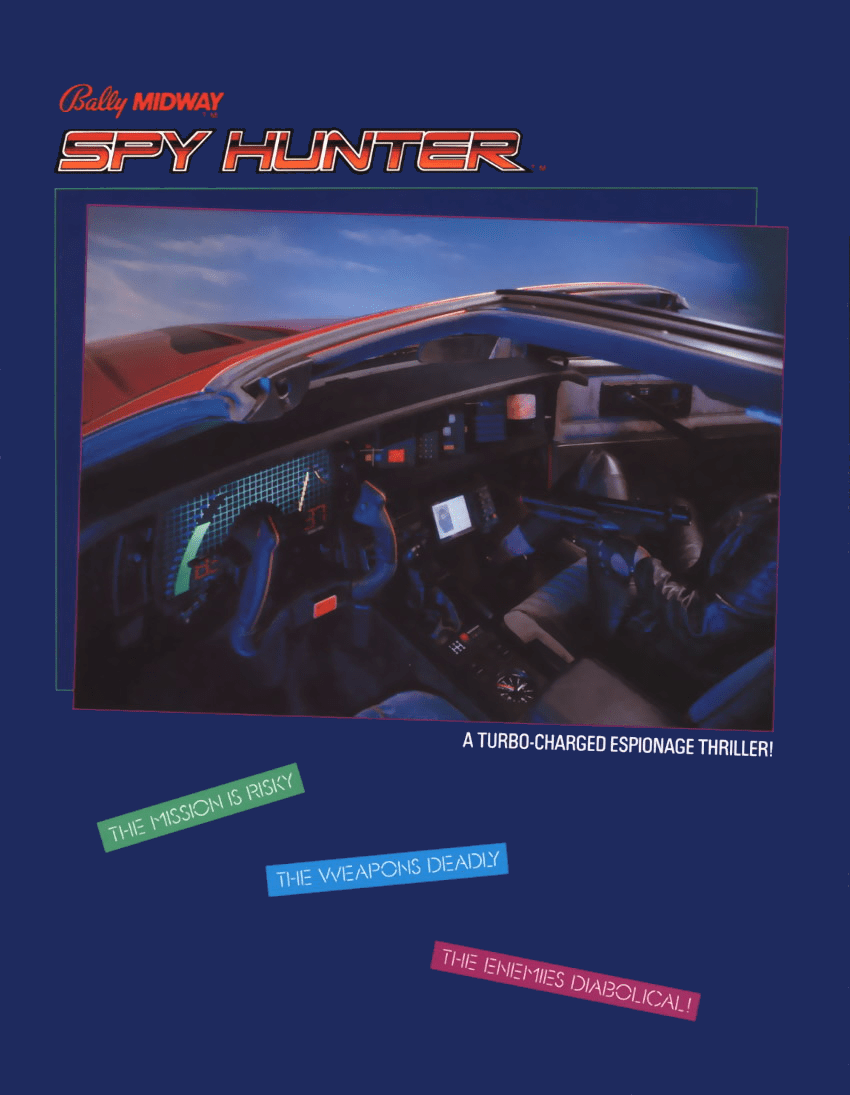
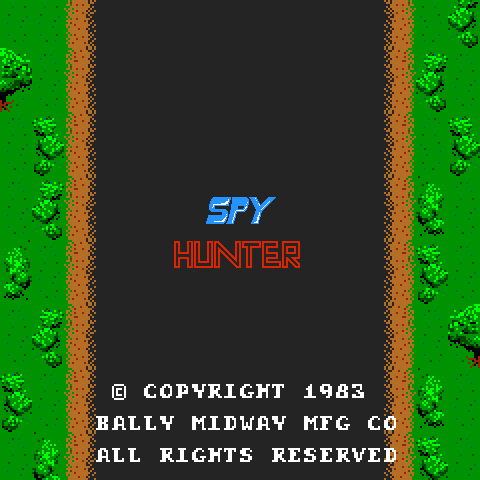
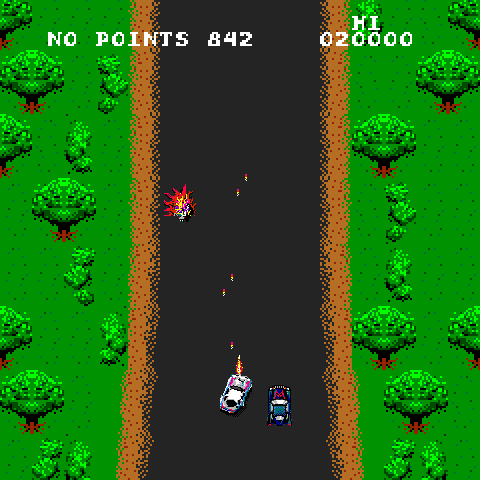
Spy Hunter is Bally Midway’s 1983 arcade driving and vehicular-combat game, built around a secret-agent fantasy rather than a conventional race. In the original Spy Hunter arcade cabinet, the player pilots the fictional G-6155 Interceptor down a vertically scrolling highway, slipping through traffic while hostile vehicles try to ram it, shoot it, or push it out of control. Bally Midway developed and published this arcade original, whose high-tech car, tense road chases, and electronic rendition of the Peter Gunn theme give it an unmistakable early-1980s arcade character.
The central challenge is survival as much as firepower. The Interceptor has a forward machine gun with unlimited ammunition, but reckless shooting can strike civilian traffic, temporarily stopping the score from accumulating. Points rise while the car is moving safely on the road, and more are earned by eliminating enemy agents or forcing them off the route. Crashes, enemy attacks, bomb craters, and wandering too far from the roadway can destroy the vehicle. After an initial lead-in period with unlimited replacement cars, every loss matters, so the game’s fast-moving roads demand steady steering, quick judgments, and awareness of traffic ahead and behind.
Spy Hunter’s original controls were designed to make the cabinet feel more like an action vehicle. Players accelerate with a floor pedal, select low or high gear with a two-position shifter, and steer with an aircraft-style yoke. Buttons and triggers on the yoke operate the machine gun and available special equipment. The combination makes speed a tactical choice: higher velocity helps the player cover ground, but leaves less time to dodge obstacles, enemy cars, and changes in the road. Both upright and sit-down cabinet versions were produced, preserving the same distinctive driving-focused control layout.
A weapons van is the Interceptor’s most important support vehicle. When its indicator is available, the player can enter the van and receive limited-use equipment: oil slicks, smoke screens, and surface-to-air missiles. Each tool serves a different danger, whether shaking pursuers, disrupting traffic, or dealing with the helicopter that attacks from overhead. Spy Hunter also changes the environment instead of treating the highway as one unbroken course. Forks lead to territories with differing conditions, and boathouses transform the Interceptor into a speedboat for water sections. In boat mode, the oil slick function becomes a flamethrower, while the other special weapons remain available.
The game has no final mission or scripted ending. It is an escalating score chase in which changing terrain, enemy behavior, depleted special weapons, and a limited supply of cars continually raise the pressure. That structure separates Spy Hunter from a stage-clear driving game: success is measured by how long the player can keep an increasingly vulnerable agent alive while maintaining a score. The design was conceived by George Gomez with Tom Leon, after an early James Bond-inspired concept could not use that license; the final game retained the spy-movie mood through its original vehicle, gadgets, and chase-driven action.
Spy Hunter became one of Bally Midway’s notable arcade hits and later reached a range of home systems, though this Arcade version is the foundation of the series. It was followed in arcades by Spy Hunter II, while later games revisited the name and the Interceptor concept in very different forms. For players looking for the defining version, Spy Hunter arcade is the compact, top-down original: a blend of driving, shooting, gadget timing, and memorable cabinet controls where protecting the road is every bit as important as blasting through it.
Gallery

Details
- Developer
- Bally Midway
- Publisher
- Bally Midway
- Genre
- Racing & Driving, Arcade Racing
- Players
- 1
- Release Date
- January 1, 1983
- System
- Arcade