About
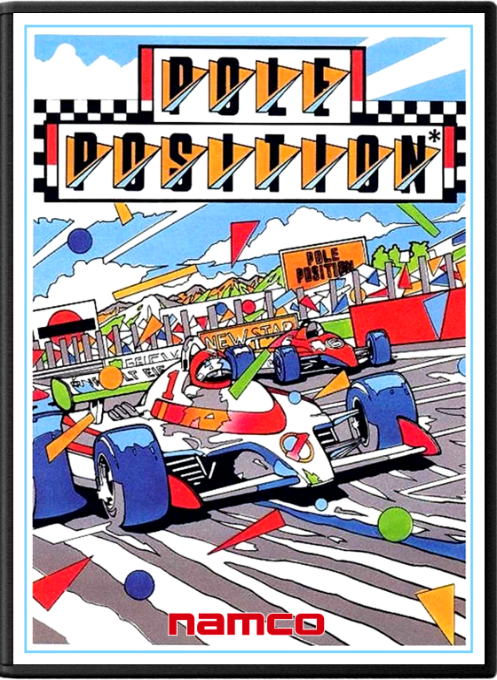
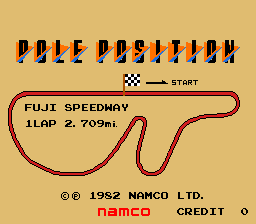
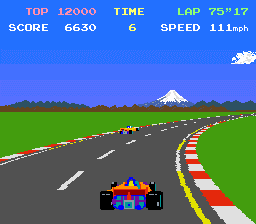
Pole Position (World) is Namco's 1982 arcade racing game, released internationally with Atari handling its North American distribution. It places one player behind the wheel of a Formula-style car on a circuit modeled on Japan's Fuji Speedway, viewed from a dramatic rear-facing perspective that makes the road narrow toward the horizon. Rather than simply asking players to stay on course, this arcade racer frames each credit as an attempt to earn a place in a Grand Prix, bringing the language and pressure of motorsport qualification into a coin-operated game.
A session begins with a timed qualifying lap. The first job is to guide the car around the complete circuit quickly enough to reach the race, while the qualifying time determines the starting position among the computer-controlled field. Steering controls the car's line through the bends, while the accelerator, brake, and two-position gear shifter make speed management part of the challenge. The original arcade machine was designed around a steering wheel and physical driving controls, so quick reactions alone are not enough: a clean route through a curve matters just as much as outright speed.
Once qualified, the player races against both the clock and rival cars. Passing opponents adds to the score, and time is extended as laps are completed, creating a constant balance between aggression and preservation. Running onto the grass drains momentum, puddles can unsettle the car, and a collision with traffic or a trackside billboard costs valuable seconds as the race resumes. These hazards turn every corner into a decision: hold a safe line, lift before the bend, or risk a faster approach in search of another overtake.
The presentation makes the course easy to read at a glance. Cars, signs, and roadside scenery change scale as they approach, while the track bends around a distant vanishing point to suggest forward motion. Green countryside, hills, and the image of Mount Fuji give the course a recognizable setting instead of an abstract roadway. Billboard advertisements also line the route, an early example of a real-world commercial look being folded into an arcade game's scenery. The result is a focused single-player race with a clear visual destination and a steadily rising sense of speed.
Pole Position arrived after Namco had built experience with electro-mechanical driving games, but its video-based road scene and qualification-and-race structure gave the company a new kind of arcade showpiece. It was released in both upright and sit-down cockpit-style cabinets. The cabinet formats preserved the core wheel-and-shifter experience, while the cockpit version emphasized the sensation of sitting in a dedicated racing machine. The game was subsequently adapted for a wide range of home systems, although those versions necessarily translated its specialized controls to the controllers available on each platform.
The arcade original became one of the defining racing games of the early 1980s and led directly to Pole Position II. Its combination of a chase-style road view, a real circuit inspiration, qualifying pressure, and rival passing established ideas that later arcade racers would develop in different ways. For players revisiting the game today, Pole Position remains a compact test of racing discipline: learn the turns, protect speed, make the qualifying lap count, and use every remaining second to chase the front of the field.
Gallery

Details
- Developer
- Namco
- Publisher
- Atari
- Genre
- Arcade Racing
- Players
- 1
- Release Date
- January 1, 1982
- System
- Arcade