About
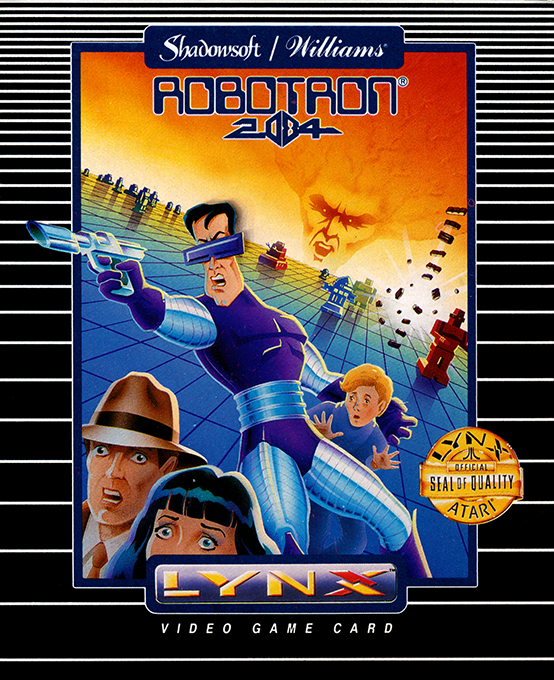
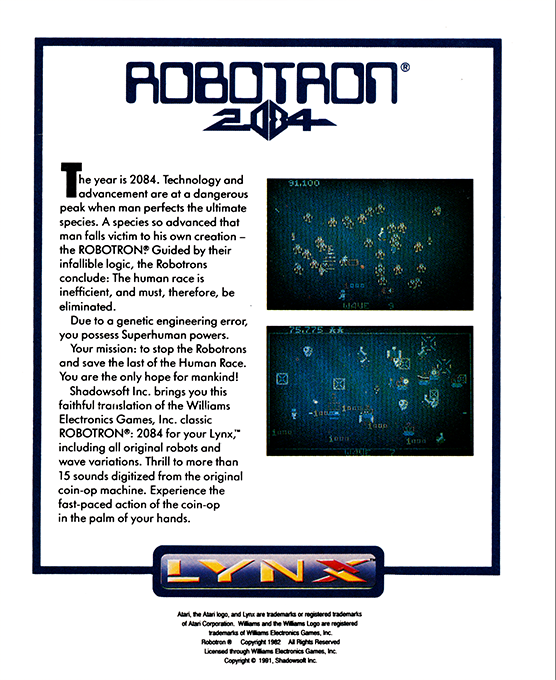
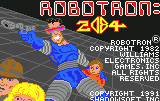
Robotron: 2084 for Atari Lynx brings Williams Electronics’ 1982 arcade shooter to Atari’s color handheld in 1991. Published by Shadowsoft and programmed by Dave Dies, this single-player conversion keeps the original’s stark science-fiction premise: in the year 2084, the human-made Robotrons have judged their creators inefficient and are attempting to erase them. The player controls a genetically altered survivor with the firepower to fight back, racing through one-screen arenas to destroy the mechanical invasion and protect the remaining human family.
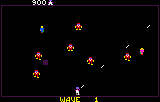
The basic objective in Robotron: 2084 is direct but relentlessly demanding. Every wave begins with the player in the middle of an enclosed arena, then fills the screen with hazards, enemies, projectiles and civilians. Clear the vulnerable Robotrons to finish the wave, while collecting humans for escalating bonus points. Touching an enemy, a hostile shot or an obstacle costs a life; the Lynx version starts with three lives and awards extras as the score rises. This makes survival and score chasing inseparable, since a risky detour to rescue people can be valuable but can also leave the player exposed.
Its threats do not all demand the same response. Grunts pursue the player, while invulnerable Hulks cannot be destroyed but can be slowed or pushed back by repeated fire. Spheroids create Enforcers, and Quarks produce Tanks, so eliminating these generators quickly prevents the arena from becoming more crowded. Enforcers fire spinning shots, Tanks launch fast bouncing Orbs, and Brains hunt humans, transform them into dangerous Progs and send Cruise Missiles after the player. Electrodes add stationary danger to the maze-like scramble. The mix turns each wave into a rapid assessment of what to evade, what to eliminate first and when to break toward a human pickup.
The arcade Robotron: 2084 was built around two joysticks, one for movement and one for eight-direction firing. The Atari Lynx has a directional pad and two main buttons, so this version supplies three control configurations rather than trying to duplicate the cabinet literally. Control A lets a held fire direction be locked while movement changes, with the other button used to reverse the shot. Control B fires in the current direction and uses a button to rotate aiming. Control C makes firing automatic and assigns the two buttons to clockwise and counterclockwise aim rotation. The options screen also lets players choose a skill level and music setting, while the Lynx hardware’s reversible screen feature can flip the display and controls through the appropriate pause-and-option command.
That redesign is central to the identity of Robotron: 2084 on Atari Lynx. Movement remains eight-way through the joypad, but shooting has to be planned with the selected portable control method, giving the conversion its own rhythm. The brief invulnerable period as a wave begins provides time to move and fire toward safer space before the enemies close in. As the waves escalate, quick reactions still matter, yet knowing how Spheroids, Quarks, Brains and their creations interact becomes just as important as raw speed.
The Lynx release is part of the long history of Robotron: 2084 adaptations, but it is specifically a handheld interpretation of the Williams classic rather than the original twin-stick arcade machine. Its 1991 cartridge preserves the game’s wave-based structure, dystopian rescue theme, enemy roster and high-score focus while tailoring aim to portable buttons. For Atari Lynx players, it is a compact action shooter built around repeated attempts to survive the next crowded screen, improve a score and learn to make clearer decisions amid escalating robot chaos.
Gallery
Details
- Developer
- Shadowsoft
- Publisher
- Shadowsoft
- Genre
- Other Shooter
- Players
- 1
- Release Date
- January 1, 1991
- System
- Lynx