About
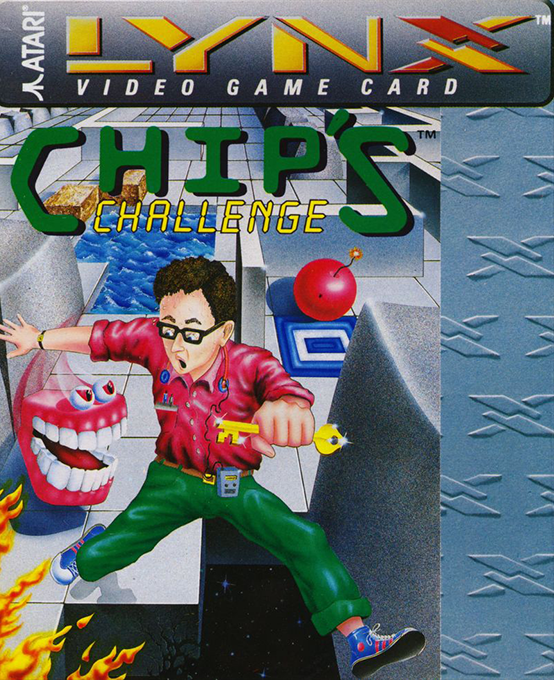
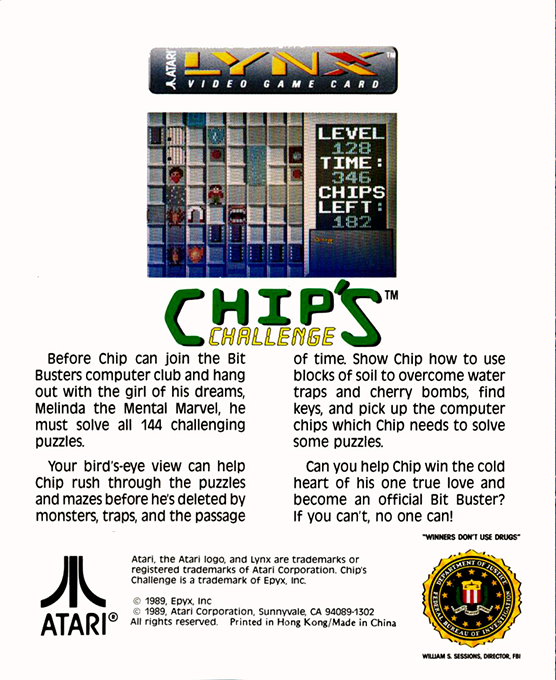
Chip's Challenge for Atari Lynx is a top-down puzzle game developed by Epyx and published by Atari in 1989. Released with the Lynx during its launch period, it puts players in control of Chip McCallahan, a student hoping to earn a place in Melinda the Mental Marvel's exclusive Bit Busters Club. The test is a long tour through the club's rooms, each presented as a compact grid of tiles that must be understood, crossed, and ultimately escaped. Although its story is deliberately lighthearted, the game uses it to give a clear purpose to every room: prove that Chip has the patience and problem-solving skill to pass the initiation.
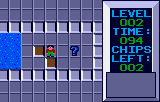
Each level begins with Chip placed among walls, paths, hazards, useful objects, and a destination that is not always immediately reachable. The central goal is usually to collect enough computer chips to unlock the socket that leads to the exit. That simple requirement creates a chain of decisions. A chip may be beyond a locked door, a dangerous floor, or a route that can only be opened after a switch is pressed elsewhere. On the Lynx, movement is direct and immediate with the handheld's controls, but success depends less on reflexes than on reading the board, planning a safe order of operations, and recognizing when one move will permanently change the available route.
Keys and color-matched doors make many rooms into small navigational puzzles. Chip can also find equipment designed for particular terrain: flippers permit travel through water, fire boots protect him from flames, ice skates help on slippery surfaces, and suction boots provide traction on force floors. Dirt blocks can be pushed to plug hazards or form crossings, while buttons, toggle walls, traps, and teleporters reshape a room's logic. A tool that solves one obstacle can be lost or rendered useless later, so the game frequently asks players to consider not only where an item will take them, but when it should be collected.
The challenge comes from the way familiar pieces combine. Some stages are maze-like searches for a workable route, while others require a precise sequence of switches, blocks, keys, and doors. Enemies and other moving hazards introduce pressure into boards that might otherwise be solved at leisure. Timed stages add another layer, making efficient movement as important as the overall plan. A mistake can leave Chip stranded, consume an essential block, or force a restart, but the short, self-contained rooms make experimentation part of the intended rhythm rather than a detour from it.
Chip's Challenge builds its difficulty across a large collection of levels, including secret material, so later puzzles can rely on the player having learned the meaning of its many tiles. The game regularly changes the emphasis from one board to the next: a room may focus on safe routing over water, then pivot to monster avoidance, then ask for careful block placement. This variety gives the Lynx version a remarkable amount of puzzle content for a cartridge game. The constant visual language of doors, boots, chips, hazards, and floor devices keeps the rules legible even as individual levels become much more intricate.
Chuck Sommerville designed the game, and its original Atari Lynx rules and level design established the foundation for the versions that followed. Chip's Challenge was later adapted for home computers and became especially familiar to many players through its Windows inclusion in Microsoft Entertainment Pack 4. Those later releases expanded its audience, but the Lynx game is the original form of the adventure: a single-player portable puzzle quest built around tile interactions, concise stages, and the satisfaction of turning a confusing room into a solvable plan.
For Atari Lynx players, Chip's Challenge stands apart from action-heavy launch-era software by making thoughtfulness the main skill. It rewards observation, memory, and the willingness to restart a difficult board with a better idea. Its humorous school-club premise and approachable early stages make the rules easy to learn, while the increasingly demanding rooms provide a deeper test for puzzle-game fans. That balance between immediate controls and layered level design is why Chip's Challenge remains closely associated with the Lynx as well as with the later computer versions that carried Chip's puzzle course to a wider audience.
Gallery
Details
- Developer
- Epyx
- Publisher
- Atari
- Genre
- Other Strategy, Logic Puzzle
- Players
- 1
- Release Date
- January 1, 1989
- System
- Lynx