About
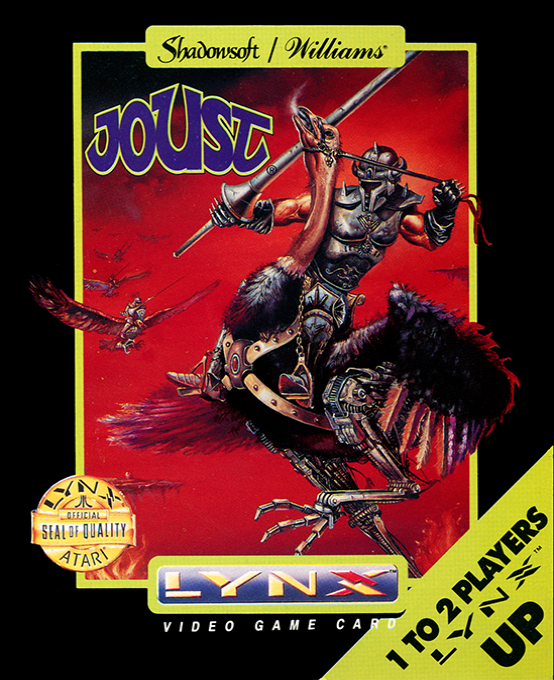
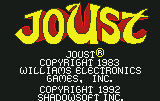
Joust for Atari Lynx brings Williams Electronics' 1982 arcade action game to Atari's color handheld in a 1992 conversion published by Shadowsoft. It retains the unusual medieval-fantasy premise that made the original immediately recognizable: a lance-bearing knight rides a flying ostrich above a field of platforms and lava, challenging hostile knights mounted on buzzards. Rather than shooting or relying on a conventional platform jump, the game turns positioning in the air into the essential skill. This Lynx edition is a score-driven, fixed-screen action game built around short waves of increasingly demanding aerial encounters.
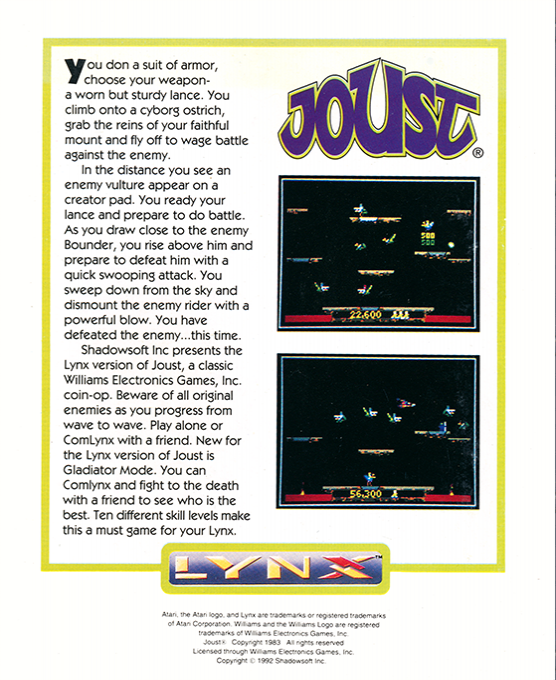
The central rule is simple but leaves room for careful timing. The player moves horizontally and repeatedly uses the flap control to climb, hover, or descend; when two riders meet, the higher lance wins the joust. A successful hit unseats an enemy and leaves an egg falling through the arena. Collecting the egg earns points, while letting it hatch restores an opponent to the field, so each pass becomes a choice between pursuing another rider and protecting the result of a previous victory. The Lynx controls translate the original's distinctive flight system to a handheld pad and buttons without changing the basic contest of altitude and momentum.
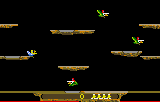
Each wave takes place on a single wraparound arena of suspended ledges above a lava-filled lower boundary. Riders can travel off one side of the screen and return from the other, a useful escape route as well as a way to approach opponents from unexpected angles. The computer-controlled ranks become more threatening as play continues: Bounders, Hunters, and Shadow Lords differ in aggression and behavior. Waiting too long also has consequences, because the pterodactyl eventually enters the arena to hunt riders, while the lava troll punishes anyone who flies dangerously low. Lost clashes and falls cost lives, keeping the arcade structure focused on survival and a growing score.
Joust on Lynx also preserves the original game's blend of cooperation and rivalry. A second player can join through the ComLynx cable with another Lynx system, allowing two knights to clear enemy waves together while still being able to collide with one another. The manual additionally identifies a two-player Gladiator Mode, giving linked systems a direct competitive option. That local link support is especially relevant to this version: it lets the handheld conversion use its hardware connection for the same kind of social, simultaneous play that was central to Joust from the arcade onward.
The 1992 release arrived a decade after Joust first appeared in arcades, so it is not a sequel or remake but a dedicated portable version of the original design. Its appeal rests on mechanics that are easy to understand yet demanding to master: judge height, control each flap, deal with eggs before they hatch, and make the most of the arena's edges and platforms. For players exploring the Atari Lynx library, Joust offers a compact adaptation of a landmark Williams game, preserving its birds, lances, lava hazards, wave progression, and linked multiplayer on a handheld system.
Gallery
Details
- Developer
- Williams
- Publisher
- Shadowsoft
- Genre
- Platformer
- Players
- 1-2
- Release Date
- January 1, 1992
- System
- Lynx