About
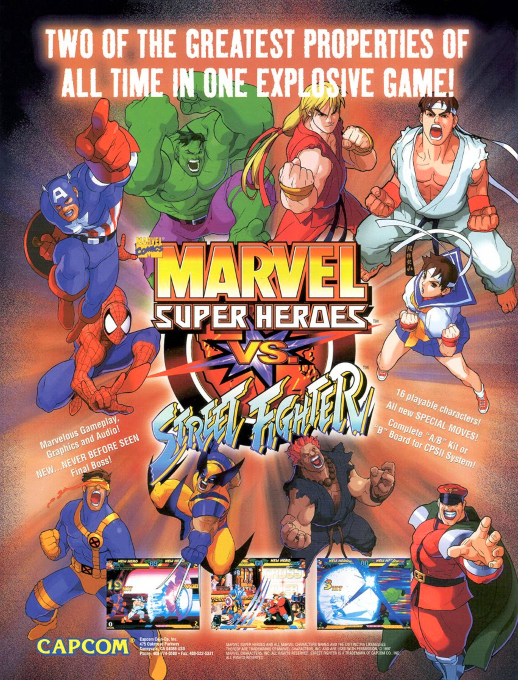
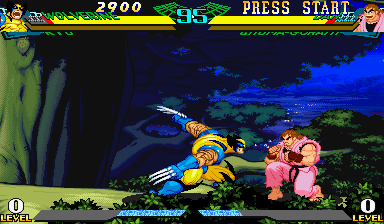
Marvel Super Heroes vs. Street Fighter is Capcom’s 1997 arcade crossover fighter, released for the company’s CP System II hardware. This Japanese 970707 version brings Marvel characters and Street Fighter regulars into a fast 2D team battle built around Capcom’s animated sprite work and six-button fighting controls. It follows X-Men vs. Street Fighter and is commonly regarded as the second entry in the Marvel vs. Capcom line, though its Capcom half is still drawn entirely from Street Fighter. The Japanese arcade release pairs figures such as Spider-Man, the Hulk and Captain America with Ryu, Chun-Li, Ken, Zangief and other familiar opponents.
A match begins by choosing two fighters. Only one is directly controlled at a time, while the partner waits off-screen with a separate health bar. The goal is to eliminate both opposing characters before time runs out, using the joystick and punch and kick buttons for normal attacks, throws, jumps, special techniques and super moves. The game keeps the high-energy style established by its predecessor: fighters can launch rivals upward, chase them into the air for extended attacks, and use the screen’s extra vertical space for unusually high jumps. Matches reward learning each character’s movement, attack ranges and command inputs, then recognizing when it is safer to change fighters or press an advantage.
Its defining addition is the Variable Assist system. Rather than tagging out, a player can call the reserve character briefly onto the screen to perform a helping attack while the active character remains in play. That creates opportunities to cover an approach, extend a combination or force an opponent to deal with two threats at once. The Hyper Combo gauge also supports more powerful attacks, while sufficiently stocked meter permits a Cross-Over Combination in which both team members attack together. These mechanics make the partner selection matter beyond simply providing a second health bar, and they helped establish the assist-based team play associated with later Capcom versus games.
Marvel Super Heroes vs. Street Fighter changes the Marvel side of the previous game’s formula by putting more emphasis on heroes and villains from across Marvel’s catalogue rather than relying chiefly on the X-Men. Wolverine and Cyclops return, while Spider-Man, Captain America, the Hulk, Omega Red and Blackheart broaden the comic-book lineup. On the Street Fighter side, returning World Warriors share space with additions including Dan and Sakura. Arcade play builds toward battles with Apocalypse and Cyber-Akuma, while head-to-head play lets two people test team combinations directly. Alternate versions of several fighters are hidden in the roster, providing variations on familiar characters rather than wholly separate selections.
This Japan 970707 arcade edition is especially notable for Norimaro, a character created by Japanese comedian Noritake Kinashi. Norimaro is neither a Marvel hero nor a Street Fighter combatant, and he was not included in the international arcade releases. The game later reached Japan’s Sega Saturn in 1998, where the 4 MB RAM expansion cartridge allowed the conversion to retain its tag-team structure. A 1999 PlayStation version took a different approach because of memory limits, replacing simultaneous tag fighting with conventional rounds and adding its own modes. Those differences make the arcade original and Saturn conversion particularly important to the game’s history.
Capcom followed Marvel Super Heroes vs. Street Fighter with Marvel vs. Capcom: Clash of Super Heroes in 1998, which expanded the Capcom representation beyond Street Fighter. The 1997 game remains a key bridge between the company’s earlier Marvel-licensed fighters and the broader crossover series that followed. Its quick tag switches, dramatic air attacks, assist calls and comic-book presentation capture the arcade-focused design of late-1990s Capcom fighters. The original arcade title was also included in Capcom’s 2024 Marvel vs. Capcom Fighting Collection: Arcade Classics, preserving this stage of the series alongside the games that led into and out of it.
Gallery

Details
- Developer
- Capcom
- Publisher
- Capcom
- Genre
- Fighting
- Players
- 1-2
- Release Date
- January 1, 1997
- System
- Arcade