About
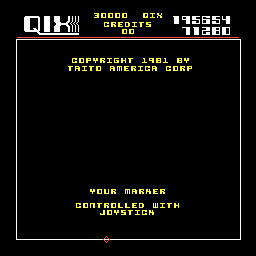
Qix (rev 2) is the preserved arcade revision of Taito's 1981 abstract action-puzzle game, created by Taito America. Rather than putting a character in a maze or a ship in space, Qix gives the player a stark rectangular field and asks for control of it. An erratic, multicolored line-form called the Qix moves inside the empty playfield while a small marker starts on its border. The aim is to fence off enough territory to clear each round, turning an unusual geometric premise into an immediate test of nerve, timing, and spatial judgment.
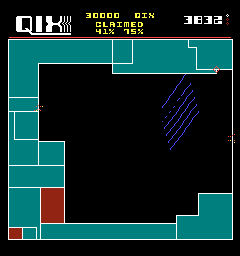
A four-way joystick moves the marker around the outer boundary and along any territory already secured. Two draw buttons determine how it ventures into the open field. Fast Draw lays a line quickly, while Slow Draw takes longer but makes successfully captured areas worth more points. The crucial move is to travel from one safe edge to another and complete an enclosure. When a line closes a region, the game fills the side that does not contain the Qix, adding it to the player's claimed area. A round is cleared by taking at least three quarters of the playfield, with an extra bonus for going beyond that target.
Drawing is where Qix turns simple territory capture into a high-pressure arcade challenge. The marker is vulnerable while a new line is unfinished: if the roaming Qix touches that exposed line, the player loses a life. Sparx, smaller enemies that race around the field's boundaries, create a separate danger for a marker traveling on safe edges. Hesitating during a draw can also be costly, because a fuse begins to burn down the unfinished line toward the player. Every enclosure therefore poses a question: cut off a modest safe section now, or commit to a larger, more lucrative piece of the board while the hazards are moving.
The game becomes more demanding as play continues. Additional Sparx are introduced, and the edge-bound enemies can become Super Sparx capable of pursuing a marker on unfinished lines. Later rounds can place two Qix figures in the field. Separating the two moving forms into different captured regions ends that round and affects subsequent scoring, so the screen's constantly changing geometry matters as much as raw percentage. Its colorful vectors, pulsing electronic effects, and bare black playfield make every new boundary easy to read even as the action grows more crowded.
Qix was an unconventional arcade release for its period, developed by Taito's American branch and released in North American arcades in 1981 before being brought to Japan. The cabinet supports one or two players, with the essentials kept deliberately direct: joystick movement, a fast drawing button, and a slow drawing button. That economy makes its play immediately understandable, but its enemies and scoring rules reward careful planning. A small cut can corral the Qix into a corner; a well-timed slow enclosure can transform the rest of the board into a major score.
The original arcade Qix also established the model for a long line of territory-capture games. It received arcade follow-ups and home conversions for systems including Atari platforms, Commodore 64, Game Boy, NES, and Atari Lynx, while its central idea was adapted by many later games. This revision remains centered on the original's distinctive contest: draw a boundary, survive until it closes, and steadily reduce a wild abstract opponent's freedom to move.
Gallery


Details
- Developer
- Taito
- Publisher
- Taito
- Genre
- Logic Puzzle
- Players
- 1-2
- Release Date
- January 1, 1981
- System
- Arcade