About
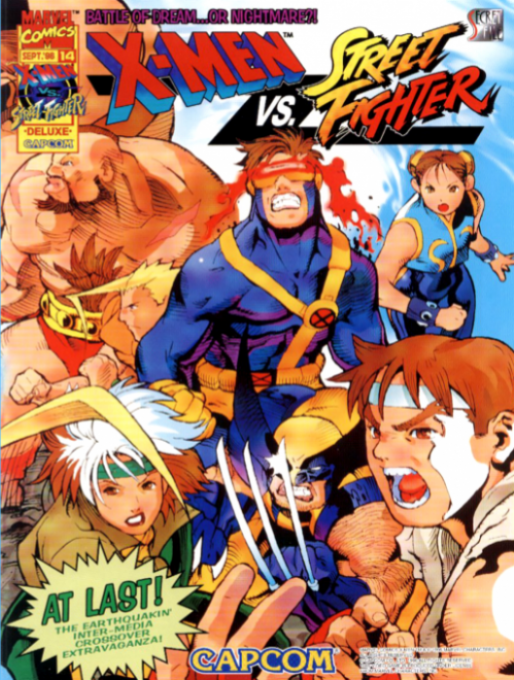
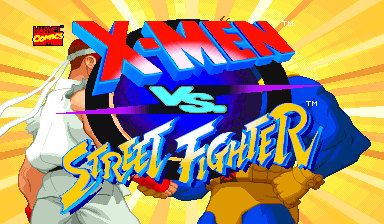
X-Men vs. Street Fighter (USA 961023) is Capcom's 1996 arcade crossover fighter for the CP System II hardware. It brings Marvel's X-Men into the same fast, colorful arena as Capcom's Street Fighter cast, with two players able to compete head-to-head at a six-button arcade cabinet. The USA 961023 title identifies a North American arcade program revision dated October 23, 1996; it is the original coin-op game rather than the later Saturn or PlayStation conversions.
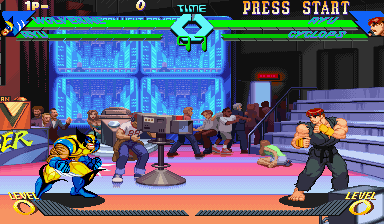
The arcade game turns a familiar one-on-one fighting format into a two-character team contest. Before a match, each side picks a pair of fighters and controls one at a time. A player can call the reserve character into battle with a tag, while the fighter waiting off-screen recovers some lost vitality. Knocking out one opponent does not end the contest: the surviving partner must still be defeated. This structure makes timing, health management, and the decision to bring in a fresh character as important as winning an exchange of punches and kicks.
Its foundations are recognizably Street Fighter: an eight-way joystick and separate punch and kick buttons support normal attacks, throws, special moves, blocking, and jumping. Capcom also carried forward the high-mobility ideas used in its earlier Marvel arcade fighters. Super Jumps send combatants high above the normal fighting plane, while Aerial Raves let players continue a successful sequence in the air. A Hyper Combo Gauge builds through combat and damage taken, then pays for powerful Hyper Combos or team-oriented techniques. Variable Counters use a blocked attack as an opening to bring in the partner, and Variable Combinations put both selected characters on screen for a simultaneous super attack.
The roster pairs heroes and villains from the X-Men world with Street Fighter regulars. Wolverine, Cyclops, Storm, Rogue, Gambit, Sabretooth, Magneto, Juggernaut, and the boss Apocalypse supply the Marvel side, while Ryu, Ken, Chun-Li, Cammy, Zangief, Dhalsim, Charlie, and M. Bison represent Street Fighter, alongside the hidden Akuma. Capcom gave the Street Fighter combatants deliberately heightened attacks so they could contend with mutants and supervillains; the result is a game built around huge projectiles, fast movement, extended chains, and dramatic screen-filling supers rather than simulation-minded martial arts.
In the arcade's single-player route, one player faces computer-controlled teams across a run that ends with Apocalypse. Competitive play is local and direct, with each participant reading the other player's chosen pair, meter, position, and remaining life. The game uses a single extended team battle instead of the usual best-of-three individual rounds, so a close match can shift suddenly after a tag, a counterattack, or a well-timed super. Capcom's operator documentation also shows its place in the coin-op environment: the board was supplied for JAMMA-compatible horizontal cabinets, with adjustable settings for items such as difficulty, credits, and sound.
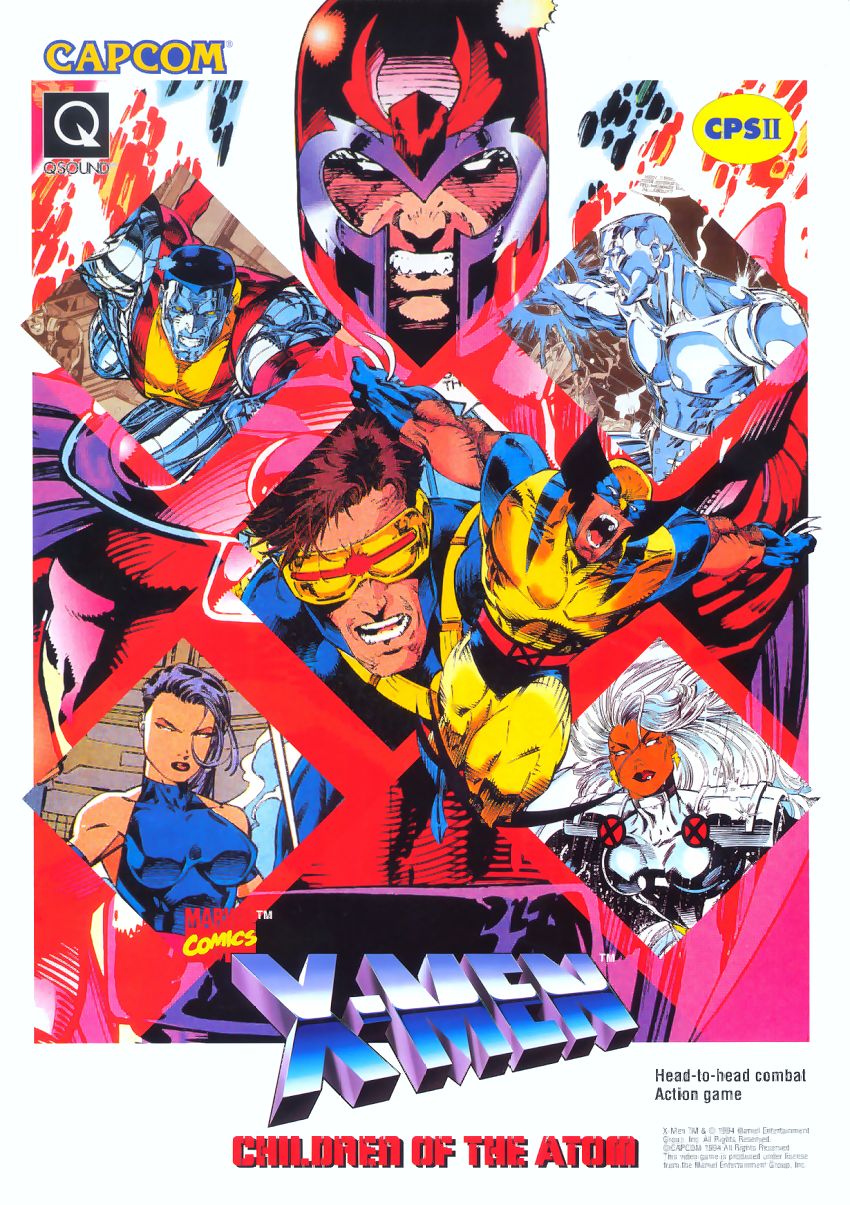
X-Men vs. Street Fighter followed Capcom's X-Men: Children of the Atom and Marvel Super Heroes, and it established the tag-team direction that would define the Marvel vs. Capcom line. The arcade version later reached the Sega Saturn with its 4 MB RAM cartridge, while the PlayStation adaptation made substantial changes because it could not keep both fighters active in the same way. For players looking specifically for X-Men vs. Street Fighter arcade action, the CP System II original preserves the full team-switching design and the rapid two-on-two battles that made Capcom's first Marvel-versus-Street Fighter collision distinctive.
Gallery

Details
- Developer
- Capcom
- Publisher
- Capcom
- Genre
- Fighting
- Players
- 1-2
- Release Date
- January 1, 1996
- System
- Arcade