About
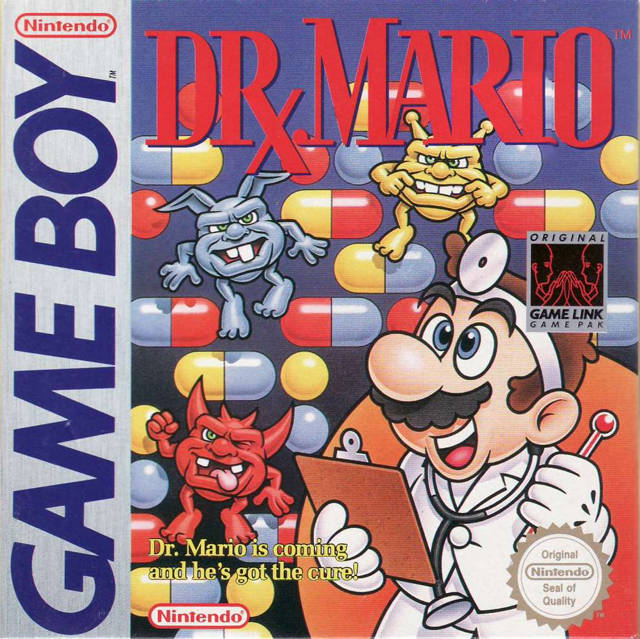
Dr. Mario for Game Boy is Nintendo's 1990 falling-capsule puzzle game, starring Mario in his unusual role as a doctor at the Mushroom Kingdom Hospital. Developed and published by Nintendo, this portable entry arrived alongside the original NES game and established a distinct puzzle offshoot of the Mario series. Its premise is deliberately light: a virus outbreak has filled a medicine bottle, and Dr. Mario responds by throwing in two-part vitamin capsules. The result is a compact Game Boy challenge built around quick placement decisions, orderly cleanup, and the pressure of a steadily descending supply of capsules.
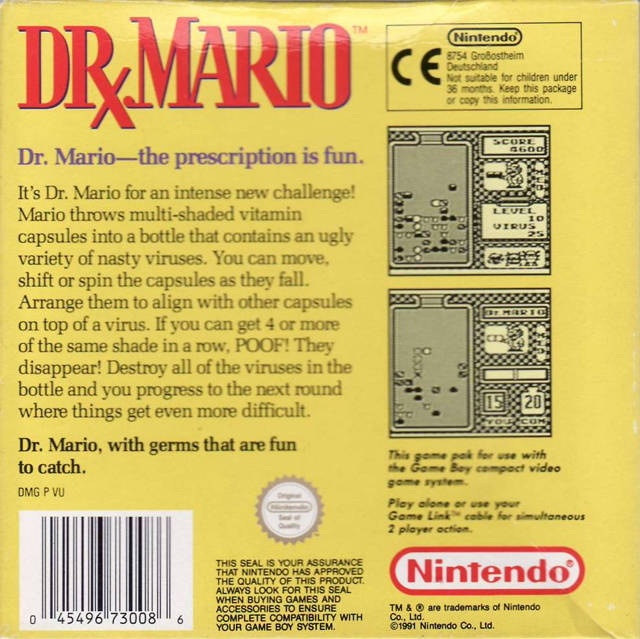
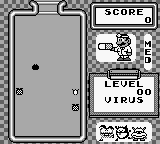
Each capsule is made of two joined halves, and the player guides it into the bottle with the Control Pad before it settles. Left and right move it across the field, Down drops it faster, and the A and B buttons rotate it in opposite directions. Viruses and capsule halves come in three matching types, represented by different Game Boy shades in this monochrome version. A horizontal or vertical line of four or more identical types disappears. Crucially, capsules can help form a line without necessarily removing a nearby virus of a different type, so clearing the board demands attention to both position and matching shade.
The single-player objective is to eliminate every virus in the bottle. Players choose a starting virus level, which changes the opening number of viruses, and choose low, medium, or high capsule speed. Faster play makes the falling pieces harder to manage, while the score rewards virus removals according to the selected speed and the number destroyed together. Clearing a group can leave unsupported capsule halves above it; those pieces drop, sometimes creating another match. Building around these falling leftovers is the heart of Dr. Mario's chain-reaction play, while a bottle packed to its neck ends the attempt.
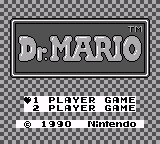
Although its rules are easy to state, the Game Boy layout asks the player to manage awkward color pairings and preserve useful spaces as the bottle fills. A capsule that is perfect for one virus may block the column needed for another, and a rushed rotation can strand half a capsule in the wrong place. The display shows the next capsule as well as the current situation, making planning possible even as the pace rises. The game also offers the familiar FEVER and CHILL music selections, and its short demonstration game on the title screen introduces the basic flow before a new player starts a round.
Dr. Mario Game Boy also supports a two-player mode through the Game Link cable. Each participant needs a Game Boy and a copy of the game, then races on a separate bottle to remove every virus first. Winning a round earns a crown, and the first player to collect three crowns wins the match. A player can also take a round when the opponent's capsules reach the top. Eliminating multiple rows or columns at once sends random pieces into the other player's bottle, turning well-timed chains into an offensive tool rather than simply a scoring opportunity. The options let each player select virus level and speed, allowing an informal handicap between opponents.
This Game Boy edition adapts Dr. Mario's color-matching format to the handheld's smaller, black-and-white screen while retaining the core capsule movement, bottle-clearing progression, and linked multiplayer competition. Mario's doctor persona, the animated viruses, and Hirokazu Tanaka's music give the puzzle format a recognizable Nintendo character, yet the focus remains on the self-contained board in front of the player. Dr. Mario became the beginning of its own Nintendo puzzle series, with later entries and remakes returning to the same simple goal: keep the bottle under control long enough to cure every virus.
Gallery
Details
- Developer
- Nintendo
- Publisher
- Nintendo
- Genre
- Tile-Matching Puzzle
- Players
- 1-2
- Release Date
- January 1, 1990
- System
- GB