About
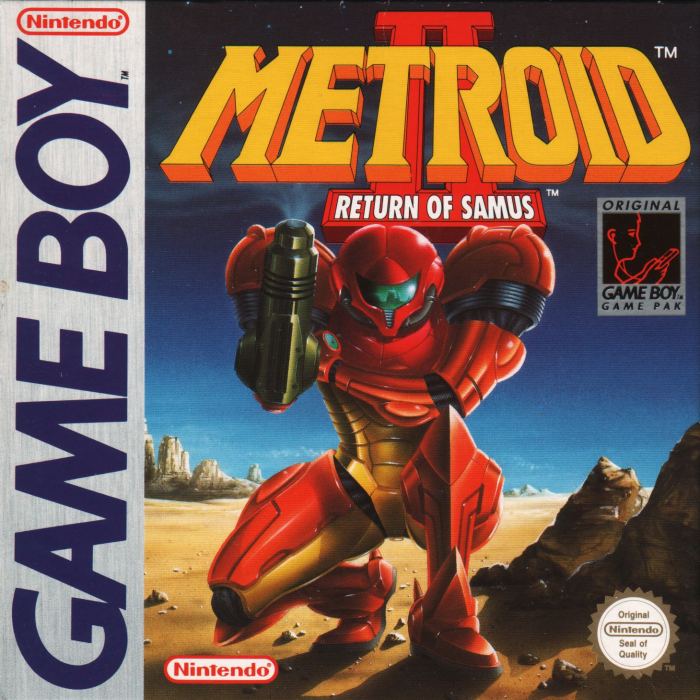
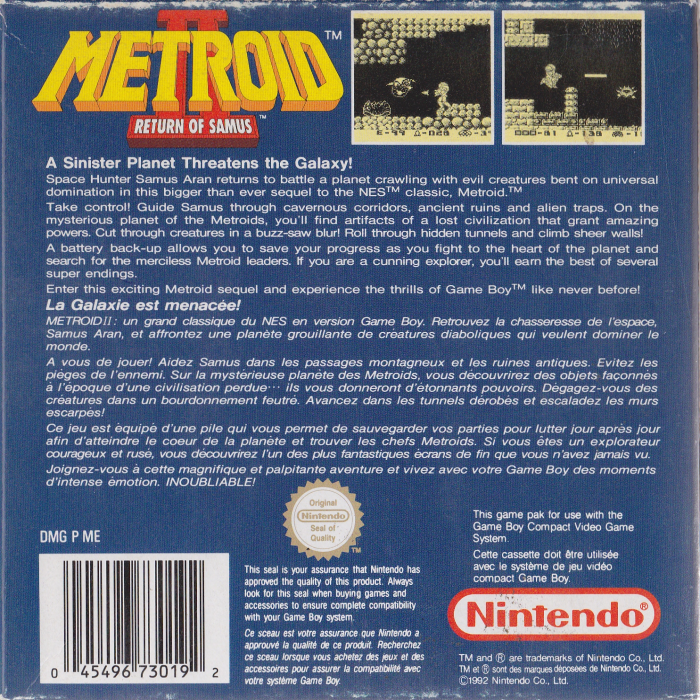
Metroid II: Return of Samus for Game Boy is Nintendo’s 1991 follow-up to the original Metroid and Samus Aran’s first portable mission. Developed by Nintendo R&D1 and published by Nintendo, this monochrome action-adventure sends the Galactic Federation’s bounty hunter to SR388, the Metroids’ homeworld. Federation expeditions have vanished there, and Samus is assigned a direct, dangerous objective: find and eliminate the alien species before its power can be exploited again.
The Game Boy adventure is built around solitary exploration and gradual expansion of Samus’s abilities. She runs, jumps, fires her arm cannon, launches missiles, and changes into the compact Morph Ball to enter narrow passages. Caverns branch through SR388’s underground zones, with doors, destructible barriers, hostile lifeforms, item rooms, and routes that only become practical after new equipment is discovered. Rather than advancing through conventional stage exits, players search the planet itself, learn its layouts, and use their growing arsenal to reach deeper territory.
Metroid II gives the hunt a clear structural role in that exploration. A counter tracks the Metroids remaining in the current area, and defeating the required creatures triggers a quake that lowers lava blocking the path below. This turns each region into a search-and-destroy assignment, while the varied Metroid encounters demand different approaches. Samus faces increasingly formidable forms as the creatures mature, culminating in the Queen Metroid. Save stations placed around SR388 let players record progress, an important convenience for an extended Game Boy quest.
Several items broaden both combat and movement. Beam upgrades include the Spazer Beam, which splits shots, and the Plasma Beam, which can pass through enemies; only one of those beam types can be active at a time. The Spider Ball lets Morph Ball Samus cling to and travel along many walls and ceilings, while the Spring Ball adds a jump in ball form. Space Jump grants repeated midair jumps, opening routes that would otherwise remain out of reach. Missile capacity, energy tanks, suit improvements, and other pickups reward close inspection of the planet’s passages.
The Game Boy hardware shaped the game’s presentation and controls without changing the series’ science-fiction premise. Samus can crouch and fire, and she can shoot downward while jumping, useful responses to enemies in tight tunnels or on lower ledges. The portable release also established a more visibly distinct Varia Suit, with rounded shoulder armor that helped distinguish it on a non-color screen and became a familiar part of Samus’s later look. Its compact display, limited palette, and maze-like caverns make careful navigation central to the experience.
Storywise, Metroid II: Return of Samus takes place after Samus stops the Space Pirates’ earlier Metroid scheme on Zebes. On SR388, the extermination mission leads from the earliest Metroid forms through more powerful evolutions and ultimately to the Queen. The ending provides one of the series’ defining turns: after the queen is defeated, a hatchling identifies Samus as its mother. Samus spares the infant and leaves SR388 with it, setting up the story that continues in Super Metroid.
Originally released in North America in November 1991, Metroid II reached Japan in January 1992 and Europe in May 1992. It was later made available through Nintendo’s 3DS Virtual Console and has also appeared in Nintendo’s classic-game library. The Game Boy original was remade as Metroid: Samus Returns for Nintendo 3DS in 2017, but Metroid II remains the original handheld chapter: a focused SR388 expedition that introduced lasting series tools, gave Samus a landmark portable adventure, and established the events behind the next major 2D Metroid story.
Gallery
Details
- Developer
- Nintendo
- Publisher
- Nintendo
- Genre
- Action-Adventure, Platformer
- Players
- 1
- Release Date
- May 21, 1992
- System
- GB