About
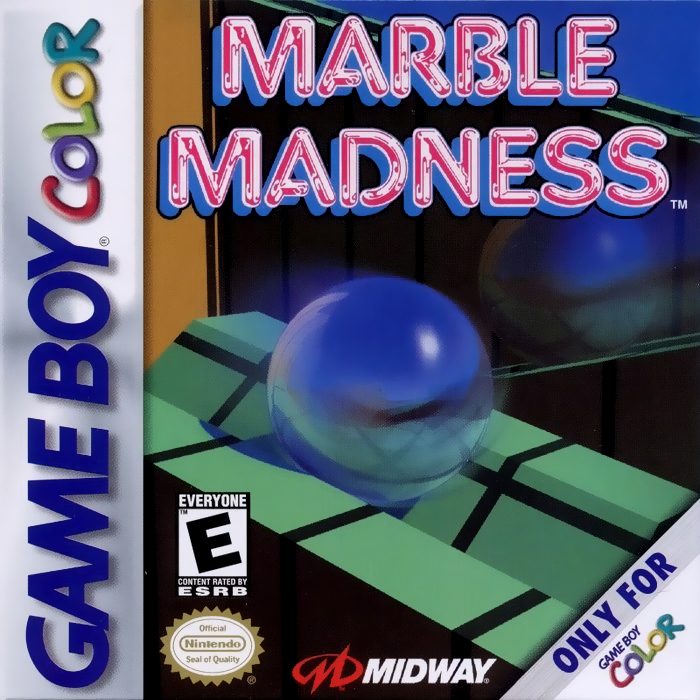
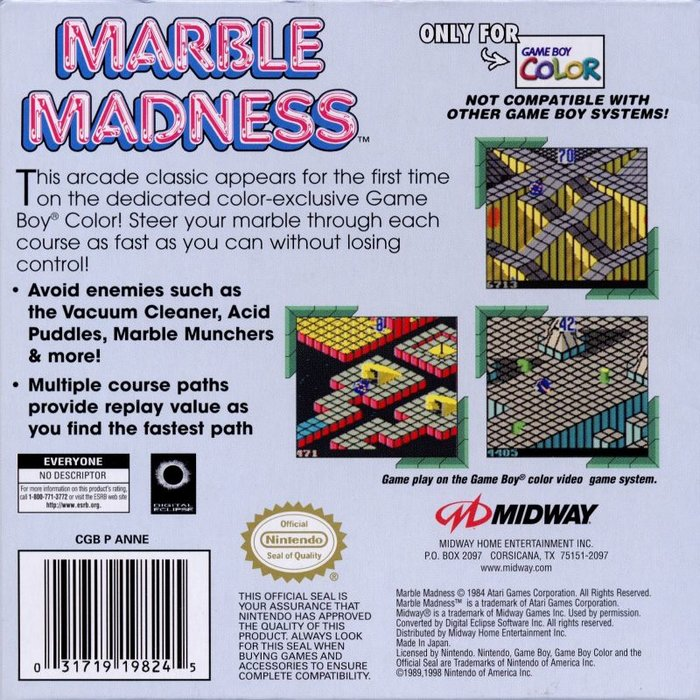
Marble Madness for Game Boy Color is Digital Eclipse’s 1999 handheld adaptation of Atari’s arcade marble-racing game, published in North America by Midway Home Entertainment. It brings the series’ instantly recognizable isometric courses to Nintendo’s color handheld, asking the player to guide a single marble from the start of each compact course to its finish before the timer runs out. The North American cartridge arrived on December 1, 1999, with a European release following in 2000. Rather than being a new entry in the series, it reworks the central challenge that made the 1984 original distinctive: keeping a rapidly moving ball under control while every slope, corner, and obstacle threatens precious seconds.
The aim in Marble Madness is direct but demanding. The Control Pad moves the marble in all directions, while the face buttons are not used for steering; START pauses the game. That simple setup places the emphasis on reading the angled playfield and making quick corrections. Each race is a timed run, and the game rewards remaining seconds with points when a course is cleared. A lost marble does not bring a conventional game-over limit—the player has unlimited attempts—but it costs time, so falls and collisions can still end a run when the clock reaches zero.
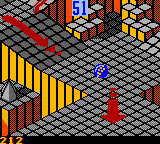
The Game Boy Color version presents its action from a diagonal, elevated viewpoint. Courses are built from narrow lanes, steep drops, raised paths, intersections, and surfaces that make it difficult to judge exactly where the marble will travel. Players must balance speed against control: rushing through a bend can send the marble off the edge, yet overcorrecting wastes the seconds needed to reach the goal. The design turns what looks like a simple rolling game into a small sequence of spatial problems, with the camera angle making direction and momentum part of every decision.
Danger comes from both the courses and their inhabitants. The manual identifies Marble Munchers, hopping worm-like enemies that interfere with the player’s route; Steelies, black marbles that pursue the player; Vacuums that pull the marble apart; and acid pools that destroy it on contact. These hazards make paths more than time trials. A safe line may take longer, while a direct route can put the marble in the path of an enemy or a trap. The first course also includes painted blocks: numbered blocks award larger bonuses, while unnumbered colored tiles add smaller point rewards, giving careful players an incentive to explore their placement even under time pressure.
This Game Boy Color release belongs to a long line of Marble Madness conversions, but it is tailored to a handheld digital pad rather than the arcade cabinet’s trackball. That change gives the port its own feel: directional inputs replace the rolling, physical motion of the original control scheme, while the compact screen concentrates attention on the marble’s immediate route. The cartridge is a single-player game, in contrast to the arcade version’s simultaneous competition, so the focus is on individual time management, score bonuses, and mastering the hazards course by course.
Marble Madness remains closely associated with the arcade game conceived by Mark Cerny and released by Atari Games in 1984, whose abstract isometric worlds and race-against-time structure helped establish the series’ identity. Digital Eclipse’s Game Boy Color edition places that concept in the late-1990s portable library without changing its essential premise. For players seeking a quick but exacting retro challenge, Marble Madness Game Boy Color is built around readable rules, escalating pressure, and the satisfying task of steering one small marble through courses designed to make every second count.
Gallery
Details
- Developer
- Digital Eclipse
- Publisher
- Midway
- Genre
- Maze
- Players
- 1
- Release Date
- December 1, 1999
- System
- GBC