About
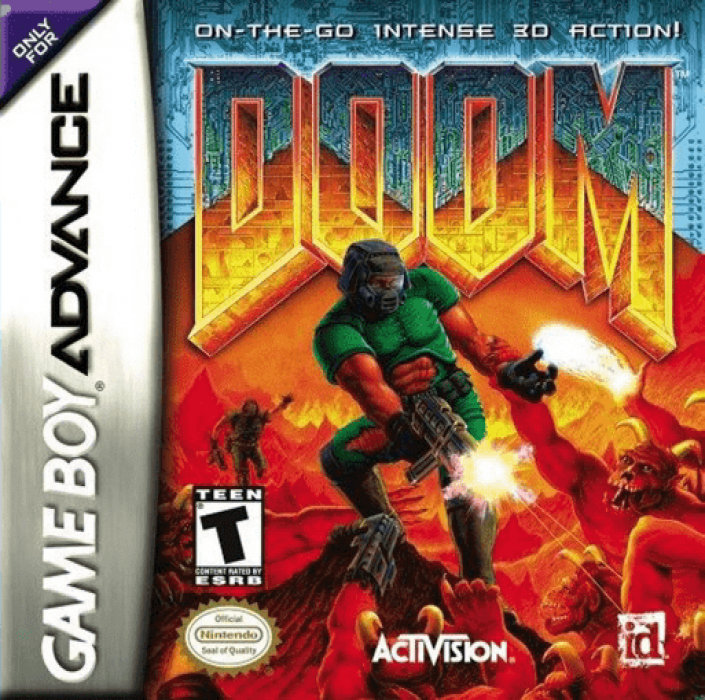
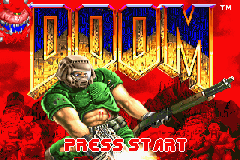
Doom brings id Software’s landmark 1993 first-person shooter to Game Boy Advance in a 2001 release published by Activision. The handheld conversion was developed by David A. Palmer Productions in collaboration with id Software, turning the demon invasion of Mars into a cartridge-based portable campaign. Its lone space marine fights through the UAC’s overrun Phobos installation and onward through increasingly hellish territory, using keycards, switches, secrets, armor, health, and ammunition to unlock routes to each exit.
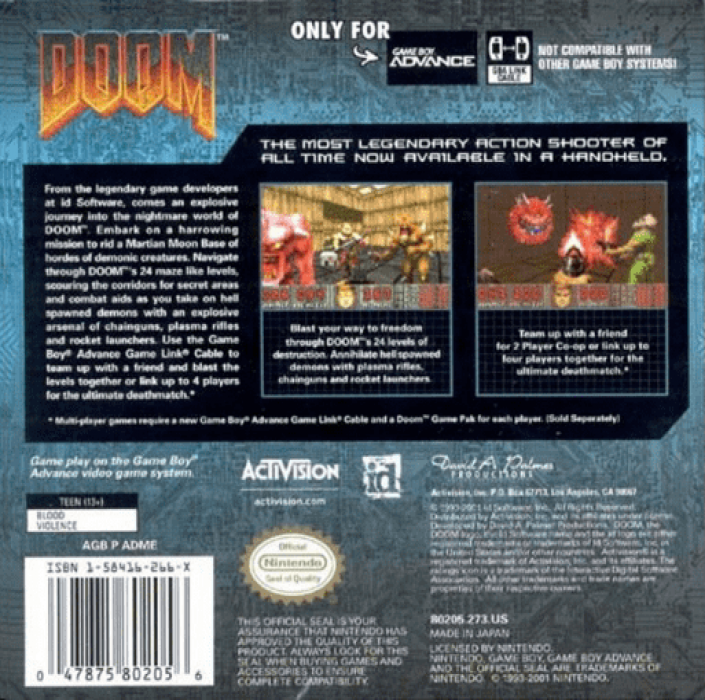
The campaign retains Doom’s fast, exploratory rhythm: maps are compact combat labyrinths where a useful pickup may sit behind a secret wall, a colored key may open a distant door, and a trap can release enemies after a seemingly routine switch. The GBA edition contains 24 single-player levels, arranged as a streamlined selection from the original game rather than a complete recreation. Its stripped-down narrative remains largely environmental, letting the succession of military bases, corrupted facilities, and infernal spaces carry the sense of escalation.
Combat draws on eight familiar tools: fists, chainsaw, pistol, shotgun, chaingun, rocket launcher, plasma rifle, and BFG-9000. Ammunition and weapon choices matter because the more powerful arms are limited, while close-range encounters reward the shotgun and chainsaw. The bestiary is reduced to seven enemy types, including possessed former humans and sergeants, imps, demons, lost souls, cacodemons, and Barons of Hell; each calls for different positioning and use of cover in the game’s tight corridors.
The controls were adapted for the Advance’s face buttons and shoulder triggers. The directional pad handles movement, the shoulder buttons strafe, A fires, and B runs or activates doors and switches in the default setup. Holding both shoulder buttons while pressing up or down changes weapons. This setup preserves Doom’s quick movement and horizontal combat on hardware without a mouse or analog stick, though weapon cycling can demand some finger gymnastics during a crowded fight.
A Game Boy Advance Game Link Cable expands the cartridge beyond solo play. Two players can tackle the campaign cooperatively, while two to four players can use the single-player maps for deathmatch; the release also includes eight maps made specifically for multiplayer. Each participant needs a copy of the game, and the modes retain Doom’s direct competitive and cooperative focus rather than adding a larger progression system.
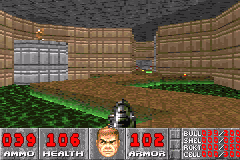
The port makes conspicuous concessions to fit Doom on the handheld. Three original levels were removed and another was heavily edited, while the Cyberdemon and Spider Mastermind do not appear. Blood is green-toned, defeated enemies dissipate instead of leaving persistent corpses, and some music assignments differ from the PC release. Its pixelated visuals can slow down in busy spaces, so brightness and dynamic-lighting options help players read the dim GBA screen; despite those compromises, it preserves textured first-person environments, weapon pickups, enemy hordes, and the core hunt for exits and secrets.
Gallery
Details
- Developer
- Activision
- Publisher
- id Software
- Genre
- First-Person Shooter
- Players
- 1-4
- Release Date
- October 28, 2001
- System
- GBA