About
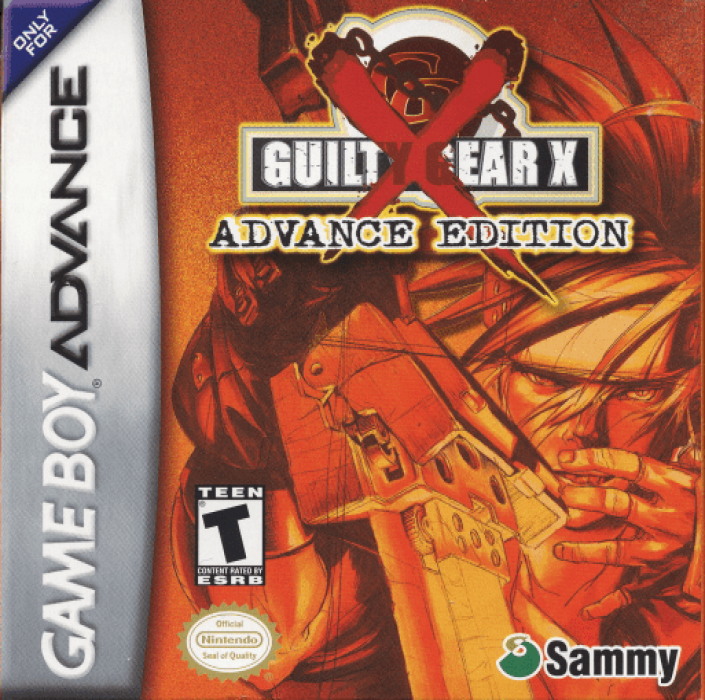
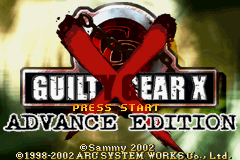
Guilty Gear X: Advance Edition brings Arc System Works’ hard-rock fighting series to Game Boy Advance as a distinct portable adaptation of Guilty Gear X. Released in Japan in January 2002 and later in North America and Europe, it returns to the world’s postwar conflict between humanity and the biomechanical Gears. The story follows a new Holy Knights Tournament, whose competitors pursue the newly discovered Gear commander Dizzy and the reward placed on her capture. It is an early chapter in the series’ continuing timeline, set after the original Guilty Gear and built around its growing cast of stylized fighters.
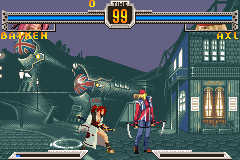
The game is a one-on-one 2D fighter in which the aim is to win rounds by draining an opponent’s life bar before time expires. Its core layout uses punch, kick, slash, and heavy slash attacks, giving each combatant a recognizable set of normals, special moves, and air attacks. Successful hits can be linked into combos, while counterattacks create openings for more damaging follow-ups. The fighting system remains focused on deliberate spacing, timing, and the contrast between straightforward buttons and character-specific techniques.
A central mechanic is the Tension Gauge. It rises when a fighter presses forward and deals damage, but falls when that fighter retreats or remains inactive for too long. With enough Tension, players can perform powerful Overdrive Attacks; filling the meter completely permits an Instant Kill attempt. The latter can end a round immediately if it connects, but failure prevents the gauge from charging again for the rest of that round. Roman Cancels also let players spend meter to cut short a move’s recovery and extend pressure or combinations.
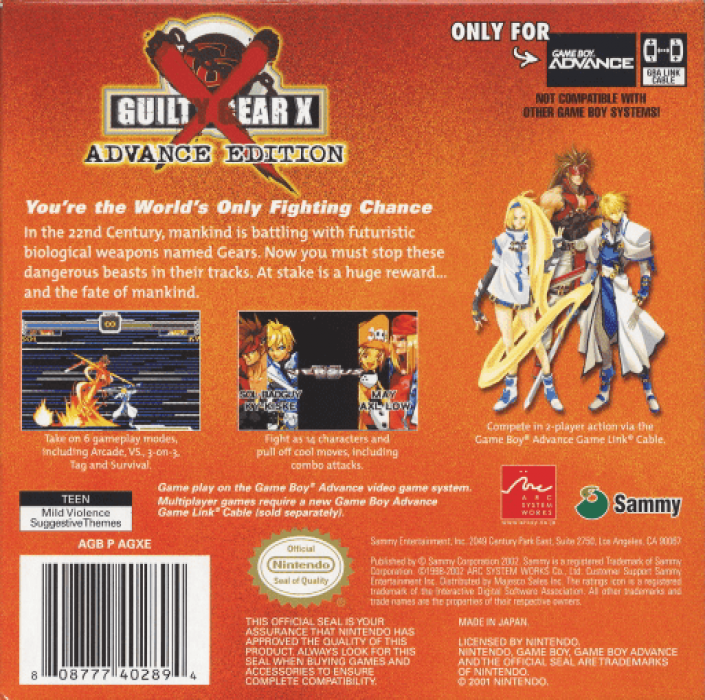
Advance Edition adapts the Guilty Gear X roster for handheld play, including series leads Sol Badguy and Ky Kiske alongside May, Baiken, Faust, Potemkin, Chipp Zanuff, Millia Rage, Zato-1, Jam Kuradoberi, Johnny, Anji Mito, Venom, Axl Low, Testament, and Dizzy. The game retains the varied designs that define the series: sword users, brawlers, long-range specialists, agile rushdown characters, and unusual fighters with unconventional tools. Some characters are available immediately, while others are unlocked through play.
The Game Boy Advance version adds match formats beyond the usual Arcade, Versus, Survival, and Training modes. Tag Match allows each side to choose two fighters and change characters during a battle, while 3-on-3 expands the team selection further. These modes make the portable edition more than a straight reduction of the arcade game, asking players to consider complementary characters and the timing of a switch. Training mode supplies a place to practice move lists and learn the game’s systems before taking on another player.
Two players can compete through the Game Boy Advance Game Link Cable, preserving the head-to-head emphasis of the series on Nintendo’s handheld. The hardware requires compromises in screen presentation and animation detail compared with the arcade, Dreamcast, and PlayStation 2 versions, but the adaptation keeps the fast rounds, dramatic special attacks, and distinctive character identities intact. Its smaller controls can be configured for three- or four-button play, an important option for fitting a complex fighter onto the system’s limited inputs.
The original Guilty Gear X was developed by Arc System Works after the success of the 1998 PlayStation game and first appeared in Japanese arcades in 2000. Advance Edition was directed by Kazuya Yukino, with Isamu Sakurai producing for Sammy; Hidemichi Suzuki and Hisayo Nishiyashiki handled programming, and the GBA staff included graphics artists Emiko Iwasaki, Yukari Fukumoto, Yoji Iwasa, Hiromi Tanaka, Tsuyoshi Wada, Yuuji Hachiman, Shingo Saito, and Mitsuru Fukuoka. Takayuki Nakamura and Tutti worked on sound, continuing the series’ association with aggressive rock-influenced music.
For players interested in the history of portable fighting games, Guilty Gear X: Advance Edition is a compact version of a pivotal entry in Arc System Works’ long-running franchise. Its combination of Tension management, Roman Cancels, Overdrives, and a broad cast offers a strategic alternative to more traditional handheld fighters. The added team modes and link-cable competition give it a particular identity within the Guilty Gear X family, preserving its futuristic fantasy setting and high-energy combat in a Game Boy Advance cartridge.
Gallery
Details
- Developer
- Arc System Works
- Publisher
- Sammy Corporation
- Genre
- Fighting
- Players
- 1-2
- Release Date
- July 10, 2002
- System
- GBA

/F-Zero_Climax.png)