About
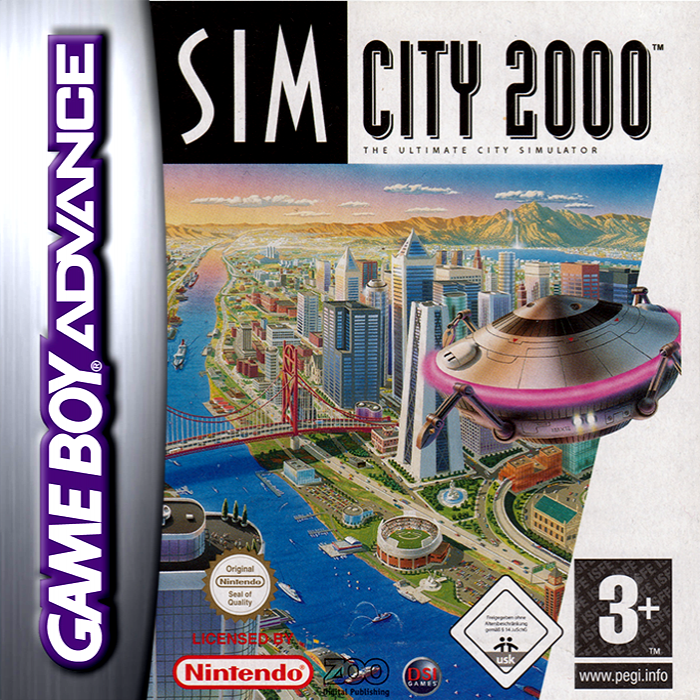
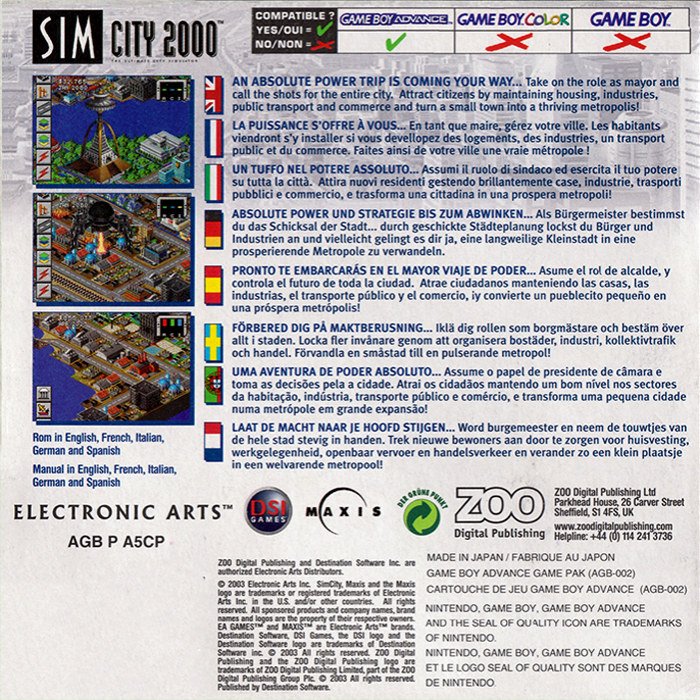
SimCity 2000 for Game Boy Advance brings Maxis’s landmark city-building simulation to Nintendo’s handheld in a 2003 conversion developed by Full Fat. Published by Zoo Digital Publishing in Europe, this version asks the player to act as planner, builder and mayor, transforming an empty map into a functioning town or sprawling metropolis. It retains the series’ isometric presentation and the central challenge of balancing growth with the needs of the virtual citizens known as Sims. A city must be pleasant enough to attract residents and businesses, yet financially sound enough to pay for the services and infrastructure that keep it running.
A new city begins with a choice of terrain, mayor and city name, starting date, and funding level. The first essentials are straightforward but interdependent: designate residential land for homes, commercial land for shops and offices, and industrial land for workplaces; then connect those areas with roads and supply them with electricity from a power plant and power lines. Sims arrive only when the basics support them. As districts develop, small houses, businesses and factories are replaced by denser construction, giving the player a changing view of the settlement’s progress.
Growth brings further responsibilities. SimCity 2000 GBA lets mayors add higher-density zoning, transport links, police and fire protection, education, recreation, airports and seaports. The city’s finances require regular attention through annual budgets, departmental funding, ordinances, taxes and bonds. Spending too freely can imperil the treasury, while neglecting public services or raising taxes too aggressively can drive residents and employers away. The game’s newspaper and information displays offer feedback on local conditions, turning each expansion decision into a trade-off between immediate cost and long-term development.
The Game Boy Advance controls adapt a traditionally menu-heavy simulation to a directional pad and buttons. The L button opens construction choices, while the R button accesses terrain-view functions such as rotating the map and changing the zoom. A places selected structures and B queries the highlighted location for information. The Select button leads to city-view overlays, including zoning, roads, power, police and fire coverage, while Start opens the pause and options menu. These tools allow the player to survey the city, inspect individual tiles, adjust the simulation speed and make deliberate changes from the handheld’s compact screen.
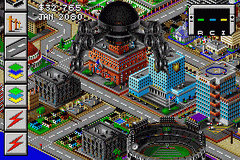
Alongside open-ended city building, the cartridge includes pre-built scenarios that place the mayor in difficult circumstances. These challenge players to recover from disasters and meet population goals within a set period, demanding practical rebuilding as well as expansion. Disasters such as earthquakes and alien attacks can interrupt an otherwise stable plan, making firefighters, bulldozers and emergency decisions part of the city-management loop. The normal game also spans years of simulated time, with later technology and additional civic options becoming available as a settlement develops.
This is not an exact copy of the earlier computer editions. To fit the Game Boy Advance, the port omits underground systems such as sewers and subways, and its streets do not show the moving vehicles found in several larger-screen versions. It also lacks some features associated with the broader SimCity 2000 release, including Launch Arcologies. Even with those reductions, the core appeal remains intact: every road, zone, facility and budget choice shapes the same living urban model. SimCity 2000 GBA is therefore a handheld interpretation of a foundational management game, built around the satisfaction—and pressure—of making a city work.
Gallery

Details
- Developer
- Full Fat
- Publisher
- Zoo Digital Publishing
- Genre
- Management Simulation
- Players
- 1
- Release Date
- January 1, 2003
- System
- GBA