About
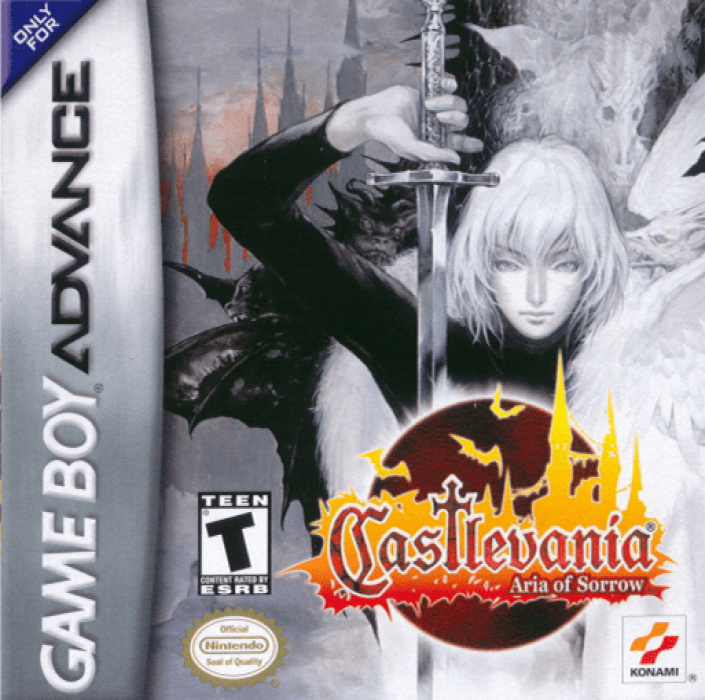
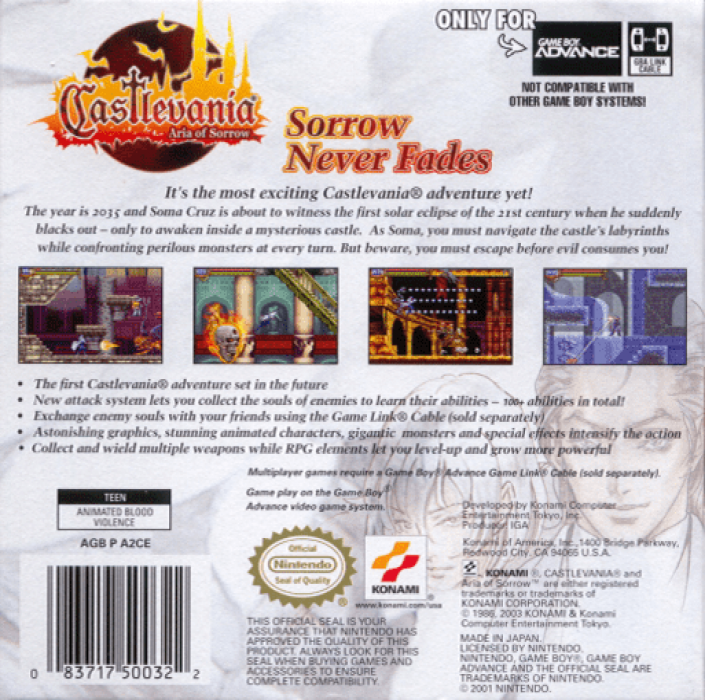
Castlevania: Aria of Sorrow is a 2003 action-adventure game developed and published by Konami for Game Boy Advance. It arrived in North America on May 6, 2003, and is the third Castlevania adventure made for the handheld. Rather than revisit the series' usual historical settings, the game moves its gothic tale to 2035 Japan, pairing a futuristic date with Dracula's familiar, ever-changing castle.
The story follows Soma Cruz, a high-school exchange student who travels with his childhood friend Mina Hakuba to view a solar eclipse near Hakuba Shrine. As the eclipse reaches totality, the pair loses consciousness and awakens within a mysterious castle. Soma's attempt to escape soon becomes a hunt for answers about the castle, its inhabitants, and the unsettling power he discovers within himself.
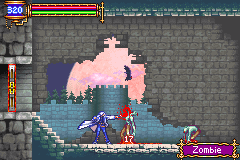
Aria of Sorrow is built around a large interconnected castle rather than a straight sequence of stages. Corridors, towers, underground passages, gardens, and other distinct areas fold back on one another, rewarding careful map-reading and revisits. Doors, high ledges, hazardous terrain, and unexplored routes gradually become accessible as Soma gains the movement and traversal powers needed to reach them.
Combat combines the series' side-scrolling action with role-playing progression. Soma can find and equip a broad range of weapons, including swords, spears, axes, hammers, and other armaments with different reach and attack rhythms, while armor and accessories adjust his capabilities. Defeated enemies grant experience, allowing his level and core attributes to grow, so exploration, combat, and equipment choices all feed into how he handles the castle's enemies and bosses.
Its defining feature is the Tactical Soul system. Soma can claim the souls of defeated monsters and assign them to slots that provide active attacks, guardian effects, or passive enhancements. These powers include magical projectiles, summons, transformations, resistances, and movement-related abilities, creating room to tailor a loadout to a particular area, enemy, or play style. The original Game Boy Advance release also let players exchange collected enemy souls through the Game Link Cable.
The castle's progression is tied closely to discovery. New souls and relic-like abilities open alternate routes, while hidden rooms, rare drops, and optional equipment encourage a return to earlier locations. Boss encounters test positioning and timing as much as raw character strength, and the game's arsenal makes it possible to approach many fights with very different combinations of weapons and supernatural powers.
Aria of Sorrow has multiple conclusions. Advancing without the correct preparation can lead to an early ending, while uncovering the necessary clues and meeting the relevant conditions reveals the deeper confrontation behind the castle's crisis. Completing the main adventure also opens additional challenges and modes, extending the game beyond a single trip through its map.
Within the Castlevania series, Aria of Sorrow closes the Game Boy Advance trilogy after Circle of the Moon and Harmony of Dissonance. Its story of Soma Cruz continued in Castlevania: Dawn of Sorrow for Nintendo DS, while the original game later returned in the Castlevania Advance Collection. The blend of a modern-era setting, interconnected exploration, character growth, and the flexible Tactical Soul system gives this chapter a distinct identity within Konami's long-running vampire-hunting saga.
Gallery
Details
- Developer
- Konami
- Publisher
- Konami
- Genre
- Action-Adventure, Platformer
- Players
- 1
- Release Date
- May 6, 2003
- System
- GBA