About
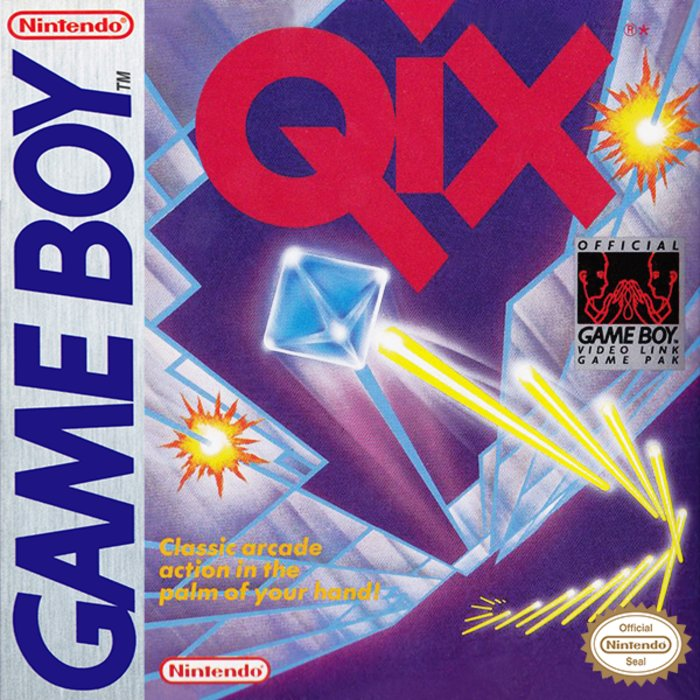
Qix for Game Boy turns one of arcade gaming’s strangest ideas into a tense portable challenge. Released in 1990, this Nintendo-published version was developed by Minakuchi Engineering and adapts Taito’s 1981 arcade game for the original Game Boy. It has no characters to rescue, worlds to explore, or story to follow. Its appeal comes from an immediately readable objective: take control of the empty playfield one line at a time while an unpredictable geometric threat moves inside it.
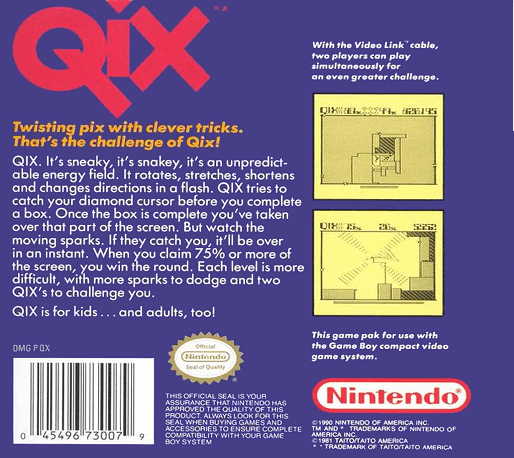
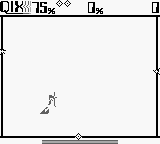
Each round begins with a bordered rectangle and the player’s small marker travelling safely around its edges. Pressing a draw button sends the marker into unclaimed space, leaving a line behind it. Connecting that line to another safe boundary cuts off a section of the board; the enclosed region is claimed, leaving the Qix confined to the remaining open territory. Clear enough of the field to reach the target percentage and the game advances, making every route across the screen a decision about area, speed, and exposure.
Qix’s defining tension is that drawing is both the way to score and the moment of greatest danger. The colorful, restless Qix can touch an unfinished line and cost a life, so an ambitious cut may be rewarding but also risky. Sparx patrol the existing borders and can catch the marker there, creating a second threat that changes how safely a player can wait for an opening. A stalled line can also be consumed by a fuse, discouraging indecision and making even a simple rectangle feel urgent.
The Game Boy controls preserve the original game’s useful contrast between fast and slow drawing. Fast lines reduce the time spent exposed, while slow lines score more generously when they successfully close an area. That trade-off gives a minimalist ruleset real scoring depth: a cautious player can take quick strips to survive, while a confident player can risk slower, larger claims for stronger totals. As stages progress, extra hazards and multiple Qix make it harder to treat the board as a puzzle with a single safe solution.
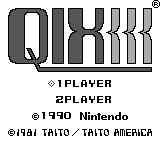
The monochrome Game Boy presentation necessarily differs from the arcade original’s bright abstract motion, but the design remains legible because the important information is structural: claimed space, open space, the moving Qix, and the line currently being drawn. Short effects and the distinctive hum associated with the Qix support the action without distracting from it. The result is a compact arcade experience built around concentration rather than spectacle, well suited to quick sessions but demanding enough to reward repeated attempts.
This is specifically the 1990 Game Boy conversion, not the later Game Boy Color game Qix Adventure, the 1991 NES release, or any of the many games inspired by the same territory-capturing concept. Nintendo later reissued this Game Boy version on Nintendo 3DS Virtual Console in 2011, a sign of the original design’s durability. For retro players, Qix remains a notable example of action-puzzle design: easy to understand in seconds, difficult to control under pressure, and distinctive because its abstract opponents make every completed line feel like a small act of nerve.
Gallery
Details
- Developer
- Minakuchi Engineering
- Publisher
- Nintendo
- Genre
- Logic Puzzle
- Players
- 1-2
- Release Date
- January 1, 1990
- System
- GB