About
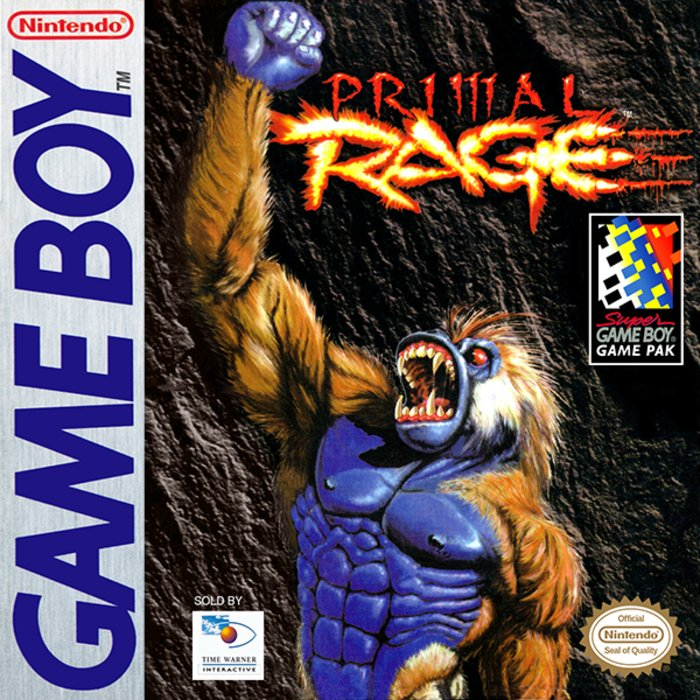
Primal Rage for Game Boy brings the prehistoric monster combat of Atari Games' 1994 arcade hit to Nintendo's handheld in 1995. Developed for this version by Probe Entertainment and published by Time Warner Interactive, it is a one-on-one fighting game set after a meteor-driven catastrophe has remade Earth into the savage world of Urth. Civilization has fallen, human survivors live in tribes, and immense ancient gods have awakened to contest control of the new land. The Game Boy release reshapes that premise for a monochrome portable cartridge while preserving the series' central clash between colossal beasts.
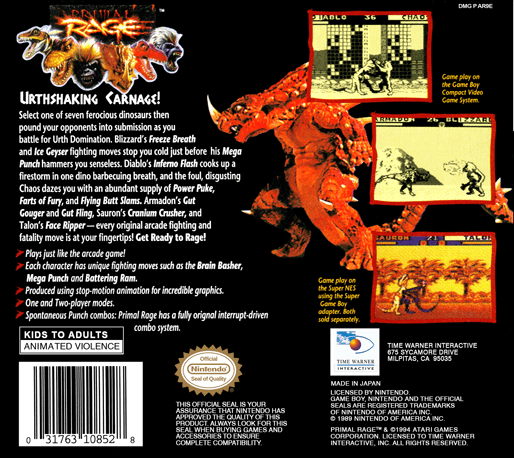
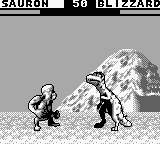
Players choose from six fighters: Armadon, Blizzard, Chaos, Diablo, Sauron, and Talon. They are not ordinary animals but rival gods with different identities, domains, and fighting styles, ranging from armored and ape-like combatants to predatory reptilian creatures. Each battle plays out from the side in best-of-three rounds. Winning means reducing the opposing creature's Life Blood Bar before time expires; if the clock reaches zero, the fighter with more life remaining takes the bout. The display also tracks a Brain Stem Bar, which shows when a hard-hit dinosaur has been dazed and left temporarily vulnerable.
The Game Boy controls make use of the system's two face buttons. One handles upper attacks and the other lower attacks, while combinations with the Control Pad produce moves such as low strikes and airborne attacks. Each god also has a signature special move performed with a particular button-and-direction input. Strings of connected hits can deal greater damage, and the game calls attention to successful combos during a rage. This compact control scheme gives every combatant a shared foundation while leaving room to learn their individual ranges, attacks, and specials.
Its one-player game sends the selected god against the other available dinosaurs in their home territories as the player claims sections of Urth. A training option allows practice with a chosen fighter and opponent, while adjustable settings include credits, round time, and eight difficulty levels. After the regular campaign, the chosen creature faces the remaining gods in the Final Battle Ground. That endurance finale removes the timer and does not reset the Life Blood Bar, making health conservation as important as defeating each opponent quickly.
Primal Rage Game Boy also supports head-to-head play through the Game Link when two consoles and cartridges are connected. Linked players can use a handicap option to set different life amounts, helping competitors of unequal experience play together. The handheld port has a smaller roster and a reduced selection of moves compared with the original arcade game, and Vertigo is absent, but it remains a distinct version rather than simply the coin-op on a smaller screen. Its Game Boy-specific balance of portable controls, local link competition, mythic monster characters, and conquest-based single-player progression makes it a notable entry among 1990s handheld fighting games.
Gallery
Details
- Developer
- Probe Entertainment
- Publisher
- Time Warner Interactive
- Genre
- Fighting
- Players
- 1
- Release Date
- July 2, 1995
- System
- GB