About
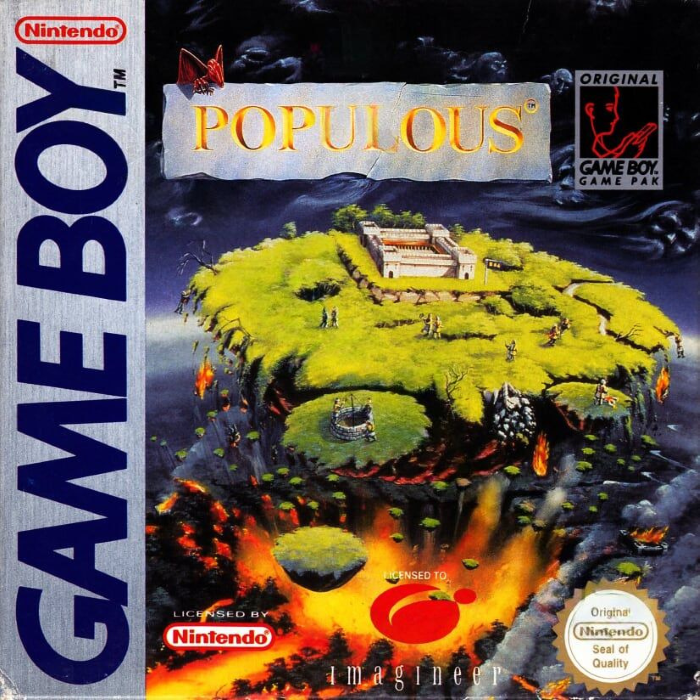
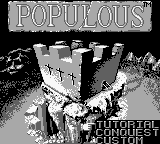
Populous for Game Boy adapts Bullfrog’s landmark 1989 strategy game to Nintendo’s monochrome handheld. This 1993 edition was developed by Enigma Variations and released as Populous in Europe and as Populous Gaiden in Japan. It preserves the central idea that made the original influential: the player is a deity guiding one settlement in a contest against the followers of a rival god. Rather than commanding individual units directly, the player changes the conditions in which a population can grow, turning landscape management into the foundation of conquest.
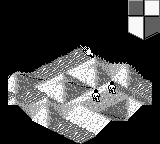
Each stage is a small world shared by two opposing civilizations. Followers construct homes and spread when they have suitable terrain, and a larger population gives the player greater divine power. The basic, constantly useful action is reshaping the ground: raising low areas and lowering hills to create the flat land that supports building. This gives the game an unusual rhythm for a strategy title. Progress comes from repeatedly reading the terrain, clearing space for expansion, and deciding when the immediate benefit of terraforming is more valuable than saving power for a stronger intervention.
Victory requires eliminating the opposing people, so development and conflict are closely connected. A thriving settlement supplies the power needed to influence the battlefield, while the enemy is pursuing the same goal on the other side of the map. Different landscape types affect how civilizations develop, making the layout of a level more than a visual backdrop. The campaign’s sequence of worlds therefore asks the player to adjust to new terrain and to balance patient preparation with the pressure of an active rival.
The Game Boy conversion had to translate a game designed around an information-rich isometric screen to a much smaller display. Enigma Variations reorganized its interface around the handheld controls: Select brings up the map and Start accesses powers, while the playfield remains the focus during normal play. This reduction makes the portable version especially deliberate. Checking the map is necessary to judge the wider situation and the opponent’s progress, then the player returns to the field to continue shaping the land and directing the contest.
That technical compromise is part of the identity of this version rather than a simple cosmetic change. The Game Boy’s compact screen and controls put more emphasis on short decisions and on remembering the state of the larger map. It remains a single-player cartridge experience, with a password system used to preserve progress. The result is a portable interpretation of the first Populous, retaining its mixture of real-time pressure, territorial growth, and godlike intervention while presenting those ideas through a streamlined handheld interface.
The broader Populous series is closely associated with the emergence of the “god game,” a label often applied to games that let players influence a society indirectly through environmental control and special powers. Peter Molyneux and Bullfrog created the original concept, but the Game Boy port is a distinct production by Enigma Variations rather than a direct reuse of the Amiga development team’s work. For players exploring early strategy games on Game Boy, Populous is notable both as an ambitious conversion and as a compact route into one of the era’s defining design ideas.
Gallery

Details
- Developer
- Enigma Variations
- Publisher
- Electronic Arts
- Genre
- Turn-Based Strategy
- Players
- 1
- Release Date
- January 1, 1993
- System
- GB