About
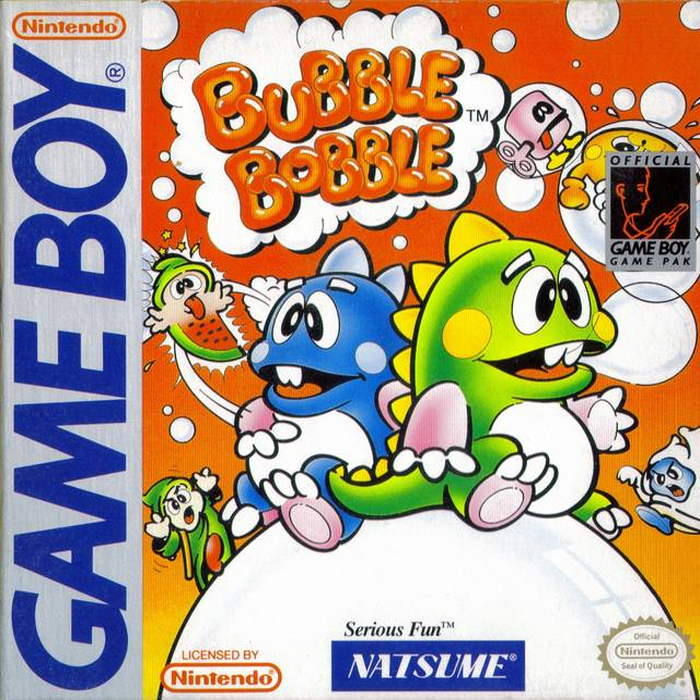
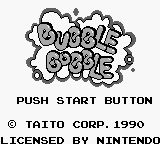
Bubble Bobble for Game Boy is Taito’s portable 1990–1991 take on its arcade platform game. Developed and published by Taito, it arrived in Japan in December 1990 and reached North America in March 1991. Rather than being a straight arcade conversion, this monochrome Game Boy release rebuilds the adventure around a solo outing for Bub, the bubble-blowing dragon. Its familiar ingredients—compact monster-filled stages, food bonuses, magical attacks, and the Cave of Monsters—remain central, but the cartridge gives them a different story and an extensive set of layouts made for the handheld.
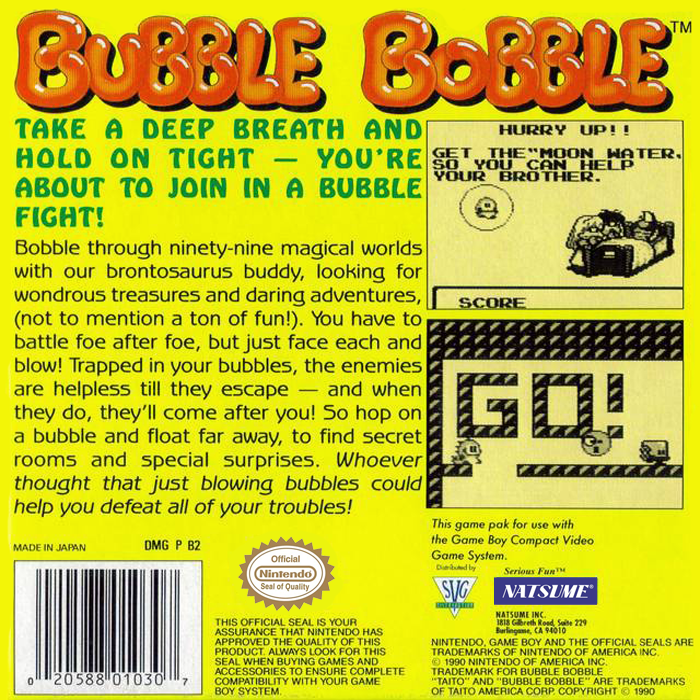
The Game Boy version sends Bub in search of the fabled Moon Water, which he needs to cure his sick brother Bob and restore him to normal. That change is important to this edition: the original arcade game was designed around Bub and Bob working together, while Bubble Bobble on Game Boy is a one-player journey from start to finish. Bub still advances by clearing each round of its enemies, turning the game into a series of quick action-and-positioning puzzles in which safe routes, enemy movement, and the available space all matter.
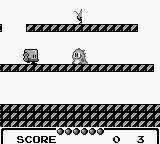
The controls keep the basic Bubble Bobble language direct. The Control Pad moves Bub, the A Button makes him jump, and the B Button fires bubbles. A bubble can imprison a monster; touching the captive bubble pops it and converts the defeated foe into a bonus item. Bub can also use floating bubbles as temporary footholds, so a well-placed shot can become a way to reach higher ledges as well as an attack. Food and other items add points or abilities, while special bubbles and magic effects offer stronger ways to deal with crowded rooms.
Taito retained the series’ escalating rhythm of enemies, treasure, and time pressure, but reshaped much of the content for this cartridge. Bubble Bobble Game Boy has 200 levels, with most of its stage designs made specifically for the port rather than copied unchanged from the 1986 arcade game. Several named sub-boss encounters appear along the route. Defeating one can reveal a concealed door, and the collectible found beyond it contributes to the better ending, giving careful exploration a purpose beyond simply surviving the next screen.
The Game Boy’s smaller display also led to a notable platform-specific design decision. Instead of reducing every playfield to fit entirely on screen, the game uses scrolling stages while keeping character art close to the arcade style. Players can pause with Select and move the view around the current area to look for treasures, enemies, or items that may be outside the immediate frame. This makes the portable version feel broader than a single fixed screen and changes how players plan jumps and search for the next target.
A password feature supports the long campaign by letting players resume from their recorded progress after a game ends. Bubble Bobble for Game Boy therefore stands apart from the arcade original, the Famicom Disk System edition, and the later Game Boy Color release: it is a Taito-made, single-player reinterpretation with a new quest, a large body of original stages, scrolling exploration, and its own route to the ending. It remains part of the wider Bubble Bobble series while presenting Bub’s bubble-trapping play in a form designed around the original Game Boy.
Gallery
Details
- Developer
- Taito
- Publisher
- Taito
- Genre
- Fighting
- Players
- 1
- Release Date
- March 2, 1991
- System
- GB