About
Tetris on Game Boy turns a deceptively small handheld screen into a contest of nerve, foresight, and tidy geometry. One of seven four-square pieces descends into the well at a time, and the immediate aim is simple: slide and rotate it into a complete horizontal row so that row disappears. The real challenge is keeping the growing pile manageable. Every awkward gap matters, every long bar feels precious, and a stack that reaches the top ends the run. Nintendo’s Game Boy edition makes the basic idea unusually readable, letting the rhythm of falling pieces and cleared lines carry the entire experience.
The controls suit the original Game Boy perfectly. The Control Pad moves a piece left or right, pressing down hastens its fall, and the two face buttons rotate in opposite directions. A NEXT window reveals the upcoming shape, so the game rewards more than a fast reaction: a player can preserve an opening, plan a rescue, or prepare a four-line clear before the current piece has landed. Points come from completed lines, with larger simultaneous clears earning more, while dropping a piece farther adds its own small incentive. It is an elegant loop that makes each placement feel both practical and consequential.
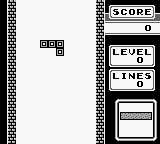
A-Type is the classic endurance game. Choose a starting level and try to build the highest score possible as the falling speed rises over the course of the session. The screen tracks score, level, lines, the next piece, and the active field with little distraction. Its appeal lies in the escalating pressure: calm early placements gradually become decisive split-second choices. A-Type is where the Game Boy Tetris experience becomes a personal high-score pursuit, whether the goal is a longer survival run, cleaner stacking, or the thrill of setting up another Tetris.
B-Type offers a more defined puzzle challenge. Rather than playing indefinitely, the objective is to clear 25 lines. Before starting, players choose a level and a HIGH setting that fills the lower field with a larger or smaller pattern of random blocks. The selected speed remains fixed in this mode, so the test is not merely staying alive as the pace climbs; it is dismantling an obstructed board efficiently. Completing Level 9 in B-Type triggers a special result screen whose presentation changes with the HIGH setting, giving expert players a memorable target beyond the ordinary score display.
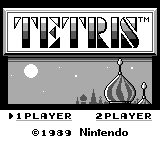
The Game Boy version also gives its stripped-back presentation personality. Before a one-player game, players can select A-Type, B-Type, C-Type, or no music, while the audio speeds up when a multiplayer stack enters danger. Its familiar falling-block routine is not a modern ruleset packed with elaborate effects or extra systems; it is a focused late-1980s handheld design built around movement, rotation, line clears, and the next-piece preview. That clarity helps distinguish this cartridge from later Tetris releases with their own mechanics, presentation styles, and competitive formats, as well as from Nintendo’s separately designed NES version.
Two-player mode is the feature that makes this Game Boy Tetris especially distinctive. It requires two Game Boy systems, two Tetris Game Paks, and a Video Link cable. Once connected, each player races to clear lines while also turning strong clears into trouble for the other side: a double sends one line, a triple sends two, and a four-line Tetris sends four. A game is won by clearing 30 lines first or by forcing the opponent’s stack to the top; the first player to win four games takes the match. The HIGH setting can also handicap the stronger player with a pre-filled field.
For a solo player, Tetris is an endlessly replayable score chase; with a cable and a second cartridge, it becomes a sharp head-to-head duel. The Game Boy’s compact display, direct controls, selectable speed, and instant restarts make it easy to play for a few minutes or lose an evening to one more attempt. This is the landmark portable edition in its own right: a precise, demanding version of Tetris whose depth comes not from excess, but from how much tension and strategy it finds in seven shapes and a shrinking margin for error.
Gallery
Details
- Developer
- Nintendo
- Publisher
- Nintendo
- Genre
- Tile-Matching Puzzle
- Players
- 1-2
- Release Date
- September 28, 1990
- System
- GB