About
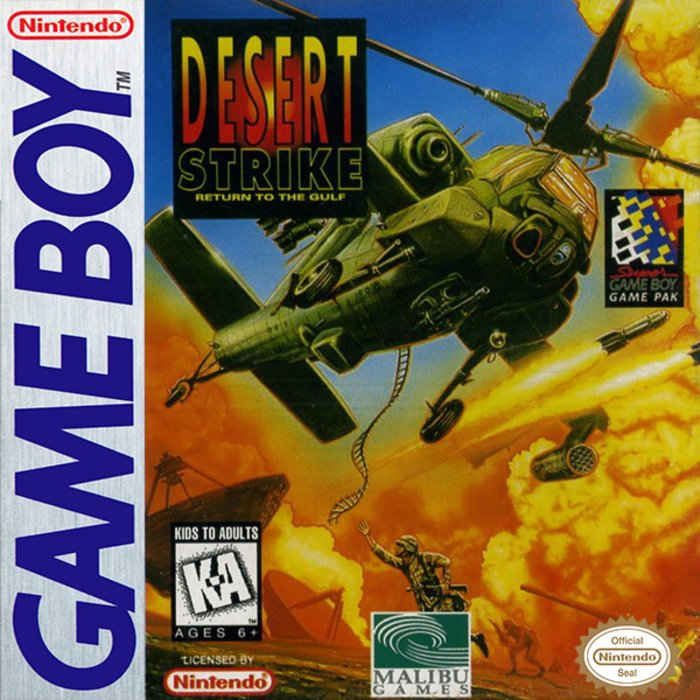
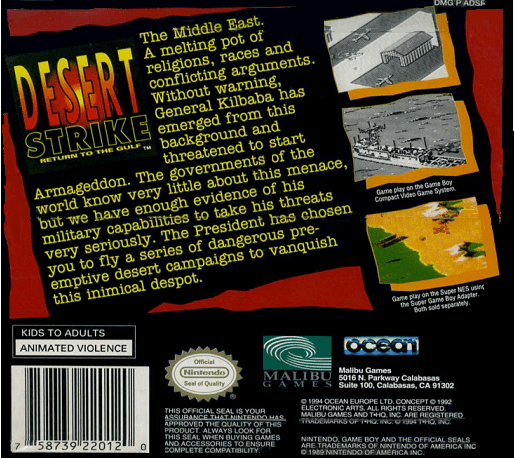
Desert Strike: Return to the Gulf for Game Boy is Ocean Software’s 1995 portable conversion of Electronic Arts’ 1992 helicopter-action game. Set in a fictional Persian Gulf conflict, it puts the player in command of an Apache-style attack helicopter sent against the forces of the self-proclaimed General Kilbaba. The Game Boy edition carries the same mixture of arcade shooting and mission planning that defined the original, but rebuilds it for Nintendo’s monochrome handheld. Ocean Europe Ltd. developed this version, with Gerald Weatherup credited for programming, Dawn Drake for graphics and animation, and Jonathan Dunn for music.
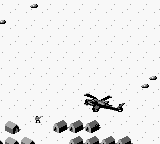
From an angled overhead view, the helicopter travels across large battlefield maps rather than along a fixed corridor. A briefing establishes the immediate assignment, while the player chooses routes through enemy territory and decides when to engage. Objectives include demolishing military facilities and weapons, locating friendly personnel, recovering prisoners, and taking enemy figures to a landing zone. Progress depends on completing the required goals and returning safely, so simply destroying everything in sight is not the point of a mission.
The aircraft’s weapons are suited to different targets and are limited by its ammunition supply. Fuel also runs down in flight, while enemy fire reduces armor; replenishment comes from useful items placed around the map. Those restrictions turn navigation into an important part of play. A long detour can leave the helicopter short of fuel, and an assault on a defended position can consume the ammunition needed later. Picking up survivors or captives adds another consideration, since they must be carried to safety before their rescue counts.
Desert Strike: Return to the Gulf uses the Game Boy’s directional controls and two face buttons to manage a vehicle that must be oriented as well as moved. This creates a deliberate, momentum-conscious style of combat: lining up an attack, turning away from anti-aircraft fire, and approaching a pickup carefully all matter. Enemy resistance ranges from ground troops and vehicles to heavier defensive emplacements, while the open layout lets players determine the order in which they tackle reachable tasks. The result is a compact single-player campaign built around reconnaissance, resource management, and firefights.
The story reflects the early-1990s Gulf War atmosphere that shaped the wider Strike series, although its location and antagonist are fictional. Kilbaba’s expanding arsenal raises the stakes across the campaign, with the helicopter assigned to disrupt installations and avert escalating threats. This Game Boy release is not the later Game Boy Advance remake, Desert Strike Advance: it is the earlier 1995 handheld adaptation, credited to Ocean and published under the Desert Strike: Return to the Gulf title. Its production credits also preserve the link to EA’s original concept while identifying the separate team responsible for the portable version.
Desert Strike began a series that continued with Jungle Strike, Urban Strike, Soviet Strike, and Nuclear Strike. On Game Boy, the first entry offers a notably strategic take on a shooter, asking players to balance a finite aircraft’s supplies against several objectives spread across hostile territory. Its campaign structure, helicopter perspective, and rescue-and-destruction assignments make it a recognizable portable expression of the series’ central idea: a mission game where planning a sortie is as important as pulling the trigger.
Gallery
Details
- Developer
- Electronic Arts
- Publisher
- Ocean
- Genre
- Shoot 'em Up
- Players
- 1
- Release Date
- February 1, 1995
- System
- GB