About
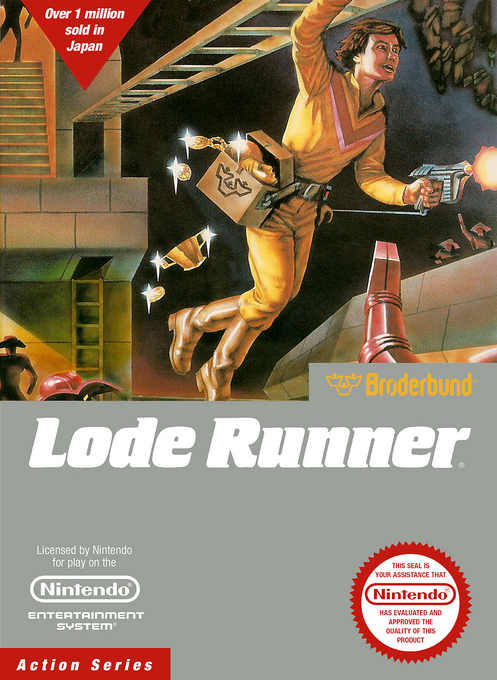
Lode Runner for the NES is Hudson Soft's console adaptation of Doug Smith's landmark puzzle-platform game. Hudson released it for the Famicom in Japan in 1984, while Brøderbund brought the North American NES cartridge to market in 1987. It recasts the original treasure raid as a colorful action-puzzle challenge: a Galactic Commando enters the Bungeling Empire's factory-like vaults to recover stolen gold while avoiding its mechanical guards.
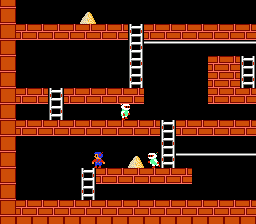
Each stage asks the runner to collect every gold pile and then use the escape ladder that appears to reach the top of the area. The route is rarely a simple dash from left to right. Ladders, hanging bars, diggable brick, solid blocks, trapdoors, and open shafts form compact obstacle courses in which a safe path can become a trap after a single poorly timed move. The player cannot jump, so choosing where to climb, drop, or cross is the heart of every solution.
The runner's essential tool is a drill that opens holes in adjacent breakable brick. A freshly dug pit can create a passage or temporarily catch a pursuing Bungeling guard, giving the player time to run over the trapped enemy or circle around it. Holes eventually close, however, making the same device hazardous to use carelessly. Guards can carry gold, too, so recovering a missing treasure pile may require luring an enemy into a pit and waiting for it to drop what it took.
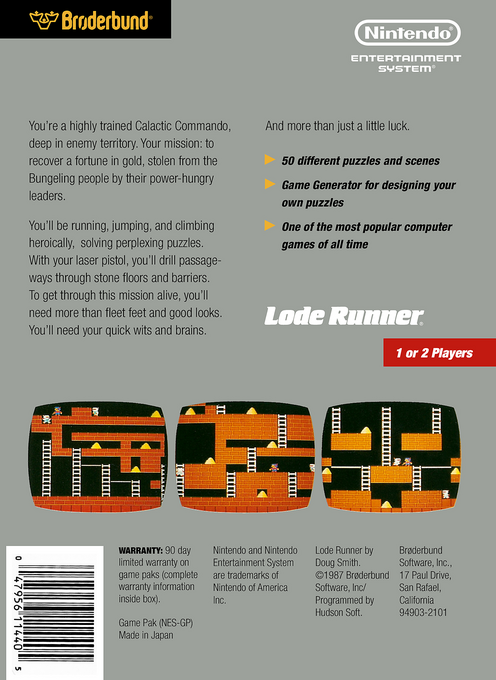
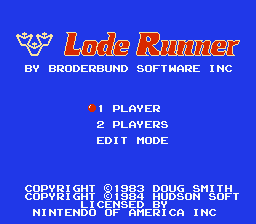
This NES version presents 50 treasury rooms rather than the 150 screens of the original computer release. Its levels extend beyond a single television view and scroll horizontally as the runner moves, turning the search for the last piece of gold or the newly revealed exit into part of the puzzle. The game also lets players choose one- or two-player play, select stages, and adjust speed, while its steadily more involved layouts reward planning as much as quick controller work.
Lode Runner NES includes an edit mode for building a custom one-screen challenge. Players can place elements such as bricks, ladders, hand-bars, gold, robots, trapdoors, and the escape ladder, then test the result directly. The American NES cartridge does not retain these creations after reset or power-off, so the editor works as a short-session design tool rather than a way to keep a library of stages. Even so, its presence reflects one of Lode Runner's defining ideas: players can examine how a level works by making one themselves.
Hudson's conversion gives the classic formula its own character through redrawn, more cartoon-like graphics, added music, and occasional bonus food items. Its enemy robots are also notable within Hudson's early catalogue, linking this version with the company's Bomberman history. For NES players, Lode Runner remains a focused blend of platform movement and spatial problem-solving: every gold pile matters, every drilled brick changes the map, and reaching the exit depends on understanding the room before the guards close in.
Gallery
Details
- Developer
- Hudson Soft
- Publisher
- Brøderbund Software
- Genre
- Platformer
- Players
- 1-2
- Release Date
- September 2, 1987
- System
- NES