About
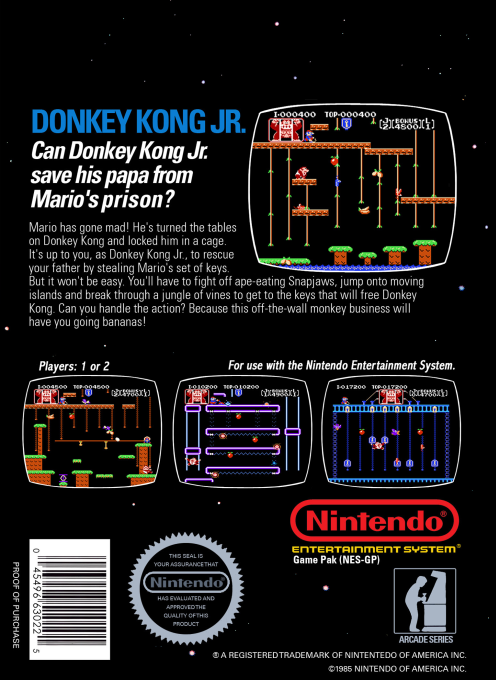
Donkey Kong Jr. for the NES is Nintendo’s home-console version of the 1982 arcade platform game, released in Japan for the Family Computer in 1983 and in North America for the Nintendo Entertainment System in 1986. Developed and published by Nintendo, it follows the original Donkey Kong with an unusual reversal: Mario has captured Donkey Kong, and the player guides Donkey Kong’s young son on a mission to free him. It is a compact, score-driven action game built around climbing, timing, and reading hazards on a single fixed screen.
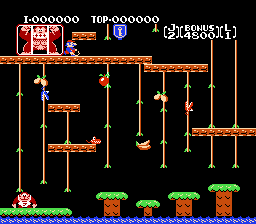
The goal in Donkey Kong Jr. is to make a safe route upward through each stage while a bonus counter steadily runs down. Junior can run across platforms, jump gaps and enemies, and grab the vines, chains, and ropes that form the game’s vertical paths. The NES controller uses the directional pad for movement and climbing and the A Button to jump. Holding two parallel climbing lines lets Junior rise more quickly, while hanging from one changes his speed and positioning. Those small choices give every ascent a tactical rhythm, especially when an obstacle blocks the most direct route.
Mario is not the playable hero here; he is the character standing between Junior and the caged Donkey Kong. The first three stages ask Junior to reach a key near the cage, prompting Mario to move the prison onward. The fourth stage changes the objective: Junior must push six keys upward into their locks to release his father. Clearing the four areas sends the game back through its course at a higher difficulty, rewarding players who learn the layouts, enemy patterns, and safest climbing lines.
Each screen gives its obstacles a different feel. Junior must contend with moving foes such as Snapjaws and Nitpickers, as well as Sparks in Mario’s electrically charged hideout. Falling too far, touching an enemy or projectile, leaving the playfield, or allowing the bonus time to expire costs a life. Fruit placed above the routes can be knocked down to clear enemies in its path, turning the scenery into a useful defensive tool. Choosing when to wait, climb around danger, or send fruit tumbling is central to building a score while staying alive.
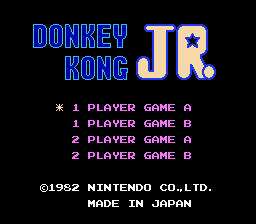
This NES release preserves the arcade game’s four major stage designs while adapting its presentation and controls to Nintendo’s 8-bit system. It includes Game A and Game B selections; the latter raises the pressure with a tougher enemy challenge. Two people can play in alternating turns, passing the controller after a player’s life or turn ends rather than sharing the screen simultaneously. The home version’s repeating sequence and rising pace make it well suited to short attempts as well as longer score-chasing sessions.
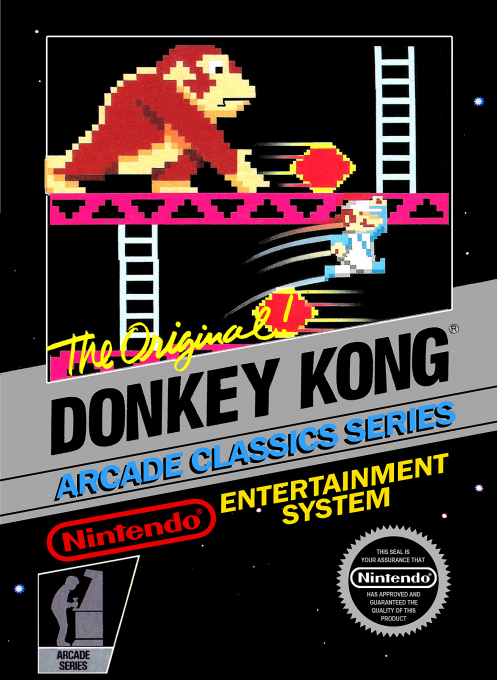
Donkey Kong Jr. also belongs to an important early moment in Nintendo’s console history. In Japan, it arrived alongside Donkey Kong and Popeye as one of the original Famicom launch games. Its premise makes it a distinctive chapter in the Donkey Kong and Mario histories, since it presents Mario as the captor while Junior is the rescuer. Nintendo later followed the arcade game with Donkey Kong 3 and released Donkey Kong Jr. Math, another 1983 game that used the Junior character.
For players exploring classic NES platform games, Donkey Kong Jr. stands apart from side-scrolling adventures with a concentrated set of repeating challenge screens. Every round is about mastering a contained obstacle course: climbing efficiently, avoiding hazards, using fruit at the right time, and reaching Donkey Kong before the bonus disappears. Its reversed rescue story, four-screen structure, and early Famicom roots make it a notable companion to the first Donkey Kong and a snapshot of Nintendo’s arcade design translated to the NES.
Gallery

Details
- Developer
- Nintendo
- Publisher
- Nintendo
- Genre
- Platformer
- Players
- 1-2
- Release Date
- June 2, 1986
- System
- NES

/Fuzzical_Fighter.png)