About
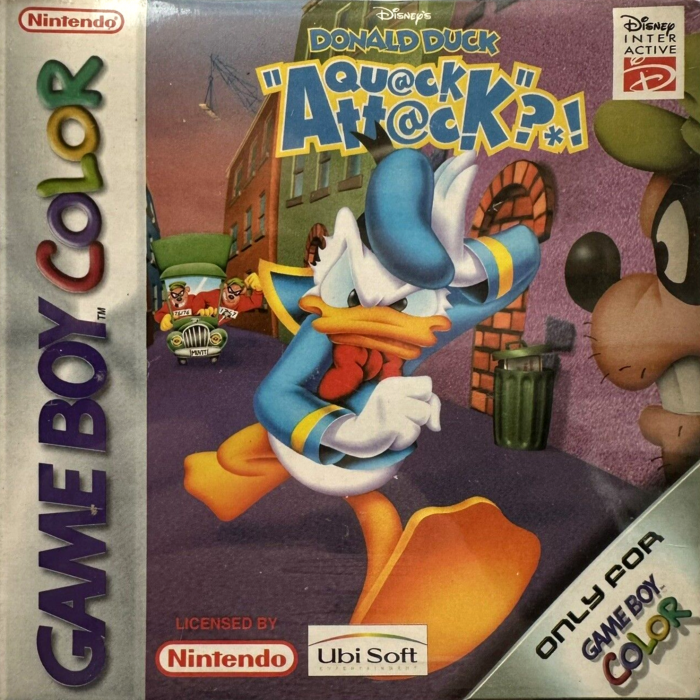
Donald Duck: Quack Attack for Game Boy Color is the European title of Disney's Donald Duck: Goin' Quackers, a 2000 single-player platform game developed by Ubisoft Milan and published by Ubisoft. It turns the wider Goin' Quackers/Quack Attack release into a handheld 2D adventure built around Disney's famously hot-tempered duck. In North America it arrived as Disney's Donald Duck: Goin' Quackers on October 19, 2000; the European Game Boy Color release followed under the Quack Attack name. Japan received the game as Disney's Donald Duck: Daisy o Tsukue!.
The story begins when Daisy Duck, reporting for the Duckburg Times, is taken by the magician Merlock. Donald asks inventor Gyro Gearloose for help. Gyro's teleportation project cannot take Donald straight to Merlock, leaving him to travel through a series of dangerous locations and recover what is needed to complete the rescue. Gladstone Gander also enters the race to save Daisy, giving the mission a fittingly competitive Donald Duck twist. The cast and premise draw on the broader Duckburg world, with Merlock serving as the central villain rather than an adaptation of a single film story.
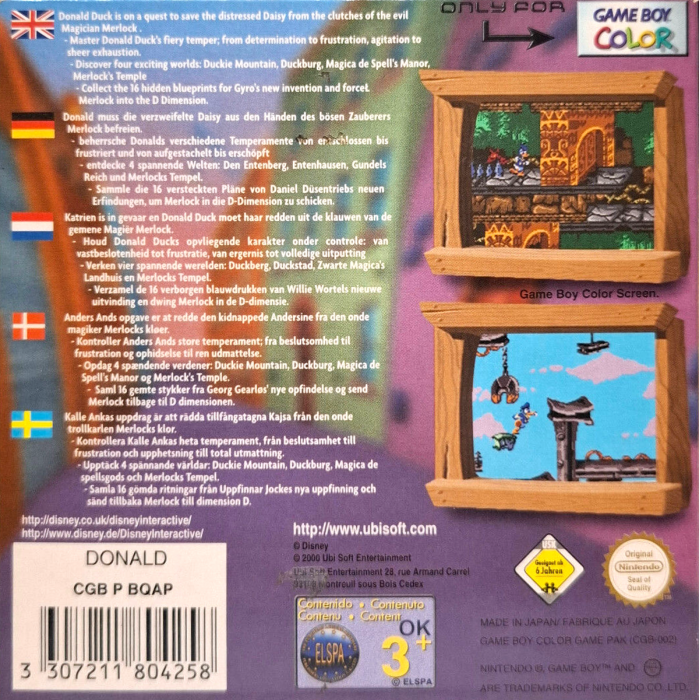
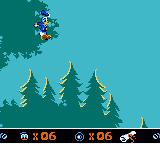
Unlike several contemporary console editions, Donald Duck: Quack Attack on Game Boy Color is entirely side-scrolling. Donald moves through four themed areas, including the surroundings of Duckie Mountain, Duckburg rooftops and a haunted house, negotiating gaps, hazards and enemies on the way to each stage's goal. The compact Game Boy Color format keeps the focus on direct platforming: read the terrain, time a jump and keep moving through cartoon obstacles instead of switching to behind-the-character 3D courses.
Donald's basic moves are designed around that arcade-like flow. He can jump on enemies to defeat or stun them, and his mid-air double jump helps him reach higher ledges and cross wider spaces. Damage has a comic-book consequence: the first hit leaves Donald visibly furious, while a second costs a life and sends the player back to try the level again. Collectible orbs can contribute to extra lives, restore his condition or trigger Hyper mode. While Hyper mode is active, Donald can plough through enemies and break barriers that otherwise block routes.
This structure gives the game both straightforward goals and reasons to watch the level layout closely. A careful player can use Donald's double jump to reach difficult platforms, preserve a hit for a risky stretch, and seek out items that make the next encounter more manageable. The health and Hyper systems turn Donald's short fuse into part of the play rather than just a visual gag. Progress is organized as a rescue journey across distinct environments, with the teleporter premise providing the link between Donald's trips away from Duckburg and the eventual confrontation with Merlock.
Donald Duck: Quack Attack also illustrates how a licensed game could be adapted for markedly different hardware in the same release period. Its home-console relatives used changing camera perspectives, whereas the Game Boy Color version was made as a dedicated 2D platformer. It was later followed by Donald Duck Advance on Game Boy Advance, another handheld entry associated with the same adventure. For Game Boy Color players, Quack Attack remains the portable, side-view interpretation of Donald's race to bring Daisy home from Merlock's clutches.
Gallery

Details
- Developer
- Ubisoft
- Publisher
- Disney Interactive
- Genre
- Platformer
- Players
- 1
- Release Date
- October 19, 2000
- System
- GBC