About
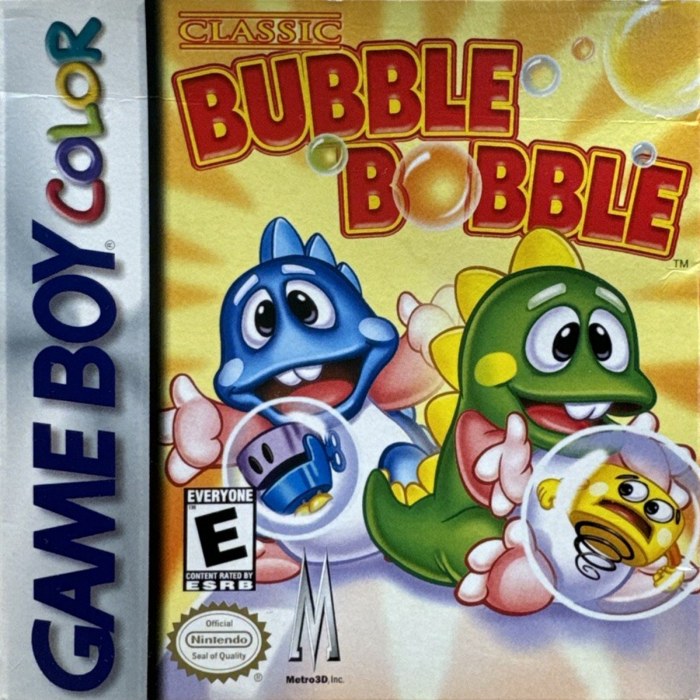
Classic Bubble Bobble for Game Boy Color is a 1999 single-player action-platform game developed by Taito and published in North America by Metro3D. Although its name points back to Taito's celebrated 1986 arcade hit, this is not simply that game transferred to Nintendo's color handheld. It is a separate, compact interpretation of the Bubble Bobble formula, built around the series' familiar bubble-trapping action but given a different story, different stage design, and a solo focus. It arrived in Europe in October 1999 and in North America on November 1, with a Japanese release following in 2000 under the title Taito Memorial: Bubble Bobble.
The adventure follows green dragon Bub after his blue counterpart, Bob, falls ill. Bub's goal is to find the Moon Water needed to cure him, a premise that separates the Game Boy Color game from the arcade original's rescue story. The shift also suits the cartridge's one-player design: rather than sharing each screen with a second dragon, the player guides Bub alone through a succession of enemy-filled platform rooms. Its colorful presentation keeps the recognizable dinosaurs, creatures, fruit rewards, and bubbly visual language associated with the wider Bubble Bobble series while framing them in a new portable quest.
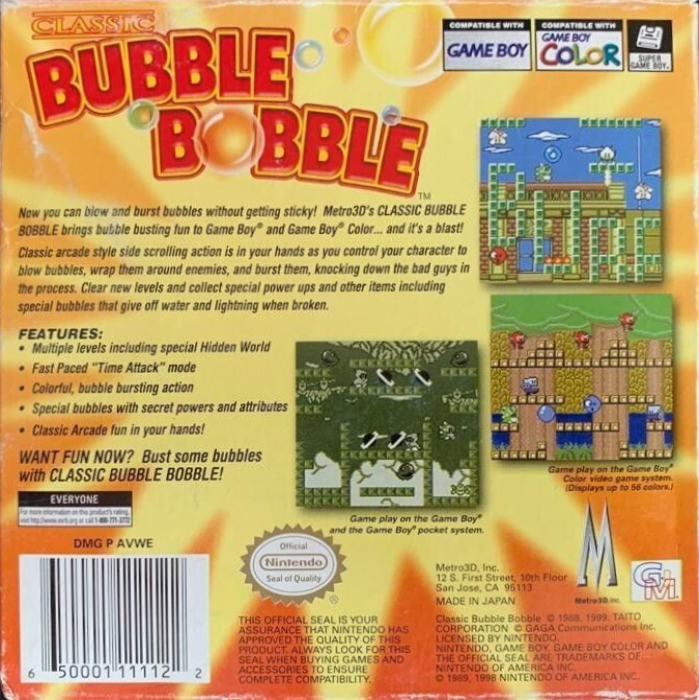
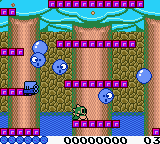
Each stage asks Bub to clear every enemy before moving on. He can move across platforms, jump over gaps, and blow bubbles to temporarily enclose opponents. A trapped enemy is not defeated until Bub bursts its bubble, so positioning matters as much as firing: bubbles can drift away, block routes, and create opportunities to approach a dangerous foe safely. Defeated enemies leave behind fruit and other bonus items, turning a simple screen-clearing objective into a search for score opportunities as well as survival. Contact with enemies or their attacks costs a life, making the small, scrolling rooms increasingly tense when several threats occupy different levels of the layout.
Classic Bubble Bobble deliberately pares back some of the additions used in other handheld Bubble Bobble games. Bub does not use charge bubbles or a hovering ability here, and the game avoids the tougher enemy types that require repeated bubble damage. That choice makes the central rule immediately clear: trap, pop, collect, and clear the room. It also preserves the series' useful dual purpose for bubbles. They are a weapon first, but they can also affect the space around Bub, forcing the player to read platforms, enemy movement, and the safe places from which to launch an attack.
A notable addition is the route system. After all enemies are defeated in certain stages, a door may appear. Entering it sends Bub onto an alternate sequence of stages, while allowing it to disappear keeps him on his current route. This gives the Game Boy Color version a degree of replay value beyond a single fixed progression and makes the player’s decisions part of the journey. Because the stages can extend beyond one Game Boy Color screen, the game scrolls to reveal the wider room; that portable layout distinguishes it from the original arcade game's self-contained single-screen rounds.
As a late-1990s entry in the Bubble Bobble line, Classic Bubble Bobble is best understood as a new handheld variation rather than a substitute for the arcade original. Taito retained the immediately recognizable concept that made the series enduring—two cute dragons, bubbles, platforms, enemies, and food bonuses—while adapting it into a one-character campaign with a different objective and branching paths. For players exploring Game Boy Color platform games or tracing the many forms Taito's arcade idea took on home systems, it offers a distinctive chapter: a color portable Bubble Bobble adventure centered on Bub's attempt to save his sick friend.
Gallery
Details
- Developer
- Taito
- Publisher
- Metro 3D
- Genre
- Logic Puzzle, Platformer
- Players
- 1
- Release Date
- January 1, 1999
- System
- GBC