About
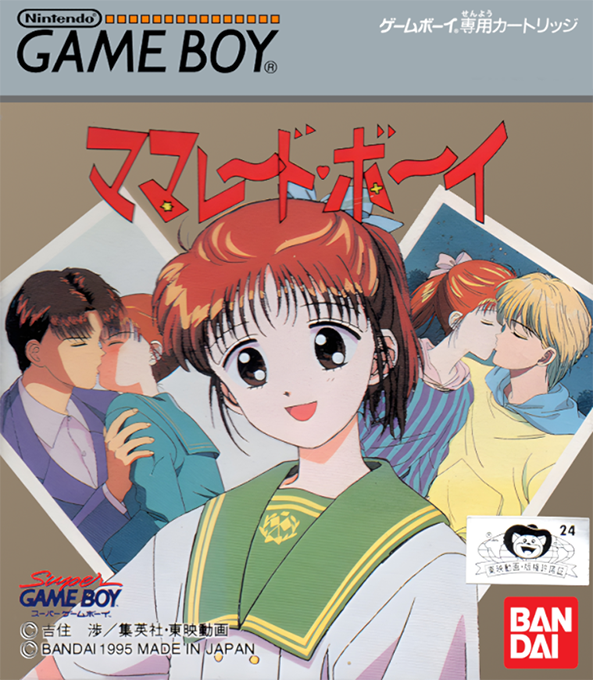
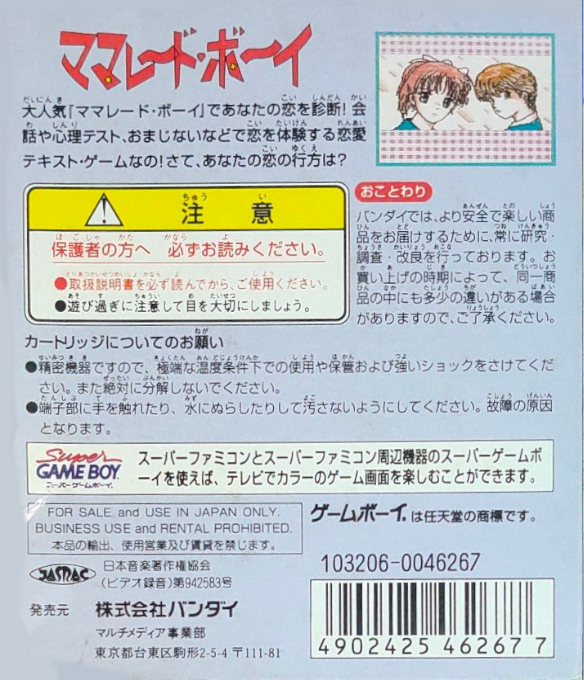
Marmalade Boy for Game Boy is a Japanese romance simulation released by Bandai on January 27, 1995. Developed by Tom Create according to contemporary game catalogues, it adapts Wataru Yoshizumi’s shōjo manga at a time when the story was also reaching television audiences through Toei Animation’s anime. The cartridge was issued only in Japan, putting the player in the shoes of the series heroine, Miki Koishikawa, rather than retelling the property as a conventional action game. Its focus is the changing relationships around Miki and the decisions that shape her romantic life.
The game draws its premise from the unusual family arrangement at the heart of Marmalade Boy. Miki’s ordinary school life is disrupted when her parents decide to separate and exchange partners with another married couple, bringing the two households together. Their son, Yuu Matsuura, becomes an important and initially difficult presence in her everyday life. Miki’s longtime classmate Ginta Suou is another central figure, so the game uses the established manga setting to frame a choice-driven love story rather than treating its characters as incidental mascots.
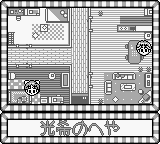
Play proceeds through a calendar-based sequence of days. As Miki moves through that schedule, conversations and story events present decisions that influence the direction of the relationship drama. The objective is to guide her toward one of the available romantic outcomes, with Yuu and Ginta serving as the principal suitors described for the Game Boy version. That structure makes dialogue and situational choices the main form of interaction: progress comes from following the unfolding school and family story, considering how Miki responds, and seeing where those responses lead.
Marmalade Boy uses the Game Boy’s portable format to turn a popular girls’ comic and anime property into a single-player character-driven experience. Its appeal lies in seeing familiar situations and personalities through Miki’s perspective, while allowing the player to steer a route that is not simply a passive reading of the source story. The game’s event-and-calendar presentation also suits the serial nature of the original, where relationships shift through encounters, misunderstandings, and school-life moments instead of through battles or physical challenges.
The release arrived during a busy period for the franchise. Yoshizumi’s manga ran in Shueisha’s Ribon from 1992 to 1995, and the television anime aired from 1994 to 1995, placing the Game Boy adaptation squarely in the series’ original Japanese run. Bandai followed it with a Super Famicom version on April 21, 1995; reference material describes that later edition as a reworked Game Boy release with added features. For players exploring romance games on Nintendo’s monochrome handheld, Marmalade Boy remains a period-specific adaptation built around Miki, Yuu, Ginta, and the relationship choices that define the series.
Gallery

Details
- Developer
- Bandai
- Publisher
- Bandai
- Genre
- Shoot 'em Up
- Players
- 1
- Release Date
- January 27, 1995
- System
- GB