About
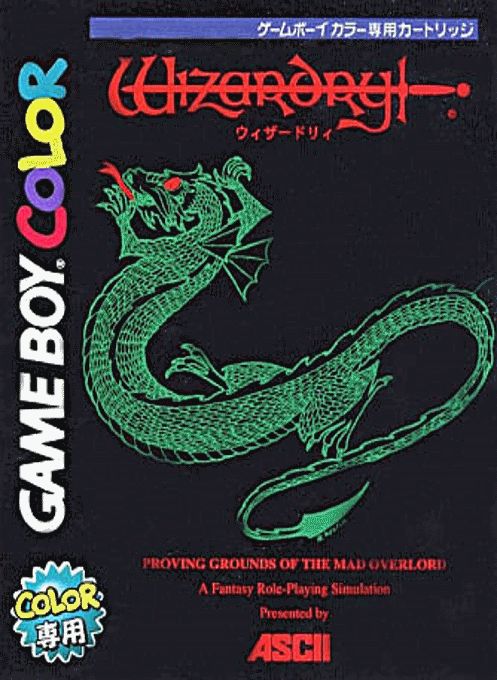
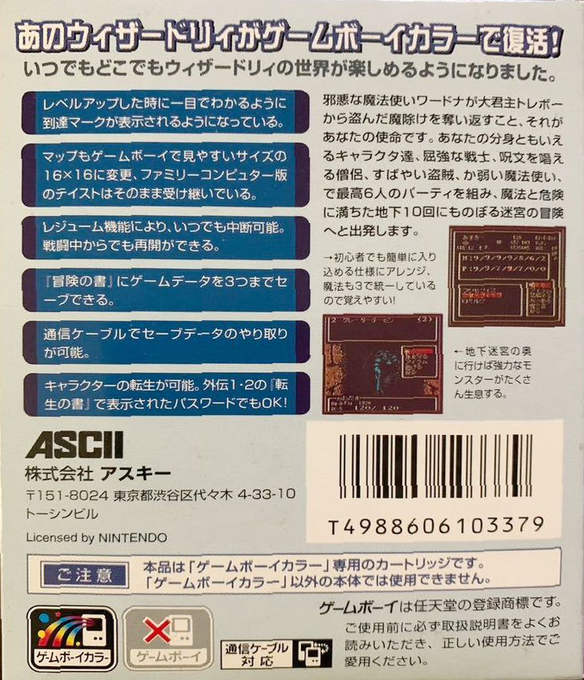
Wizardry: Proving Grounds of the Mad Overlord for Game Boy Color brings the foundational Wizardry dungeon-crawling role-playing adventure to Nintendo's color handheld. Released in Japan by ASCII on February 23, 2001, it is a late portable version of the first Wizardry scenario, the game originally created by Andrew Greenberg and Robert Woodhead and first published for computers in 1981. The Game Boy Color release was supervised by Game Studio, with GungHo staff credited for its development work. Its story returns players to the maze beneath the castle of the Mad Overlord Trebor, where the rogue wizard Werdna has taken the powerful Amulet of Mair and filled a vast underground labyrinth with monsters and traps.
The adventure begins in town, where players build a party of up to six explorers before entering the dungeon. Characters are chosen from human, elf, dwarf, gnome, and hobbit races, and their alignment and class shape the equipment and magic available to them. Fighters, priests, mages, and thieves form the starting professions, while more specialized paths can become available as characters grow stronger. Party composition matters from the outset: front-line warriors absorb attacks, spellcasters manage precious magic, and a group must be prepared to return alive with both its treasure and its hard-earned experience.
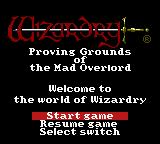
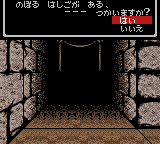
Exploration is built around step-by-step movement through a ten-level maze. From a first-person dungeon view, players choose directions, inspect their surroundings, manage the party, and decide when to press deeper into danger or retreat to safety. Battles replace the maze with turn-based commands against groups of enemies, asking the player to select attacks, spells, defense, or other actions for each character. Progress comes through survival, recovered loot, and experience levels, but the dungeon also contains hazards such as darkness, teleportation effects, and routes that can leave an unprepared party far from the exit.
Wizardry: Proving Grounds of the Mad Overlord emphasizes planning as much as combat. Equipment bought in town helps a newly created group survive its first expeditions, while better weapons, armor, and magical items gradually change what the party can risk. Spell users gain access to increasingly useful magic as they advance, including tools that support navigation and escape as well as attacks and healing. The quest is intentionally demanding: a defeated party does not simply continue from the same spot, and players are encouraged to learn the maze, protect valuable characters, and weigh every descent against the supplies and spells still available.
The Game Boy Color edition belongs to a long Japanese history for Wizardry, a series that became especially influential there through ASCII's releases and adaptations. Although its original setting and objective remain recognizable—the final goal is to confront Werdna at the bottom of Trebor's proving grounds and reclaim the amulet—the portable release lets the classic party-based structure stand on its own as a handheld RPG. It is connected to the opening trilogy, whose later scenarios continue to use the world and adventurers established here, and it preserves the combination of character creation, maze navigation, tactical encounters, and risky treasure hunting that made Wizardry a defining name in computer role-playing games.
Gallery
Details
- Developer
- Game Studio
- Publisher
- ASCII
- Genre
- JRPG
- Players
- 1
- Release Date
- February 23, 2001
- System
- GBC