About
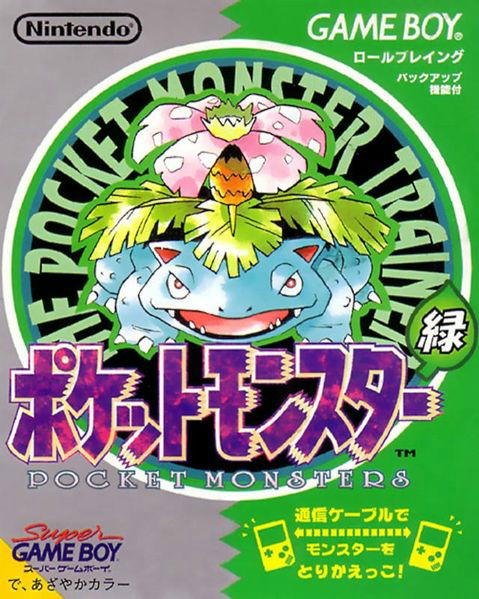
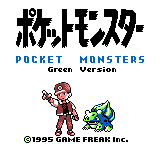
Pokémon Green for the original Game Boy is a Japanese role-playing game developed by Game Freak and published by Nintendo. Released in Japan on February 27, 1996 as Pocket Monsters: Green, it launched alongside Pocket Monsters: Red and began the main Pokémon game series. The player takes the role of a young Trainer setting out from Pallet Town in the Kanto region, where collecting creatures, building a battle team, and exploring an interconnected map shape the adventure. Pokémon Green was not the green counterpart sold internationally under that title: the overseas Pokémon Red and Blue releases used a later Japanese Blue revision as their technical basis, while retaining the original Red and Green version pair’s central structure.
The journey starts when Professor Oak introduces the player to Pokémon and offers a choice of Bulbasaur, Charmander, or Squirtle. From there, the player travels on foot through towns, routes, caves, and waterways, using a top-down view to search for wild Pokémon and challenge other Trainers. Encounters switch to turn-based battles, where each active Pokémon can use up to four learned moves. Victory awards experience points, and gaining enough experience raises a Pokémon’s level, improving its capabilities and sometimes causing it to evolve into a new form. Items can restore health, cure status conditions, or support capture attempts, while a party can hold up to six Pokémon at once.
Catching is central to Pokémon Green’s progression. Wild Pokémon can be weakened in battle and targeted with Poké Balls, then added to the player’s party or stored for later use. The Pokédex records the species the player has seen and obtained, giving the expedition a collection goal beyond simply reaching the ending. Different species appear in particular locations, and Green has its own selection of version-exclusive Pokémon. A single cartridge cannot provide every creature in the original set, so the Game Link Cable lets two Game Boy systems exchange Pokémon or stage player-versus-player battles. Trading is also important for certain Pokémon whose evolution depends on being exchanged.
Kanto’s route through the game is organized around eight Pokémon Gyms. Each Gym has a leader who awards a Badge after defeat, and these Badges mark the player’s growing access to the region. The player eventually travels to Indigo Plateau to face the Elite Four and the Pokémon League Champion. Along the way, the story includes recurring contests with the player’s rival and clashes with Team Rocket, a group exploiting Pokémon for criminal schemes. Progress also depends on field techniques taught to compatible Pokémon, which can clear obstacles, move across water, light dark passages, or otherwise open previously inaccessible areas.
Pokémon Green is a first-generation release with a historical place distinct from Pokémon Blue, Pokémon Yellow, and later remakes. Japan received Red and Green first; an updated Japanese Pocket Monsters: Blue followed later, with revised presentation that informed the international Red and Blue releases. As a result, Green preserves the earlier Japanese version’s creature availability, dialogue, and audiovisual presentation rather than matching the cartridge known as Blue in many other territories. Its combination of exploration, party-building, turn-based strategy, collecting, and link-cable trading established the framework that later Pokémon games expanded, while its Kanto setting, Gym challenge, Pokédex objective, and original 151 Pokémon remain defining elements of the series’ first adventure.
Gallery

Details
- Developer
- Game Freak
- Publisher
- Nintendo
- Genre
- JRPG
- Players
- 1
- Release Date
- February 27, 1996
- System
- GBC