About
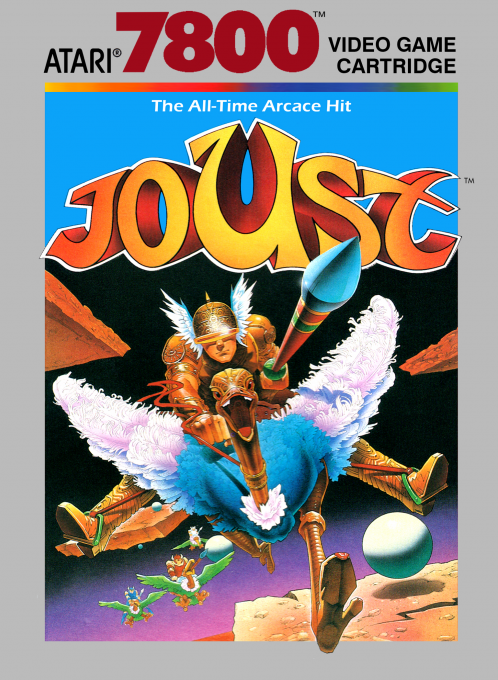
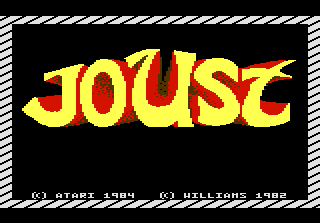
Joust for Atari 7800 brings Williams Electronics’ fantasy arcade contest to Atari’s home console as a single-screen action game built around aerial duels. Atari published the cartridge under license from Williams during the 7800’s 1980s library, adapting the 1982 arcade original’s unusual medieval-and-science-fiction world. A player controls an armored knight mounted on an ostrich, while a second player may join on another bird for a two-player contest that can shift between cooperation and rivalry.
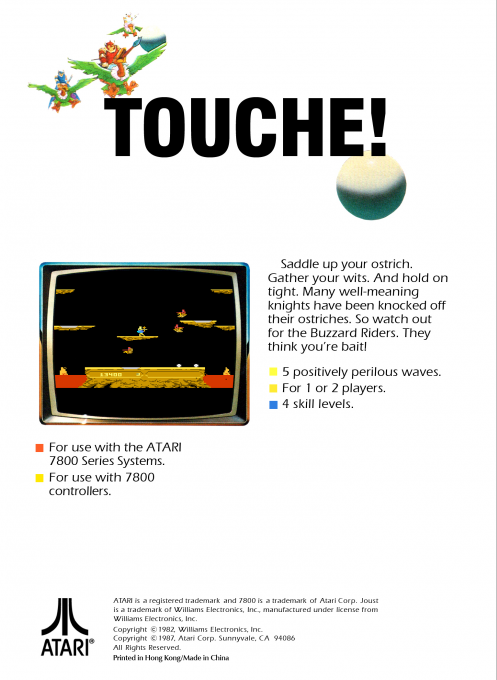
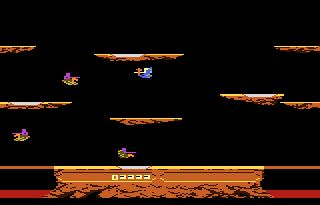
Each arena is a fixed screen of floating ledges over lava. The basic controls are deliberately spare: move left or right with the controller, and repeatedly press the button to flap and manage altitude. Holding a direction builds horizontal speed, so success depends on reading momentum as well as timing each burst of flight. A joust is decided by height at contact—the rider whose bird is higher wins—while an even collision leaves both combatants alive. The screen wraps at the sides, letting knights reappear from the opposite edge and turning escape routes into possible attacks.
The opposition arrives in waves as Buzzard Riders. Bounders, Hunters, and Shadow Lords grow more dangerous as their encounters escalate, and defeating one leaves an egg behind. Collecting eggs removes the threat and adds to the score; leaving one on a ledge allows it to hatch into another opponent, with tougher results at higher difficulty levels. The opening setup offers Beginner, Intermediate, Advanced, and Expert settings, so the same central rule—take the high ground—plays out against increasingly demanding enemy pressure.
The Atari 7800 version adds several named wave variations to its regular progression. Survival Waves reward a flawless clear, Egg Waves begin with opponents still unhatched, and Pterry Waves put the pterodactyl into play immediately. In two-player sessions, Team Waves offer a bonus when neither player unseats the other, while Gladiator Waves explicitly reward the first successful hit against the other knight. That changing structure gives players reasons to decide whether another rider is an ally, a target, or both from moment to moment.
Lava is as important as the aerial foes. After the early waves, bridges protecting the bottom of the arena burn away, exposing the Lava Pits and their Troll. Flying too close can invite the Troll’s grasp outside the Beginner setting, although quick flapping may break free. The pterodactyl is another major danger, and the manual identifies its mouth as the precise target for a counterattack. Players start with five lives and gain extras through scoring, creating a continuing balance between risky egg collection, careful positioning, and aggressive jousting.
Joust remains closely associated with the arcade game designed by John Newcomer and developed by Williams, but the Atari 7800 cartridge is its own home-console interpretation rather than a different sequel or remake. Its licensed presentation preserves the defining bird-mounted combat, screen-wrap arenas, lava hazard, and simultaneous two-player play while tailoring the game to the 7800 controller and its selectable difficulty. For Atari 7800 players, it is a compact action challenge where a single flap, a narrow height advantage, or a decision to trust the other knight can decide the wave.
Gallery
Details
- Developer
- Williams
- Publisher
- Atari
- Genre
- Platformer
- Players
- 1-2
- Release Date
- May 1, 1986
- System
- Atari 7800