About
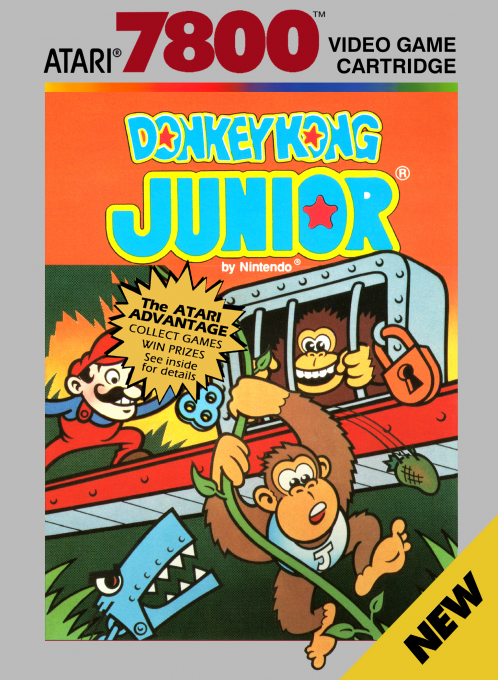
Donkey Kong Junior for Atari 7800 is Atari Corporation's 1988 home conversion of Nintendo's 1982 arcade platform game. Developed for the 7800 by International Technology Development Corporation, it casts the familiar Donkey Kong story in reverse: Mario has captured Donkey Kong, and his son Junior must climb through a series of perilous screens to rescue him. The Atari cartridge uses the North American title spelling "Donkey Kong Junior," while the game itself is also widely known as Donkey Kong Jr.
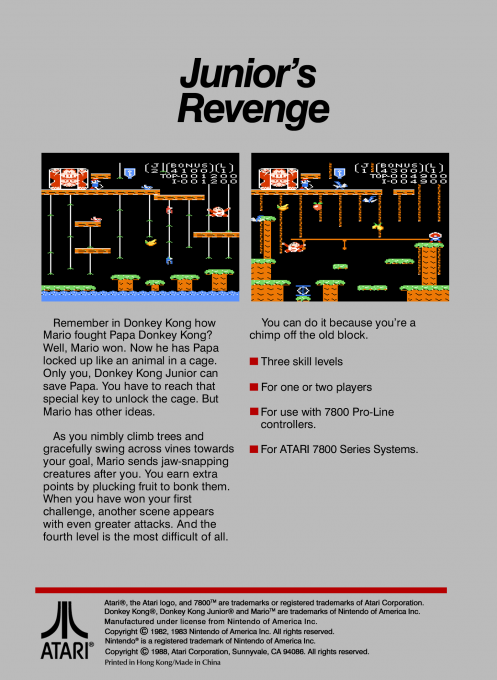
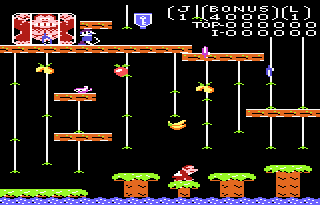
Each rescue attempt is a compact, single-screen challenge built around routes, timing, and enemy avoidance. Junior runs along platforms, climbs vines and chains, slides downward, and jumps with the controller's fire button. Grabbing two parallel vines or chains lets him climb faster, although sliding on a single one is quicker. Those trade-offs make a safe-looking ascent a constant choice between speed and control, especially as the stage timer steadily reduces the available bonus.
The route begins in the jungle, where Junior works upward toward a key while dodging Snapjaws. A springboard stage follows, asking the player to navigate changing positions and airborne threats. Mario's hideout replaces the jungle setting with coils, vines, globes, and sparks, while the chains screen turns the final rescue into a key-moving puzzle: Junior must push six keys into the locks above. Reaching the goals advances the action, but a collision, a bad fall, or an expired timer costs one of Junior's lives.
Enemies do more than simply block the way. Snapjaws, Nitpickers, sparks, and other hazards can be avoided with careful jumps and route changes, while fruit offers a way to clear a path and build score. A dropped piece of fruit earns points and can strike several objects as it falls, rewarding well-timed use. The Atari 7800 manual also records score bonuses for jumping hazards and inserting keys, with an extra life awarded at 20,000 points. After a complete rescue sequence, the game returns to the jungle at a tougher difficulty.
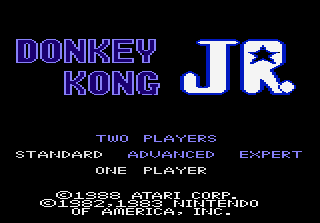
Donkey Kong Junior supports one or two players, selected before play along with the difficulty setting. In two-player play, participants take turns rather than sharing the screen at the same time. Its central appeal is the unusual climbing-based platform design: Junior cannot simply travel through platforms, so every climb requires moving between the correct vines or chains and reaching the right height before stepping onto a ledge. The result is an arcade-style game of short stages that demands repeated precision rather than a long continuous adventure.
The Atari 7800 edition arrived years after the arcade original and after several earlier home versions, yet it preserves all four of the original game's screen types. That makes it a noteworthy entry among Atari's late-1980s Nintendo-licensed releases. As the direct sequel to Donkey Kong, it is also notable for putting Mario in the role of captor while Junior, rather than Mario, is the player character. For Atari 7800 owners, Donkey Kong Junior delivers the series' distinctive rescue premise and vine-and-chain platform action in a dedicated cartridge release.
Gallery
Details
- Developer
- Nintendo
- Publisher
- Atari
- Genre
- Platformer
- Players
- 1-2
- Release Date
- November 1, 1988
- System
- Atari 7800