About
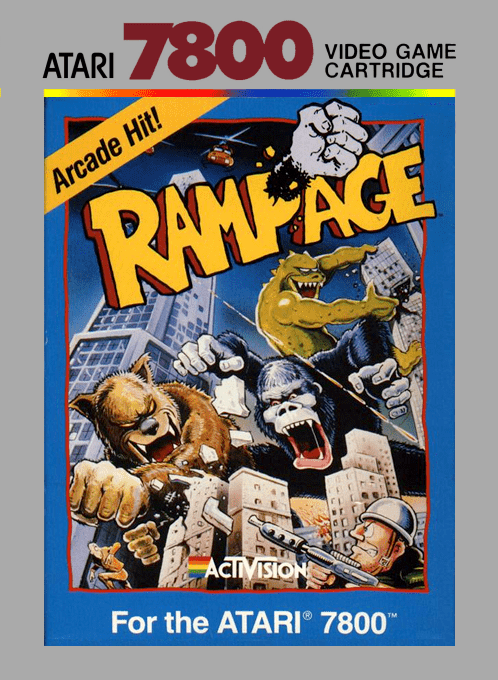
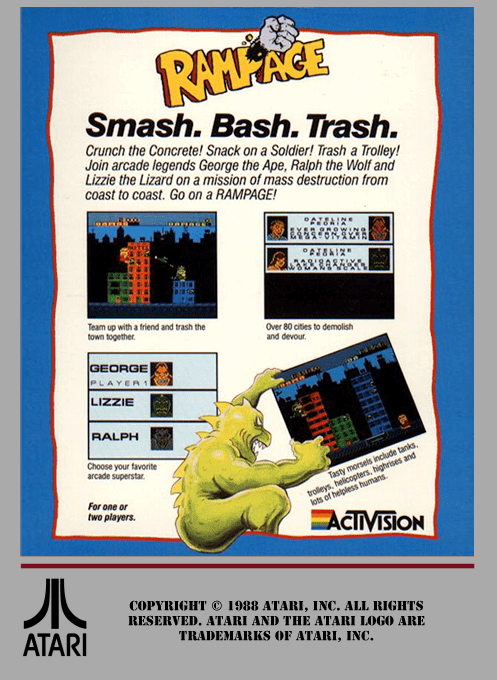
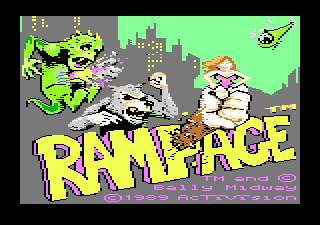
Rampage for the Atari 7800 is Activision’s 1989 home conversion of Bally Midway’s monster-destruction arcade game. Reprogrammed for the system by Spectral Dimensions, it puts one or two players in control of giant, formerly human creatures—George the ape, Lizzie the lizard, and Ralph the wolf—as they tear through a long itinerary of North American cities. Rather than defending a city from invaders, the central joke is that the players are the catastrophe: every stage ends only after its buildings have been reduced to rubble.
At the start, players choose their monster from the three-character roster. A single player uses the left controller; in a two-player game, the second player chooses from the remaining monsters. The 7800 version uses a straightforward joystick layout: move left or right to walk, press up at a building to climb it, and use the left button with a direction to punch. The right button makes a centered monster jump, offering a faster way to travel and a way to catch a building while passing it.
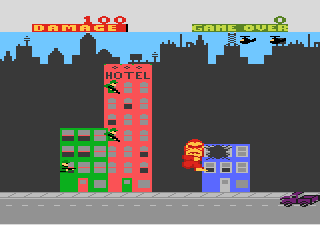
Each city is a compact action arena of climbable structures, streets, and occasional water. Scaling a skyscraper lets a monster smash walls, opening windows and steadily weakening the building. Monsters can also hit the traffic and military hardware moving below, including police cars, tanks, helicopters, trolleys, and boats. The immediate objective remains demolishing every building, but scoring rewards a broader spree of wreckage, from knocking apart walls and vehicles to grabbing money and consuming people or useful items.
A damage bar under the score measures each monster’s remaining strength. Enemy fire steadily drains that energy, and water is especially hazardous if a creature stays in it too long. Food found during the destruction can restore strength, although the game makes scavenging a risk as well as a benefit: flowers and some other items help, while cacti, poison bottles, toasters, and active televisions can hurt. When all energy is gone, the monster reverts to a human. A timely button press can restore the creature before the human leaves the screen; later continues arrive by Rampage blimp, with a limited number of chances to keep the score.
Two-player Rampage makes its cooperative destruction deliberately unruly. Partners can jointly clear a city, but they can also punch one another, reduce the other monster’s energy, and even eat a transformed human for points and strength. That competitive edge sits alongside the practical advantages of having two monsters clearing buildings at once. The Atari 7800 port therefore preserves the arcade game’s playful mix of shared goals, slapstick sabotage, and rapid decisions about when to chase food, strike an enemy, or keep hammering at the last standing walls.
The 7800 release is a distinct home version, not the original three-player coin-op: its manual specifies support for one or two players and a selection among George, Lizzie, and Ralph. It also sets out a 132-city campaign, giving the simple destroy-and-survive loop a substantial route to work through. Activision published the cartridge under authorization from Bally Midway, with Tom Sloper producing for Activision and John Crompton credited for product management. For Atari 7800 owners, Rampage turns the enduring arcade fantasy of movie-monster mayhem into a controller-driven demolition tour built around climbing, punching, jumping, and surviving the response to the chaos.
Gallery
Details
- Developer
- Spectral Dimensions
- Publisher
- Activision
- Genre
- Fighting
- Players
- 1-2
- Release Date
- November 1, 1989
- System
- Atari 7800