About
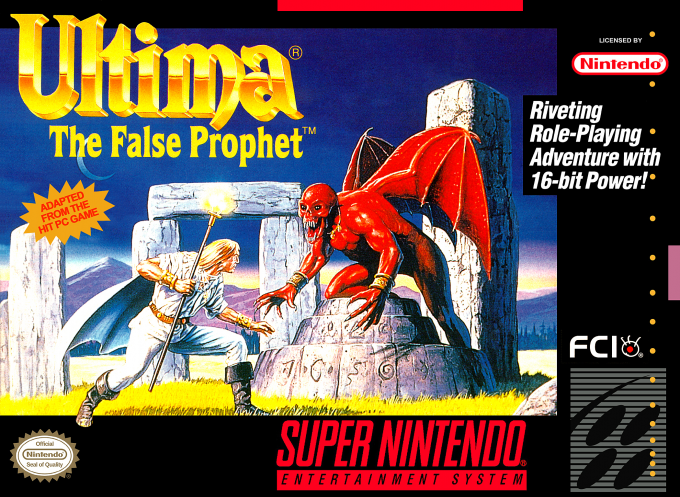
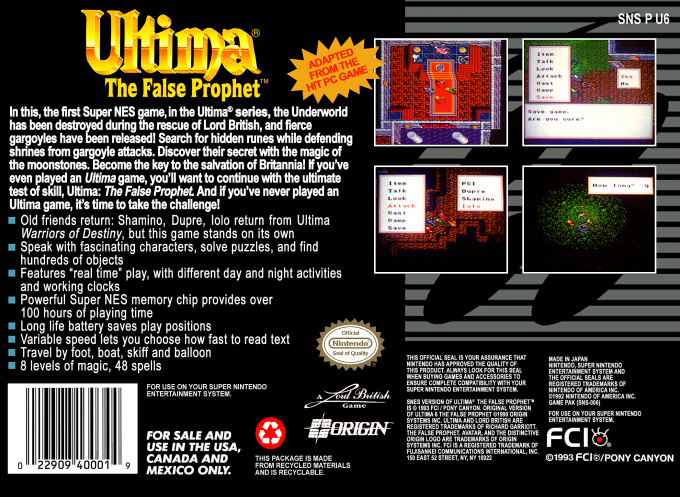
Ultima: The False Prophet for Super NES brings Origin Systems’ sixth main Ultima adventure to Nintendo’s 16-bit console. Developed for this version by Infinity, it was published in Japan by Pony Canyon as Ultima VI: Itsuwari no Yogensha in 1992; FCI released the English-language North American edition in April 1994. This is a single-player fantasy role-playing game set in Britannia, following the Avatar after the events of Ultima V: Warriors of Destiny and concluding the series’ Age of Enlightenment trilogy.
The adventure begins amid a crisis. Gargoyles have emerged to occupy Britannia’s Shrines of Virtue and menace its towns, while the Avatar is drawn into the conflict after a dangerous encounter with their forces. Lord British asks the player to investigate and protect the realm. What initially appears to be a straightforward campaign against invaders becomes a wider quest about prophecy, belief, and understanding the opposing side’s purpose. Familiar companions including Iolo, Shamino, and Dupre are part of the story, and conversations with Britannia’s residents provide the clues needed to continue.
Britannia is explored from an overhead view as a connected fantasy land of towns, castles, wilderness, dungeons, islands, and waterways. The party travels on foot and can also use vessels including boats, skiffs, and balloons. Cities supply weapons, armor, food, healing, magical ingredients, and information, while more remote locations reward careful searching. The game’s passing day-and-night cycle and its many people encourage players to revisit places, follow leads, and pay attention to changing circumstances rather than simply moving from battle to battle.
The Super NES game adapts Ultima VI’s broad, object-focused role-playing style to the Control Pad. Pressing the A Button opens a command menu for examining inventory, using or equipping items, giving equipment to companions, rearranging the party, looking at the surrounding area, attacking, casting spells, camping, and saving. The direction pad moves the party and selects commands. Conversations use a list of discussion topics: new keywords are added as characters reveal them, turning dialogue into a central part of solving the adventure. A player names the Avatar at the start, while the console version does not include the original computer game’s full character-creation process.
Combat uses a party of adventurers whose arrangement, gear, attributes, and chosen actions matter. Strength affects damage, Dexterity influences how often a character can strike, and Intelligence relates to magical ability. Weapons and armor can be equipped through the status screen, and resting restores the party when sufficient food is available, although camping in dangerous territory may invite trouble. Magic is organized across eight levels and uses reagents alongside magic points, offering practical options for healing, protection, travel, discovery, and offense. The cartridge’s battery-backed save feature lets players preserve their progress through a lengthy quest.
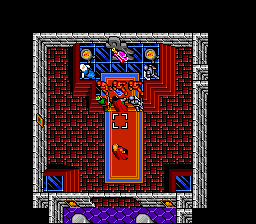
This Super NES adaptation is visually close to the computer original in its depiction of Britannia but is presented full screen and omits character portraits. Its menu-driven interface and keyword conversations were redesigned around a gamepad, and several elements were altered for Nintendo’s content policies: blood effects were removed, civilians cannot be attacked, and some spells were left out. Despite those platform-specific changes, Ultima: The False Prophet preserves the defining journey through Britannia: gathering clues, managing a capable party, exploring a detailed world, and seeking a resolution more complicated than defeating an enemy.
Gallery
Details
- Developer
- Infinity
- Publisher
- Pony Canyon
- Genre
- JRPG
- Players
- 1
- Release Date
- April 1, 1994
- System
- SNES



/Feda_The_Emblem_of_Justice.png)