About
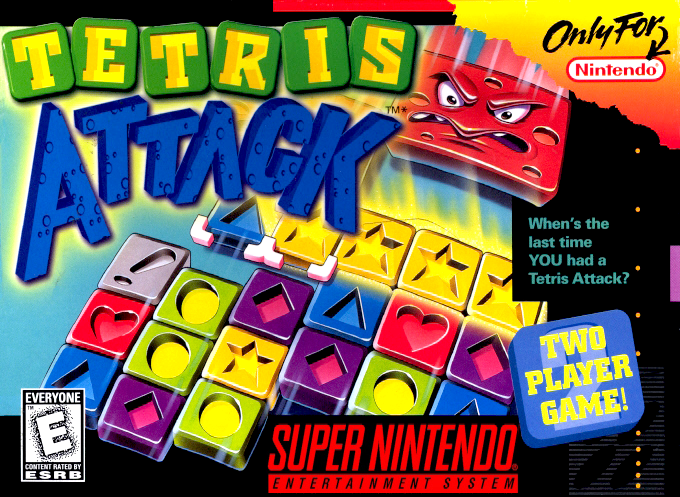
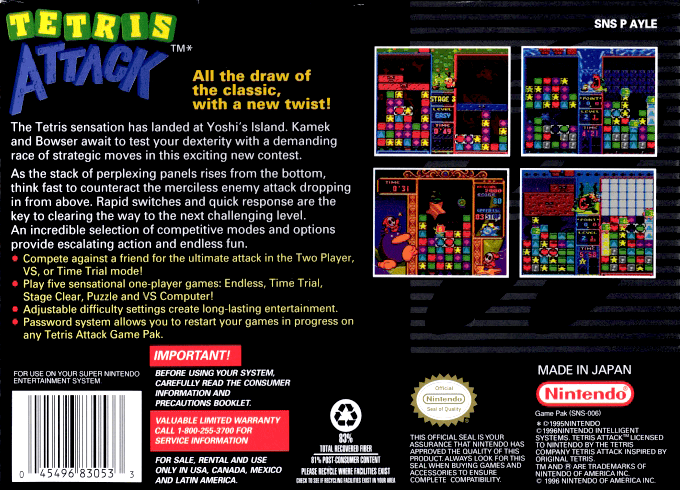
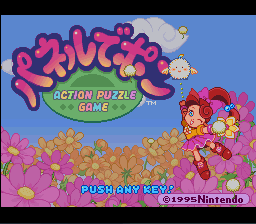
Tetris Attack for the Super NES is Nintendo and Intelligent Systems' fast-moving 1996 puzzle game, built around exchanging colored panels instead of guiding falling tetrominoes. Although its Western title suggests a connection to Tetris, its play system is entirely different. The game is the localized counterpart to Japan's 1995 Super Famicom release Panel de Pon. For its North American presentation, Nintendo replaced Panel de Pon's fairy-tale cast and setting with characters and imagery from Super Mario World 2: Yoshi's Island, making Yoshi the face of this SNES puzzle challenge.
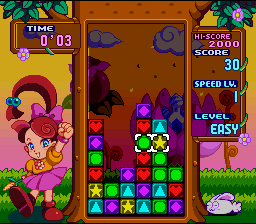
A small cursor highlights two horizontally adjacent panels. Moving it around the rising stack and swapping the two spaces is the essential control: line up three or more matching panels in a row or column and they disappear. Panels above a cleared group fall into the opened space, creating opportunities to set off further matches. The board continuously climbs from below in the standard action modes, so play is a contest between quick decisions, careful setup, and the danger of allowing the stack to reach the top of the screen.
Its depth comes from what can happen while panels are clearing. Players can continue moving the cursor and rearranging the remaining board during those moments, preparing another match before the first resolves. Well-timed setups turn into chain reactions, while clearing a larger group at once creates a combo. These techniques raise scores and, in competitive play, send garbage panels to the opposing board. Those obstacles must be cleared around or incorporated into later matches, so a successful chain can change a close two-player match in an instant.
Tetris Attack's single-player options give the mechanics several different purposes. Story Mode presents a sequence of computer-controlled opponents within the Yoshi's Island-themed scenario. Endless play asks players to survive an increasingly demanding rising field, while a timed mode focuses on scoring before the clock runs out. Stage Clear changes the goal to removing panels below a marked boundary, and Puzzle Mode supplies fixed arrangements to solve within limited moves rather than a stack that rises on its own. Together, the modes accommodate immediate score chasing as well as deliberate planning.
The SNES game also supports head-to-head play, letting two participants race to make matches and use combos or chains to burden the other field. Adjustable settings and computer opponents help establish a pace, but the same basic actions apply whether playing solo or competitively: position the cursor, swap panels, and read how gravity will reshape the stack. The simple rule of matching three panels makes the opening moments approachable, while faster speed and planned cascades reward familiarity with the board.
Panel de Pon and Tetris Attack share their core layouts, mechanics, and 16-bit puzzle design, but their character worlds are distinct regional versions rather than separate game systems. The Japanese original arrived in 1995, and the Yoshi-led Tetris Attack followed on the Super NES in 1996. This release established the panel-swapping style that later Nintendo puzzle games continued under the Puzzle League name, while remaining a notable example of a localization that changed a game's visual identity without changing its central gameplay.
Gallery
Details
- Developer
- Intelligent Systems
- Publisher
- Nintendo
- Genre
- Tile-Matching Puzzle
- Players
- 1-2
- Release Date
- August 1, 1996
- System
- SNES