About
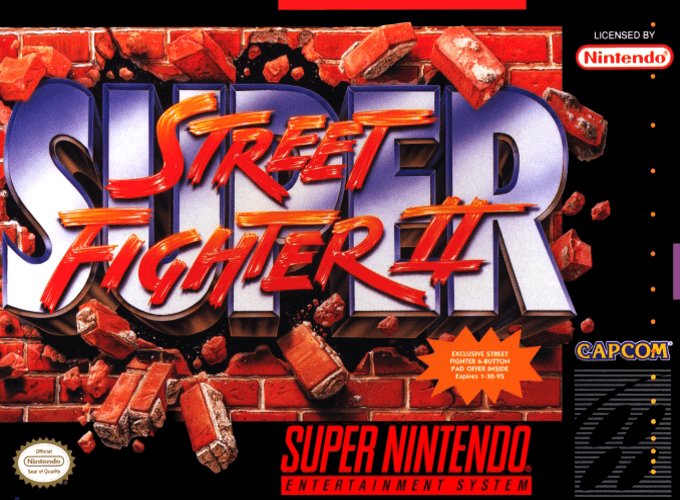
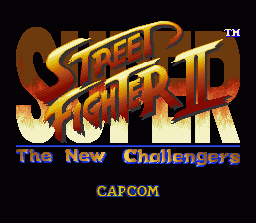
Super Street Fighter II: The New Challengers for Super NES is Capcom's 1994 home conversion of the 1993 arcade fighting game and the third Street Fighter II release on Nintendo's 16-bit system. Built around fast, one-on-one contests between martial artists from around the world, it expands the familiar Street Fighter II formula with a larger cast, refreshed presentation, and a selection of play modes designed for both solo sessions and local competition. Capcom also released it for the Sega Genesis/Mega Drive in the same period, but this entry refers specifically to the SNES cartridge.
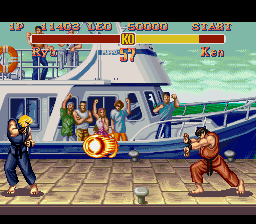
A match pits two fighters against one another in best-of-three-round combat. Players move with the Control Pad, jump, crouch, block, and use the Super NES controller's six face and shoulder buttons for light, medium, and heavy punches and kicks. Every combatant has ordinary attacks alongside character-specific special moves activated with directional and button commands. Judging distance, choosing the right attack, and timing blocks or counters are central to each bout; a player can win by draining the rival's life bar or by having more health when the round timer expires.
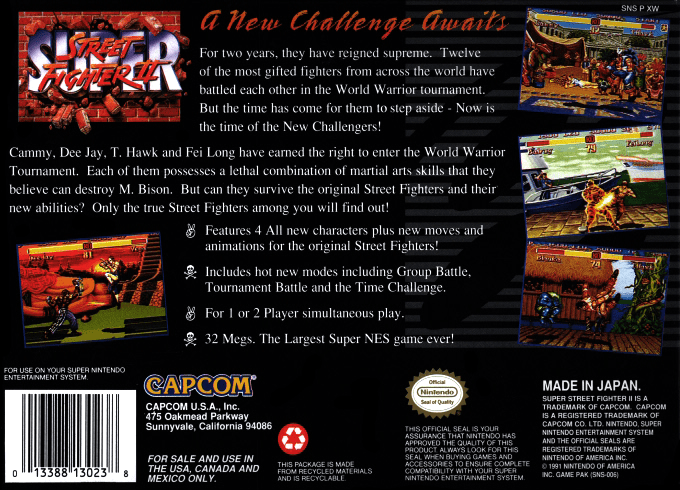
The selectable lineup contains sixteen fighters. Returning World Warriors such as Ryu, Ken, Chun-Li, Guile, Zangief, Dhalsim, Blanka, and E. Honda are joined by the former boss characters Balrog, Vega, Sagat, and M. Bison. Four newcomers make their Street Fighter II debut here: British special-forces fighter Cammy, Jamaican kickboxer and musician Dee Jay, Hong Kong film star Fei Long, and T. Hawk, a Mexican fighter seeking to reclaim his people's homeland from Shadaloo. Each has an individual fighting style, special techniques, voice samples, stage, and ending, giving the roster markedly different ranges and rhythms.
In the main single-player route, the chosen fighter faces a succession of computer-controlled opponents before taking on the Grand Masters. Versus Mode lets two players settle matches locally, while the additional Group Battle, Point Battle, Tournament, and Time Challenge options provide structured alternatives to a standard head-to-head session. These modes can turn a gathering into a series of elimination matches or score-based challenges, and the adjustable speed setting lets players choose a more measured or more rapid pace. The game also offers multiple costume colors for every character, helping players distinguish their fighters during competitive play.
Super Street Fighter II brought new backgrounds, redesigned character portraits, remade music and sound effects, and a new announcer to the Street Fighter II series. Its arcade original was Capcom's first game on the CP System II hardware, and the SNES edition adapts that enhanced look and enlarged roster to a 32-megabit cartridge. The Super Nintendo version has its own details: it includes modes such as Group Battle and Time Challenge, supports the XBAND service in North America, and alters some visual content, including removing or replacing blood in beaten-up character portraits to meet Nintendo's policies of the era.
The game sits between Street Fighter II Turbo and Super Street Fighter II Turbo in the long-running fighting-game series. It preserves the decisive arcade-style clashes that made Street Fighter II a defining name in the genre while broadening the cast and competitive possibilities for the Super NES. Whether working through the computer ladder with a favorite fighter or handing a second controller to a rival, Super Street Fighter II: The New Challengers remains a substantial 16-bit chapter in Capcom's landmark series.
Gallery
Details
- Developer
- Capcom
- Publisher
- Capcom
- Genre
- Fighting
- Players
- 1-2
- Release Date
- June 1, 1994
- System
- SNES