About
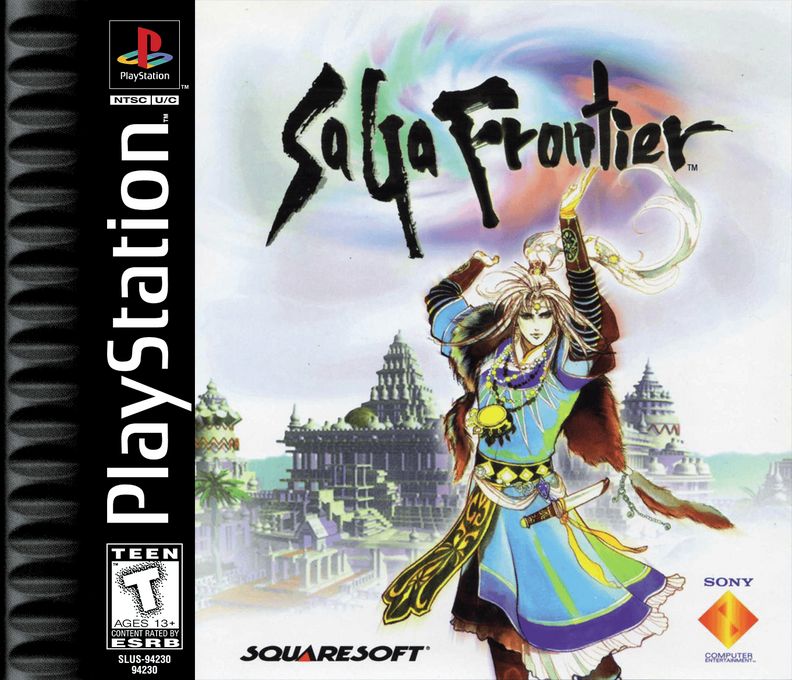
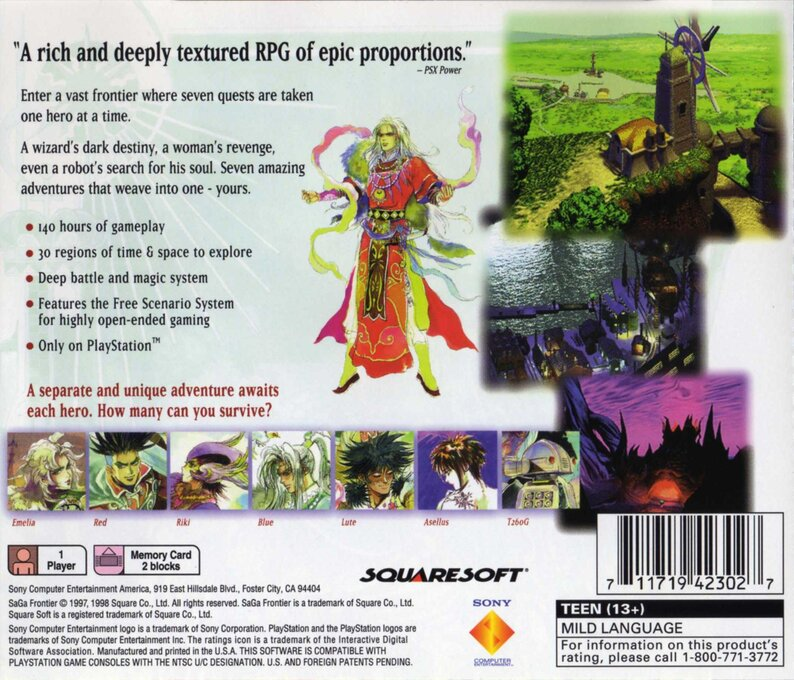
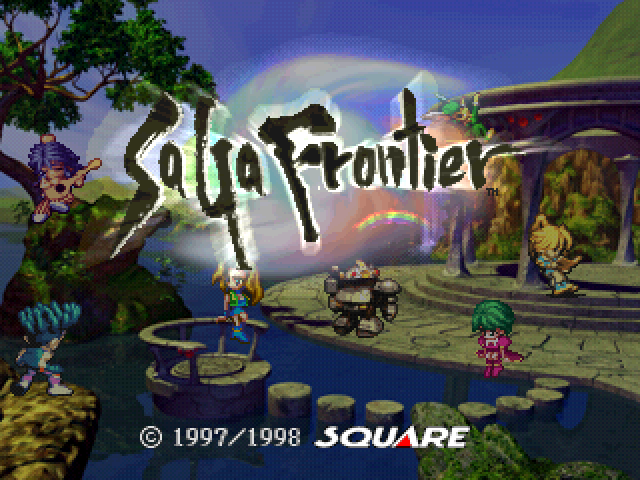
SaGa Frontier for PlayStation is a single-player role-playing game developed by Square and released in Japan in 1997 before arriving in North America in 1998. The seventh entry in the SaGa series, it brought the franchise’s experimental approach to Sony’s console while presenting a science-fantasy setting through illustrated character art, pre-rendered locations, and turn-based battles. Rather than centering on one fixed hero, the original PlayStation game asks players to select one of seven protagonists, each with a separate opening, personal objective, and route through the shared universe called the Regions.
The Regions link worlds with sharply different cultures, technologies, and forms of magic. A player can travel between many of these places by ship, speak with residents, recruit allies, buy equipment and spells, and discover optional events alongside a chosen hero’s main quest. This structure is the game’s Free Scenario System: its campaigns overlap in setting and supporting cast, but their priorities, starting points, and conclusions differ. Decisions about where to travel and whom to bring along shape the path, giving the game a deliberately open-ended rhythm compared with more linear role-playing adventures of its era.
The seven leads create seven distinct perspectives on that setting. Asellus is caught between human and Mystic identities after an encounter with the Mystic lord Orlouge. Blue pursues magical gifts while moving toward a confrontation with his twin, Rouge. Emilia, a former model, is framed for murder and becomes involved with the Gradius organization. The other campaigns follow Lute, a wandering musician; Red, who inherits the masked Alkaiser identity to fight Black X; Riki, a Lummox searching for the Rings of Margmel to save his home; and T260, an ancient Mec recovering its lost mission. Players may encounter characters from other scenarios, but each campaign remains its own adventure.
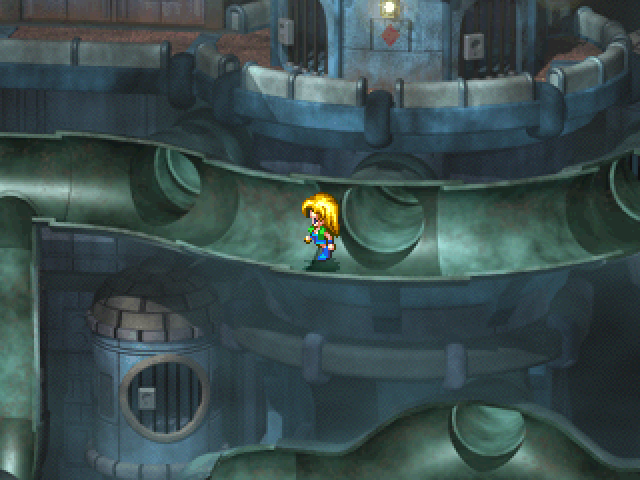
Exploration takes place in connected, screen-based environments where enemies can be seen before battle. Contact with an enemy shifts the action to a turn-based combat screen, where a party chooses physical attacks, weapon techniques, magic, and other abilities before the round plays out. SaGa Frontier uses several playable races, including humans, Mystics, monsters, and Mec units, which helps make party building feel less uniform from one route to another. Equipment, armor, spells, and abilities can be managed outside combat, while victories improve a character’s capabilities and open more possibilities for a growing party.
A defining battle mechanic is the chance to learn new techniques in the middle of a fight, often called glimmering. Party members can also trigger linked combination attacks when the right actions line up, rewarding experimentation with attack choices and team order. These systems sit alongside the series’ character growth and race-specific traits, so a group is not simply built by assigning the same role to every member. The result is a PlayStation RPG whose battles encourage trying unfamiliar weapons, skills, and allies as much as following a prescribed build.
SaGa Frontier was the first SaGa title released outside Japan under the SaGa name; several earlier overseas entries had been presented as Final Fantasy games. Its PlayStation debut also established the title’s particular blend of fantasy, futuristic technology, superheroes, robots, and multiple worlds. The seven-route design provides a reason to revisit the game with a different lead, and completed data can supply benefits for later playthroughs. That replay-oriented framework is central to the original release, where a single ending is only one view of the wider Regions.
The 2021 SaGa Frontier Remastered revisited the game on newer platforms with updated presentation and additional material, including Fuse as an eighth protagonist and restored events for Asellus’s scenario. Those additions belong to the remastered edition rather than the 1997 PlayStation original. For the original PS1 release, SaGa Frontier remains a notable entry in Square’s role-playing catalogue: a collection of interlocking adventures built around player choice, varied heroes, and a battle system that can reveal new options in the heat of combat.
Gallery
Details
- Developer
- Squaresoft
- Publisher
- Squaresoft
- Genre
- JRPG
- Players
- 1
- Release Date
- March 31, 1998
- System
- PS1