About
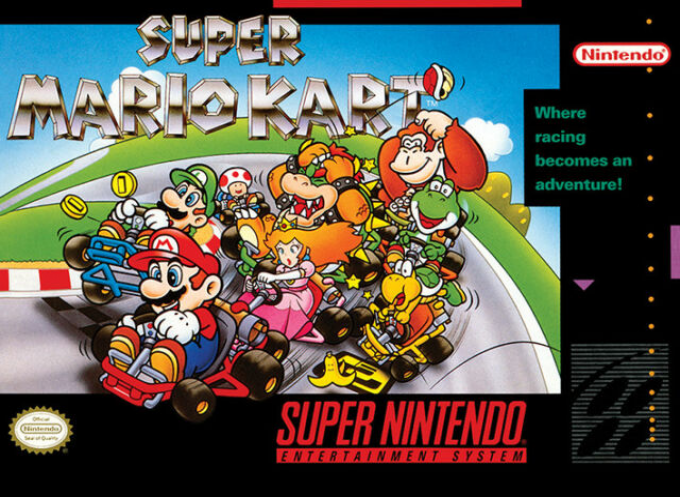
Super Mario Kart began the Mario Kart series when Nintendo released it for Japan’s Super Famicom on August 27, 1992. Developed and published by Nintendo, this original 16-bit racing game brought familiar Mushroom Kingdom characters together in a competitive kart format that paired speed with playful interference. It later reached the Super Nintendo Entertainment System in other regions, establishing the foundation for a long-running Nintendo racing series.
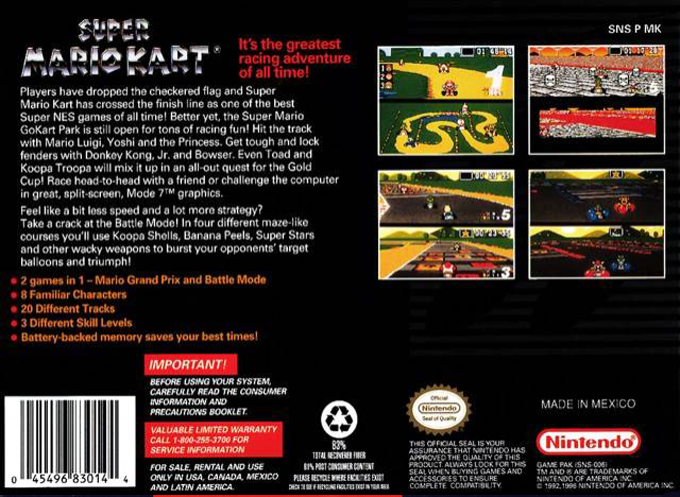
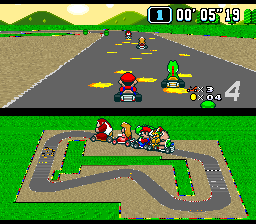
Its races use the Super NES’s Mode 7 graphics technique to turn and scale a flat course layer, creating a convincing road stretching toward the horizon. The view makes corners, slopes, grass, water, and trackside hazards feel immediate while keeping the action fast and readable. This distinctive presentation gave Super Mario Kart a visual identity unlike conventional top-down racers of its era.
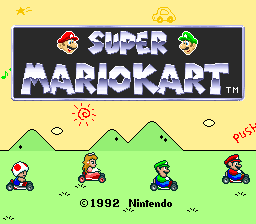
Eight drivers take the wheel: Mario, Luigi, Princess Peach, Yoshi, Bowser, Donkey Kong Jr., Koopa Troopa, and Toad. Their karts are divided into four handling types, so choosing a racer affects acceleration, top speed, cornering, and stability. Learning how each vehicle behaves is as important as memorizing a course, particularly on tight turns and slippery or rough surfaces.
Grand Prix supplies the central single-player challenge through 50cc, 100cc, and 150cc engine classes. Four cups—Mushroom, Flower, Star, and Special—each contain five races, for a total of 20 courses across locations such as Mario Circuit, Donut Plains, Koopa Beach, Bowser Castle, and Rainbow Road. Success depends on placing well across a cup, not merely winning one race, which gives every position weight.
Question-mark panels deliver items that can turn a race around. Mushrooms provide a burst of speed, banana peels obstruct rivals, shells attack opponents, and a Star grants a short period of invincibility. Coins scattered around the tracks also matter: collecting them improves a kart’s speed, while collisions can knock coins away, adding another layer of risk to aggressive driving.
Time Trial shifts the focus from competition to precision. Players race alone against the clock, refine their lines, and can compete with a saved ghost of their own best performance. It is a compact test of braking, drifting, shortcuts, and itemless consistency that reveals how much depth lies beneath the game’s approachable controls.
Super Mario Kart also supports two players simultaneously. Friends can race head-to-head in split-screen events or enter the original Battle Mode, where each driver protects balloons while using items to attack across dedicated arenas. Its blend of direct competition, simple rules, and unpredictable tools made local matches especially memorable.
As the first Mario Kart game, Super Mario Kart introduced a formula Nintendo would revisit for decades: recognizable characters, varied courses, performance differences, item tactics, time attacks, and competitive multiplayer. Its Mode 7 roads and Battle Mode remain defining parts of the series’ history, and its classic tracks, ideas, and racing rivalries continue to echo through later Mario Kart entries.
Gallery
Details
- Developer
- Nintendo
- Publisher
- Nintendo
- Genre
- Arcade Racing
- Players
- 1-2
- Release Date
- September 1, 1992
- System
- SNES