About
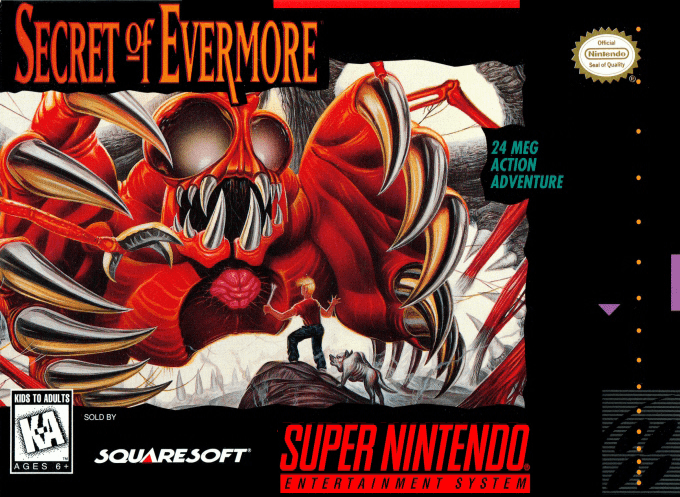
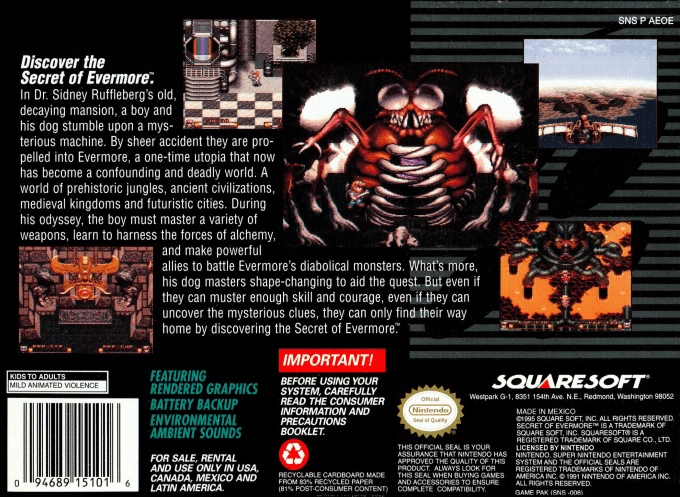
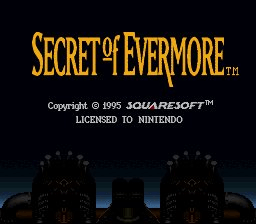
Secret of Evermore is a Super Nintendo action role-playing game developed and published by Squaresoft in 1995. Released first in North America, it follows an unnamed teenage boy and his dog after a mishap in the abandoned home of Professor Sidney Ruffleberg carries them from their ordinary hometown of Podunk into Evermore, a strange manufactured world. The game was made by Squaresoft's North American team and is a standalone adventure, not part of the Mana series despite sharing a number of familiar action-RPG ideas.
Evermore is divided into distinct regions whose cultures resemble different eras and genres: the prehistoric lands of Prehistoria, the classical ruins of Antiqua, the medieval realm of Gothica, and the futuristic station of Omnitopia. The boy and dog search these places for a route home while uncovering what happened to Ruffleberg and the people drawn into his experiment decades earlier. The setting lets the story move from jungles and dinosaur country to castles, marketplaces, pyramids, robots, and science-fiction machinery, with the hero's dialogue often colored by his affection for old monster and adventure movies.
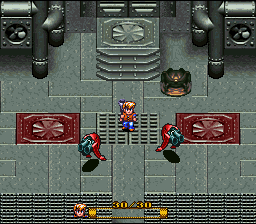
Exploration is viewed from above, with real-time fights unfolding directly on the field rather than on a separate battle screen. The player can take direct control of either companion while the other follows under computer control. A ring-shaped command menu provides quick access to equipment, items, status information, and special abilities. Attacking or running drains a meter that refills over time, so the rhythm of combat involves choosing when to strike, retreat, and build back to full power. The boy gains swords, spears, axes, and eventually a bazooka; repeated use improves weapon proficiency and opens stronger charged attacks.
The dog has a practical role beyond fighting. It can be ordered to sniff around the ground, leading the pair to hidden ingredients needed for the game's alchemy. Instead of spending a conventional pool of magic points, alchemical formulas consume pairs of gathered materials. Formulas can heal, damage enemies, or provide support, and their effectiveness grows through use. Ingredients vary by area, encouraging searches in the field and adding a resource-management layer to every journey. Alchemists teach and store formulas, while shops, equipment, healing locations, and exchanges help prepare the duo for the next region.
Local details change from realm to realm. The dog's appearance transforms to fit its surroundings, becoming a wolf in Prehistoria, a sleek greyhound in Antiqua, a poodle in Gothica, and a robotic form in Omnitopia. Currency also changes with the setting: players deal in talons, gems, gold, or credits and can use converters when crossing between territories. Some marketplaces emphasize barter, making traded goods as important as the local money. These variations make each stage feel like a self-contained destination while still serving the larger trip through Evermore.
Secret of Evermore was designed for single-player play, unlike the multiplayer structure associated with Secret of Mana. Its North American development gave Squaresoft an opportunity to build a console RPG with a distinctly Western-flavored setting and humor, while its Super NES presentation still uses elaborate sprites, detailed backdrops, and expressive special effects. The score was Jeremy Soule's first video-game composition; its restrained, atmospheric approach supports the shift between prehistoric wilderness, fantasy locales, and futuristic interiors.
The game reached PAL territories in 1996, including localized French, German, and Spanish editions, while a planned Japanese release did not go ahead. Its mix of direct action, command-ring menus, ingredient-based alchemy, and a boy-and-dog partnership gives Secret of Evermore its own identity within the Super Nintendo library. For players exploring Squaresoft's 16-bit catalogue, it remains a self-contained quest built around changing worlds, flexible combat tools, and the mystery behind an experiment that turned private dreams into a perilous reality.
Gallery
Details
- Developer
- Squaresoft
- Publisher
- Squaresoft
- Genre
- JRPG
- Players
- 1
- Release Date
- September 18, 1995
- System
- SNES