About
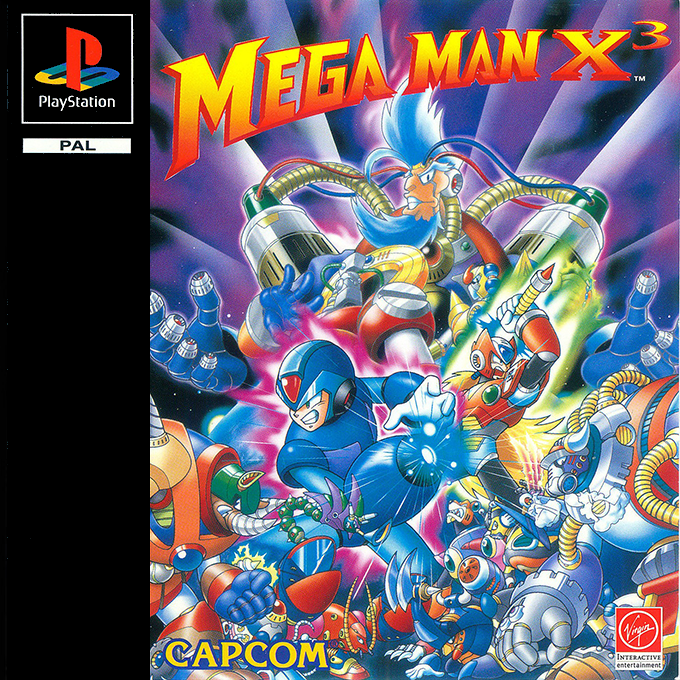
Mega Man X3 for PlayStation is a 2D action-platform game from Capcom, released in Japan in 1996 and in Europe in 1997. Known as Rockman X3 in Japan, this CD-ROM edition adapts the third main Mega Man X adventure, which first appeared on Super NES. It returns to the series’ futuristic 21XX setting, where humans live alongside advanced androids called Reploids and the Maverick Hunters protect society from Reploids that turn dangerous. X and Zero are dispatched when scientist Dr. Doppler’s apparently peaceful community becomes the center of a new Maverick uprising.
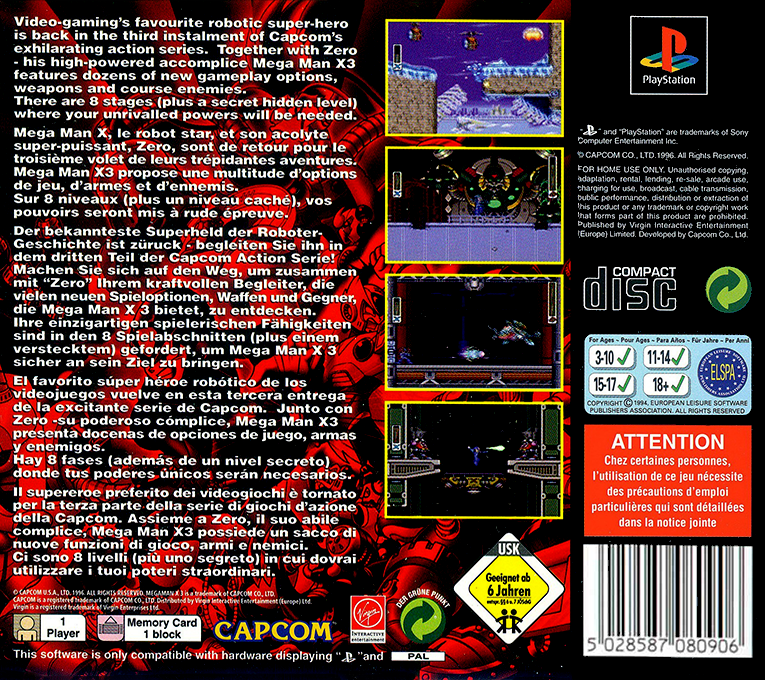
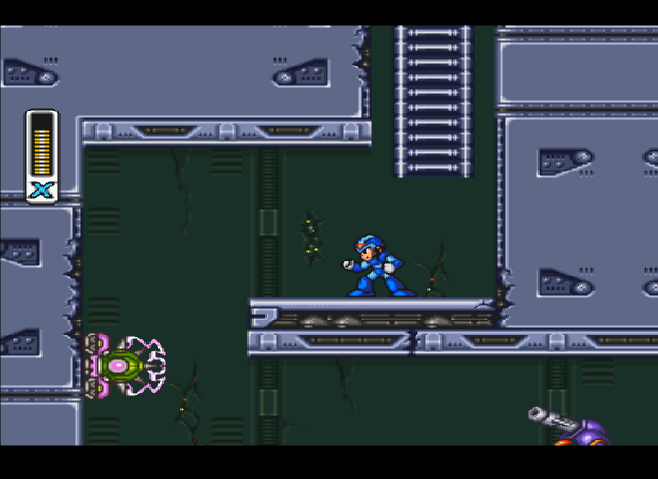
The PlayStation game follows X through eight selectable Maverick stages. Each area is built around precise running, jumping, shooting, dashing, and wall-climbing, with hazards, enemy robots, and a boss waiting at the end. Defeating a Maverick adds that enemy’s weapon to X’s arsenal. Those weapons have different ranges and behaviors, and bosses have particular weaknesses, so choosing a stage order is part of the strategy. X’s chargeable X-Buster remains his standard weapon, while careful use of gained abilities can make difficult routes and battles more manageable.
Exploration has as much importance as direct action. Hidden Heart Tanks increase X’s maximum life energy, and Sub-Tanks store recovered energy for later use. Dr. Light’s capsules contain armor components for the head, body, legs, and X-Buster, expanding X’s movement, defense, or firepower. Stages also include Ride Armor machines, with some items allowing the player to call in these mechanized suits beyond their original locations. The game rewards revisiting levels with new tools and looking beyond the obvious route for upgrades, collectibles, and alternate paths.
Mega Man X3 also introduces limited playable use of Zero, X’s fellow Maverick Hunter. Zero can be summoned to take X’s place through much of a stage and uses his own arm cannon, though this early appearance is deliberately more restricted than his later roles in the series. He cannot collect X’s upgrades and normally cannot finish a stage boss. Keeping him safe matters as well: if Zero is defeated, he becomes unavailable for the rest of that playthrough. One particular encounter involving Zero can affect X’s access to a powerful secret weapon, tying the feature into the game’s broader search for hidden content.
Dr. Doppler’s rebellion drives the campaign beyond the initial eight boss battles. The early premise presents Dopple Town as a Reploid utopia founded on Doppler’s work to curb Maverick behavior, only for its residents and forces to turn hostile. As X investigates, the story reconnects with the lingering threat of Sigma, the antagonist of the preceding Mega Man X games. The result is a branching route through the story’s final stretch, with the condition of Zero influencing part of the conclusion and Dr. Doppler’s antivirus research becoming crucial to the resolution.
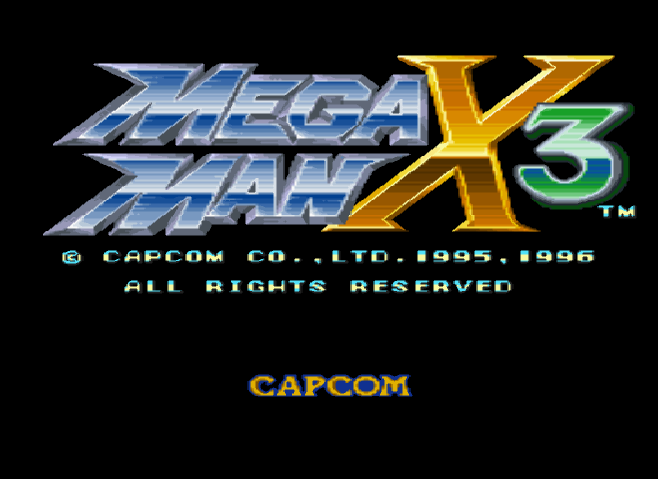
This PlayStation version is broadly the same platform game as the Super NES original, but its presentation reflects the move to disc-based hardware. It adds animated full-motion-video story scenes, including character introductions, alongside a rearranged soundtrack and different sound effects. The PlayStation and Sega Saturn releases arrived in Japan and PAL territories; the PlayStation edition was not issued in North America at the time. For players exploring the Mega Man X series on PS1, Mega Man X3 offers the classic stage-selection and weapon-copying structure while marking Zero’s first playable appearance and adding a distinct audiovisual treatment to the original adventure.
Gallery
Details
- Developer
- Capcom
- Publisher
- Virgin
- Genre
- Platformer
- Players
- 1
- Release Date
- March 1, 1997
- System
- PS1