About
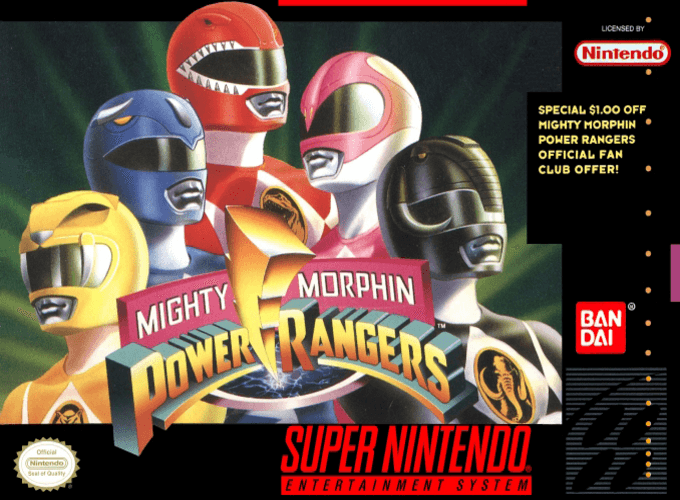
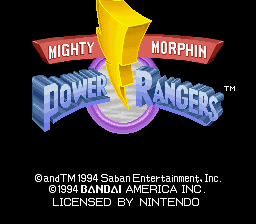
Mighty Morphin Power Rangers for the Super NES is Natsume’s 1994 side-scrolling action game based on the first season of the television phenomenon. Published by Bandai, it is a distinct game from the contemporary Genesis fighter, the Game Gear release, the Game Boy adaptation, and the later SNES games based on the movie and The Fighting Edition. This Super NES entry turns the team’s early battles with Rita Repulsa’s forces into a compact single-player adventure built around seven stages.
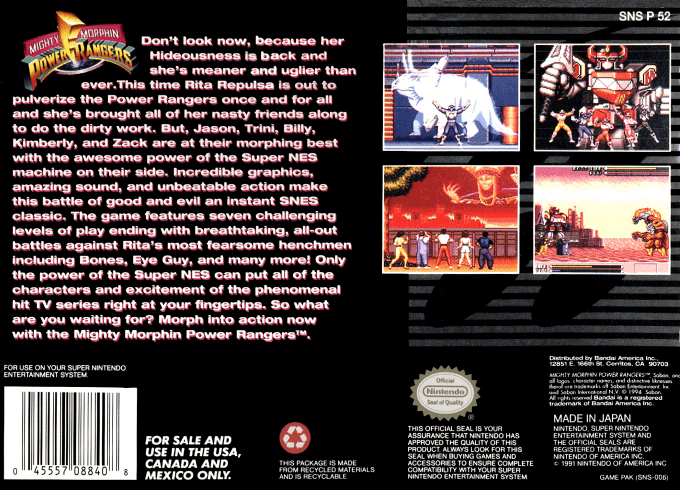
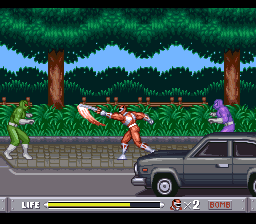
The story begins in Angel Grove, where the five teenagers Jason, Zack, Billy, Trini, and Kimberly confront a new wave of Putty Patrol enemies and familiar monsters. Before a stage’s major encounter, the selected hero fights in civilian form, using hand-to-hand attacks and agile movement to make it through streets, industrial areas, and other themed environments. Reaching the right point lets the character morph, shifting the presentation from ordinary teenager to costumed Ranger and raising the scale of the action.
Players can choose any of the original five Rangers, with each character given an individual weapon and fighting style once transformed. The game uses the Red Ranger’s Power Sword, the Black Ranger’s Power Axe, the Blue Ranger’s Power Lance, the Yellow Ranger’s Power Daggers, and the Pink Ranger’s Power Bow to give the team different visual identities. The structure emphasizes moving to the right, jumping across hazards, and clearing groups of Putties and other enemies before advancing to the next confrontation.
Stages alternate traditional action-platforming with big boss moments modeled on the series’ escalating battles. The Rangers face monsters associated with Rita’s attacks, and the climax moves beyond the normal-sized fight when the enemy grows enormous. At that point the game changes perspective and places the player in control of the Megazord, delivering a one-on-one giant-robot showdown that mirrors the television formula. These Megazord sequences give the campaign a different rhythm from its walking-and-brawling sections.
The Super NES version is designed as a solo experience and is notably not the competitive fighting game released for Sega’s 16-bit hardware. It also does not make the Green Ranger a playable selection, another difference from the Genesis and Game Gear games. Keeping those version-specific details straight matters for collectors: this is the Natsume-developed SNES action game released in 1994, rather than Mighty Morphin Power Rangers: The Movie from 1995 or the separate SNES fighting title, Mighty Morphin Power Rangers: The Fighting Edition.
Natsume’s colorful sprites, animated transformations, and energetic sound aim to reproduce the show’s fast, toybox-like appeal on 16-bit hardware. Contemporary reviews recognized its responsive presentation and character-specific touches while also noting its straightforward, familiar beat-’em-up design. The result is a brisk licensed game that favors recognizable Rangers, monsters, weapons, and Megazord spectacle over elaborate systems, making it an accessible snapshot of Power Rangers at the height of its first-season popularity.
For fans revisiting the original team, Mighty Morphin Power Rangers on SNES offers a direct route through the franchise’s signature pattern: fight Rita’s foot soldiers, morph into a Ranger, defeat the monster, and bring out the Megazord when the threat becomes gigantic. Its clear stage progression and changing combat contexts make it easy to pick up, while its platform-specific design gives it a place of its own among the many 1990s games that shared the Mighty Morphin Power Rangers name.
Gallery
Details
- Developer
- Natsume
- Publisher
- Bandai
- Genre
- Beat 'em Up
- Players
- 1
- Release Date
- September 1, 1994
- System
- SNES