About
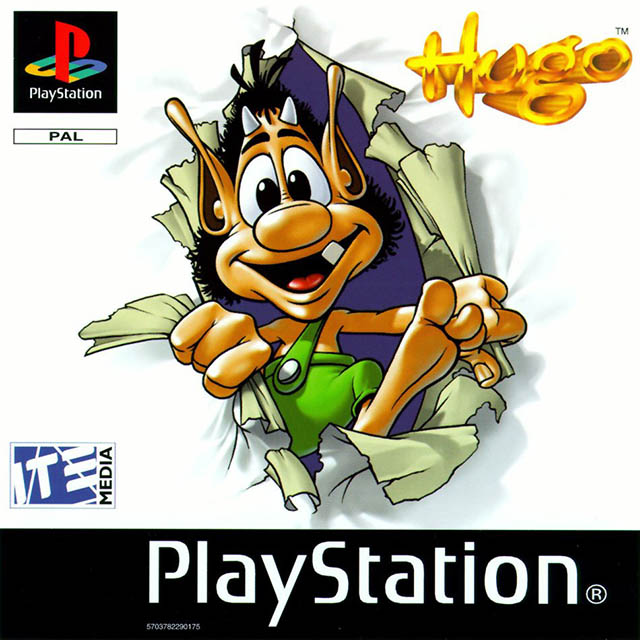
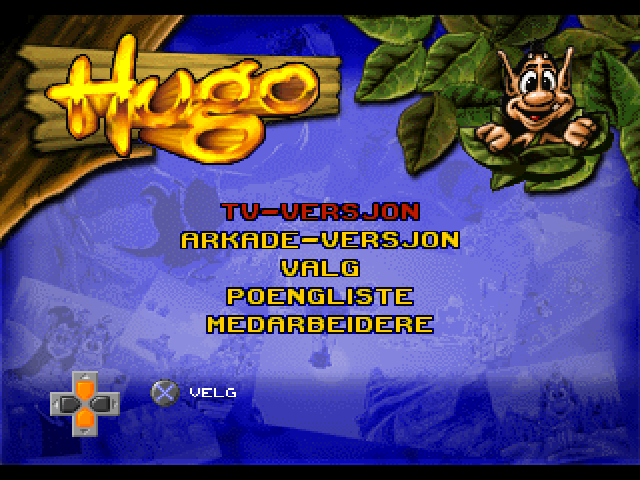
Hugo for PlayStation brings ITE Media’s Danish television-game-show troll to Sony’s 32-bit console in a 1998 European release. Developed and published by ITE Media, this action game reworks material from the earlier Amiga and computer Hugo adventures rather than being a new entry built around a different version of the character. Players take control of Hugo, the small forest troll, as he sets out to rescue his wife Hugolina and their children from the witch Scylla. The familiar television connection is central to its identity: the game turns the short, hazard-filled challenges associated with the Hugo show into a home-console sequence of self-contained stages.
The adventure is structured as a chain of arcade-style scenarios, with progress depending on fast reactions, observation and steering Hugo safely through each course. The PlayStation game combines seven principal challenges before the final mountain approach, so its rhythm is closer to a collection of linked mini-games than to one continuous platforming world. A mistake can send Hugo into an obstacle or trap and costs one of his available chances, making each run a matter of learning the route as well as responding quickly when the screen fills with hazards.
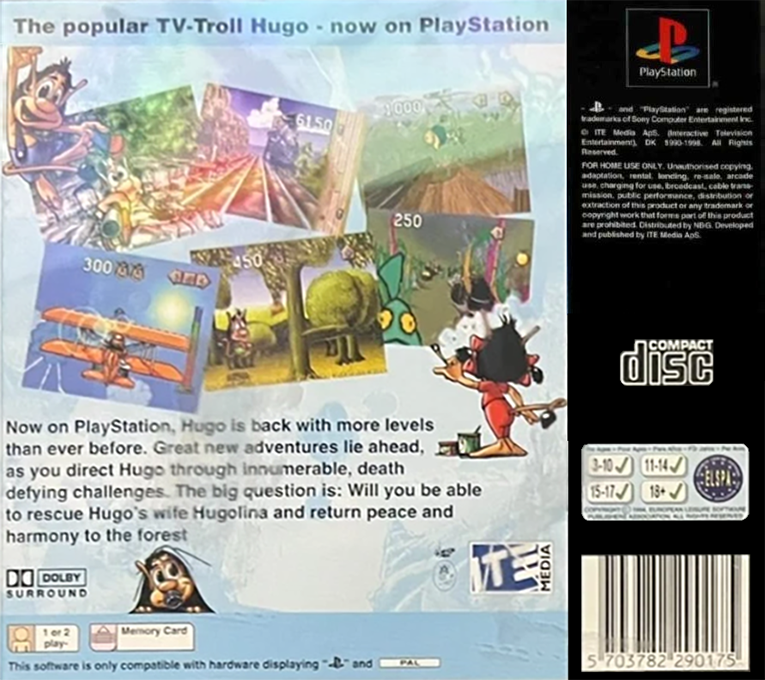
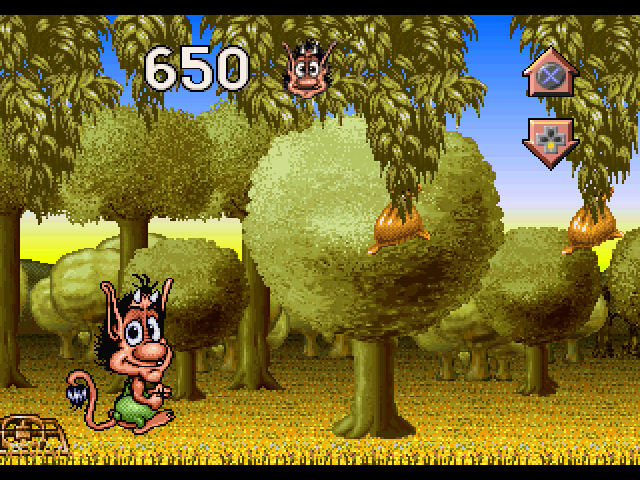
Its stages give the rescue journey a deliberately varied set of vehicles and viewpoints. Hugo pilots a biplane through dangerous weather while avoiding explosive balloons, rides a handcar along tracks, travels through the forest, swims beneath the water, balances through a log-river sequence and takes to a skateboard course. The mountain scenario acts as the destination of the trip. Across these different settings, the player directs Hugo around rocks, gaps, enemies and other threats while collecting valuables when it is safe to do so. The changing scenarios are the game’s defining feature, giving each section its own pace and obstacle pattern.
The premise comes from the classic Hugo stories: Scylla has captured Hugo’s family and intends to use Hugolina in her pursuit of beauty. Hugo therefore crosses the troll-world’s forests, rivers, skies and mountain paths to reach the witch’s hideout. The game’s compact narrative is conveyed through this forward movement from one peril to the next rather than through a large exploration map. Reaching the end means surviving the obstacles well enough to confront the threat to Hugo’s family, preserving the rescue-story framework that linked many early Hugo television and computer-game appearances.
Although released years after the earliest Hugo computer games, this PlayStation edition remains tied to their format and to the franchise’s European television roots. ITE Media had built the Hugo name around an interactive show in which simple directional choices guided the animated troll through danger. On PlayStation, that idea becomes direct pad-controlled play, while the familiar challenge concepts receive console presentation with updated graphics and sound. The result is a period-specific adaptation designed around immediately readable objectives: keep Hugo moving, choose the safe route and carry the rescue attempt from one distinct scenario to the next.
Hugo is also notable as the first of two late-1990s PlayStation releases to use the character’s simple name. The following PlayStation Hugo 2 continues the series on the same system but uses a different selection of challenges and a continuation of the story. This 1998 game stands as a console version of the franchise’s earlier adventure material: an action title built from quick, themed obstacle courses, a fairy-tale rescue premise and the enduring conflict between Hugo’s troll family and Scylla.
Gallery
Details
- Developer
- ITE Media
- Publisher
- ITE Media
- Genre
- Platformer
- Players
- 1-2
- Release Date
- December 15, 1998
- System
- PS1