About
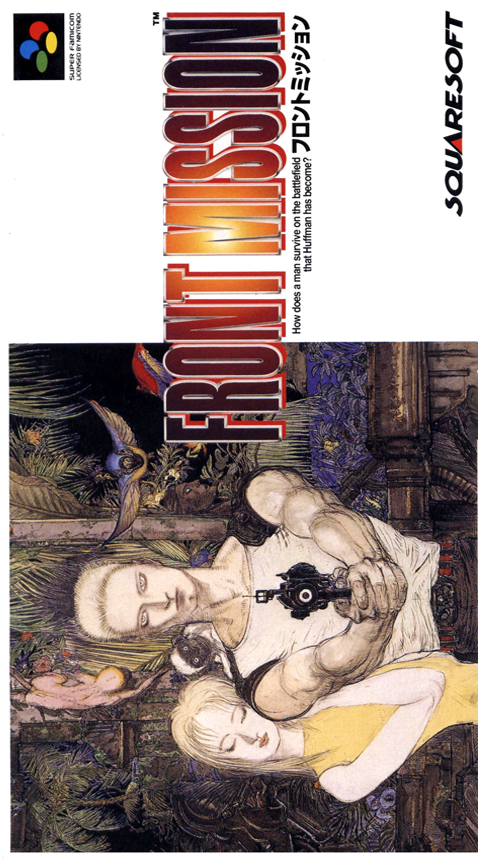
Front Mission for SNES is the 1995 tactical role-playing game that introduced Square’s long-running mecha strategy series. Developed by G-Craft and published by Square for Japan’s Super Famicom, it places its military drama in the year 2090 on Huffman Island, a contested Pacific territory caught between the Oceania Cooperative Union (OCU) and the United States of the New Continent (USN). The original cartridge release was a single-player Japanese game; its story and systems later formed the basis for subsequent ports and remakes.
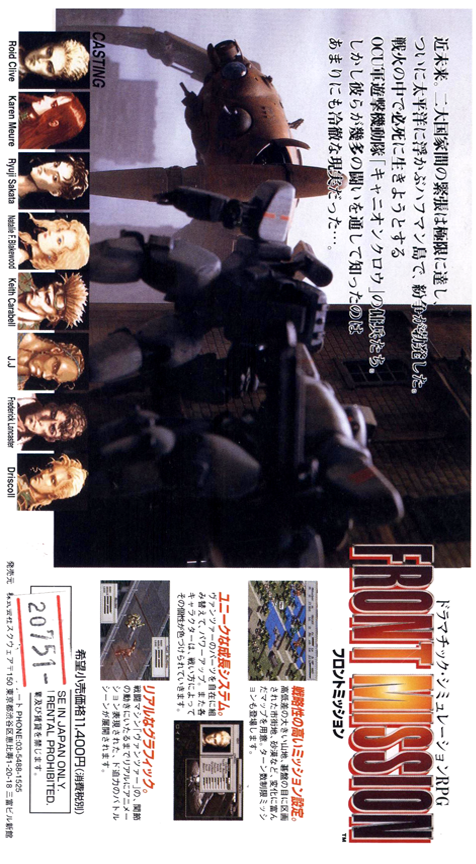
The campaign begins with OCU pilot Royd Clive taking part in a reconnaissance operation at a USN weapons facility in Larcus. The raid ends in disaster when USN officer Driscoll’s force intervenes, leaving Royd’s fiancée Karen missing in the destruction and creating an incident that intensifies the struggle for Huffman Island. A year later, Royd has fallen into wanzer arena fighting until Colonel Guri Olson recruits him for the Canyon Crows, a mercenary unit working alongside the OCU. The search for answers about Larcus runs alongside a broader war story involving political maneuvering, weapons research, and soldiers on both sides of the conflict.
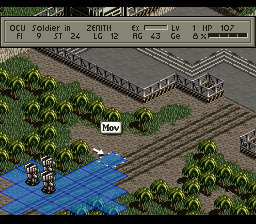
Front Mission is built around missions on an isometric grid. Players move a squad through battlefields, weigh attack ranges, protect allies or objectives, and choose how to use each turn before enemy units respond. Mission goals can ask the player to remove opposing forces, reach or hold key points, or keep a designated unit safe. Between battles, a world map reveals new locations as the campaign advances, while towns provide places to speak with characters, gather information, prepare equipment, and move the story forward.
Its central combat machines are wanzers, a name derived from “walking tank.” Each one is assembled from separate body, arm, and leg components, so a unit’s equipment is more than a cosmetic choice. The legs affect mobility and evasion, the arms are needed for hand-held and shoulder-mounted weapons, and destruction of the body removes the wanzer from the field. Losing an arm or leg does not necessarily destroy the machine, but it can restrict its weapons or sharply reduce its movement. This part-by-part damage model makes target selection an important tactical decision.
Preparation is a major part of Front Mission’s strategy. Wanzers can receive different frames, computers, backpacks, shields, and weapons, provided the complete machine stays within its available power and weight limits. Close-combat tools, short-range guns, long-range weapons, and indirect-fire launchers all serve different roles on the map. Computers help with weapon accuracy and can support learned abilities, while backpacks can carry supplies such as ammunition or increase a unit’s capacity for heavier gear. Pilots gain experience and develop their own effectiveness as the campaign continues, encouraging players to refine a squad rather than rely on a single fixed setup.
The game also includes an arena where Royd can face computer-controlled opponents for money between story operations, as well as pre-battle briefings that outline enemy forces. These quieter intervals contrast with a campaign concerned with the human consequences of mechanized war. Front Mission’s approach joins character-driven scenes to a deliberate simulation RPG structure: each mission is part of Royd’s personal pursuit, but every victory depends on building machines and teams suited to the next assignment.
As the first Front Mission entry, the Super Famicom release established Huffman Island, the OCU and USN rivalry, and the wanzer technology that became recurring foundations for the series. Square Enix later brought the original to WonderSwan Color in Japan in 2002. The PlayStation remake, Front Mission 1st, added a USN-side scenario, and that version later reached Nintendo DS markets under the simpler Front Mission title, making this foundational story accessible outside Japan. Later editions added content, but the 1995 SNES version remains the starting point for the series’ tactical battles and interconnected world.
Gallery
Details
- Developer
- Squaresoft
- Publisher
- Squaresoft
- Genre
- Tactical RPG
- Players
- 1-2
- Release Date
- February 24, 1995
- System
- SNES
/Bishoujo_Senshi_Sailor_Moon_R.png)
/Wizardry_I-II-III_Story_of_Llylgamyn.png)