About
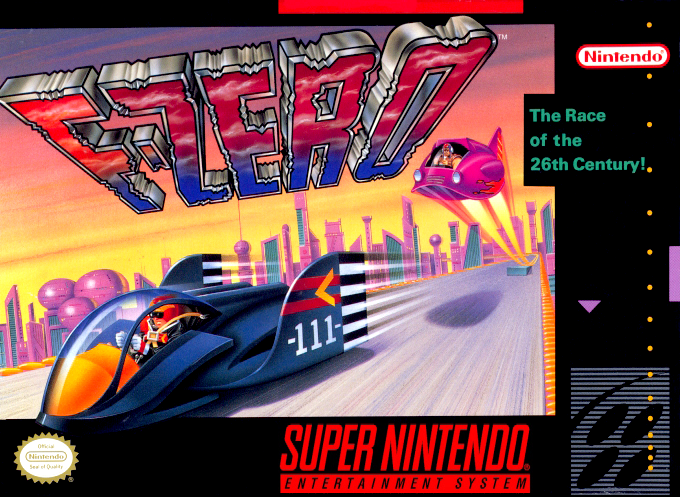
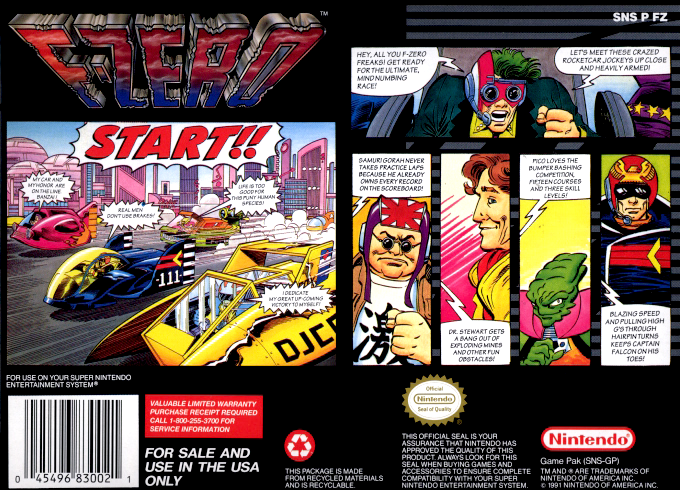
F-Zero for Super Nintendo Entertainment System is Nintendo’s original high-speed futuristic racing game, created for the Super Famicom’s 1990 Japanese launch and released in North America in 1991. Developed and published by Nintendo, it begins the F-Zero series with a vision of motor racing in the year 2560. Interplanetary wealth and technology have turned the old idea of Formula One into a dangerous spectator sport, with pilots guiding anti-gravity machines along elevated circuits at extraordinary speed. The SNES game presents that concept as a single-player race for survival and championship position rather than a conventional road-racing simulation.
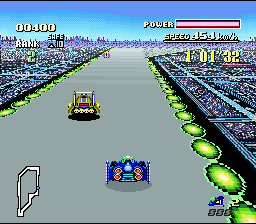
The basic goal is clear: bring one of four machines around each circuit for five laps, protect its energy, and stay high enough in the field to avoid elimination. Steering demands anticipation, since the courses combine very high speeds with sharp turns, narrow edges, changing surfaces, and obstacles. Collisions with barriers, mines, or other racers deplete the power meter, while designated pit areas restore energy. Falling from the track is equally costly, so learning a course’s bends and hazards is as important as taking the fastest possible line.
Players select the Blue Falcon of bounty hunter Captain Falcon, Dr. Stewart’s Golden Fox, Pico’s Wild Goose, or Samurai Goroh’s Fire Stingray. The vehicles are deliberately distinct in acceleration, top speed, turning behavior, weight, and resilience, giving the same track a different feel depending on the choice. A race’s placement requirements add pressure across its laps: a player must improve through the pack instead of merely reaching the chequered flag. Completing laps also earns the temporary Super Jet speed boost, and dash zones and jump plates create opportunities to gain momentum when they can be used safely.
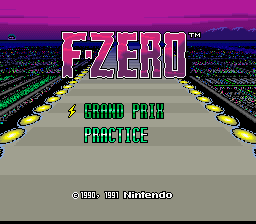
F-Zero offers Practice for learning selected courses and Grand Prix for contesting an entire league against computer-controlled rivals. Its 15 tracks are arranged in the Knight, Queen, and King leagues, with the challenge rising from one set to the next; each league can also be approached at several difficulty levels. The locations give the fictional circuit a broader sense of place, from the different Mute City courses to Port Town, Death Wind, Sand Ocean, White Land, Fire Field, and Red Canyon. Some tracks alter their layouts in later appearances, rewarding familiarity without turning every race into the same route.
A defining feature of F-Zero on SNES is its use of the system’s Mode 7 scaling and rotation effect. The track surface swings and recedes beneath the racer to suggest depth and velocity while the vehicle remains readable in the foreground, an approach well suited to its demanding cornering and rapid visual feedback. The original game’s four pilots, machines, league structure, and science-fiction racing world supplied the foundation for later F-Zero entries, while its focused solo design remains centered on mastering machine handling, memorizing courses, and keeping control when the field compresses at speed.
Nintendo later made this first F-Zero available again through services and collections on newer Nintendo hardware, including Virtual Console releases, the Super NES Classic Edition, and Nintendo Switch Online’s Super NES library. Those reissues preserve the original SNES experience: a fast, technically distinctive racing game built around four hover machines, fifteen hazardous courses, and a championship that becomes more exacting as the player moves from league to league.
Gallery
Details
- Developer
- Nintendo
- Publisher
- Nintendo
- Genre
- Arcade Racing
- Players
- 1
- Release Date
- August 23, 1991
- System
- SNES