About
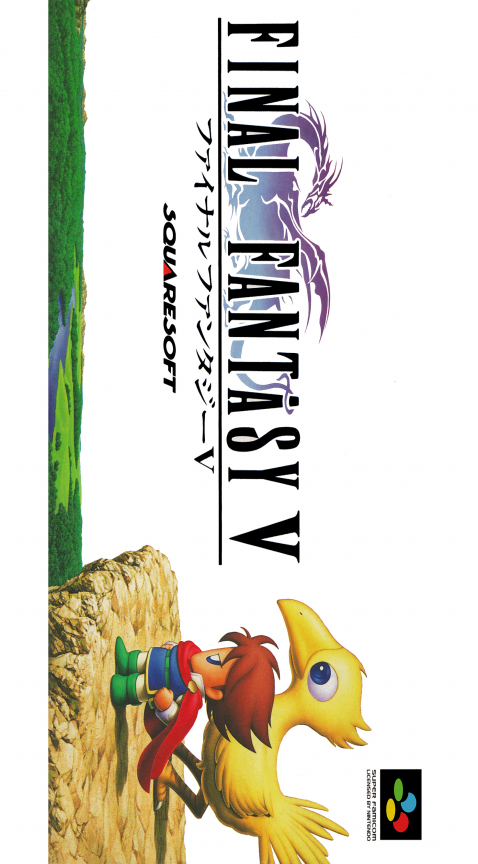
Final Fantasy V is Square’s 1992 role-playing game for Japan’s Super Famicom, later known internationally through a range of ports and remasters. The original release is a 16-bit adventure built around a colorful world, expressive sprite work, and Nobuo Uematsu’s score. Its first official English release arrived years later in the PlayStation compilation Final Fantasy Anthology, so the SFC edition remains the original version for this SNES/SFC entry.
The story begins when the world’s elemental Crystals begin losing their power. Bartz Klauser, a young traveler crossing the land with his chocobo Boko, investigates a fallen meteor and meets Princess Lenna, the amnesiac Galuf, and the pirate captain Faris. Their search for Lenna’s missing father leads to the Wind Crystal, a growing threat to the remaining crystals, and a wider conflict that reaches beyond the party’s home world.
Bartz is not a predetermined specialist; he is the player’s entry point into Final Fantasy V’s flexible party-building system. As the adventure continues, the party gains new allies and confronts the sorcerer Exdeath, while the revelations surrounding Galuf, Krile, the Warriors of Dawn, and the divided worlds steadily expand the stakes. The game balances adventurous comedy and character moments with crystal mythology, dangerous dungeons, and dramatic turns.
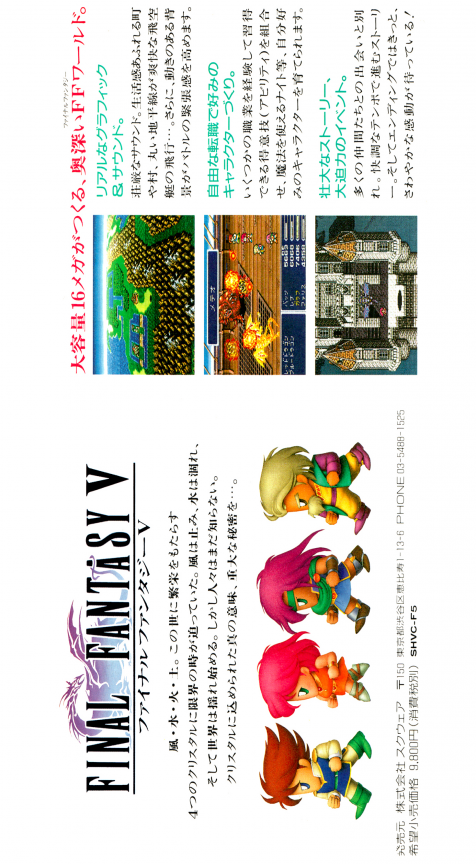
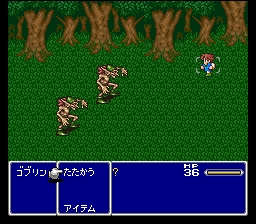
Combat uses the Active Time Battle system, so each character and enemy acts when its time gauge fills rather than in strictly alternating turns. Party members can attack, cast magic, use items, defend, or call on the commands supplied by their current jobs. Encountering monsters in towns, caves, towers, forests, ships, and ruins earns experience for character levels as well as Ability Points for job development.
Final Fantasy V’s defining feature is its Job and Ability system. Crystal shards unlock jobs such as Knight, Monk, Thief, Black Mage, White Mage, Blue Mage, Summoner, Bard, and more, letting a character change role outside battle. Mastering a job grants abilities that can be equipped while using another job, making combinations such as a physical fighter with magic commands or a spellcaster with learned passive benefits possible.
This freedom gives the four-person active party room to adapt to specific bosses and dungeon challenges. Players can build around healing, elemental spells, weapon techniques, status effects, stealing, summoning, and unusual enemy abilities learned by Blue Mages. The Freelancer job becomes particularly useful after extensive job mastery, turning long-term experimentation into a meaningful part of progression rather than a temporary detour.
Exploration unfolds across connected overworlds and expands through new forms of travel, including boats, chocobos, wind drakes, and airships. Towns offer equipment, supplies, information, and rest, while optional discoveries reward players who revisit locations or investigate off the main route. The original Super Famicom version established this structure and job-driven customization; later PlayStation, Game Boy Advance, mobile, and Pixel Remaster releases differ in translation, presentation, convenience features, and—in some versions—additional jobs or content.
Gallery

Details
- Developer
- TOSE
- Publisher
- Square
- Genre
- JRPG
- Players
- 1
- Release Date
- December 6, 1992
- System
- SNES