About
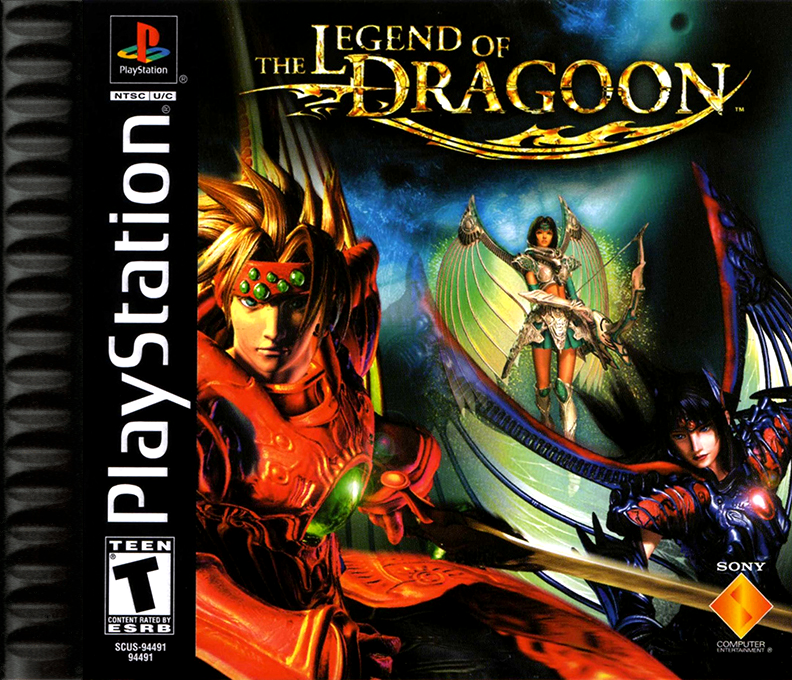
The Legend of Dragoon is a single-player Japanese role-playing game developed by Sony Computer Entertainment Japan Studio and published by Sony Computer Entertainment for the original PlayStation. It first reached Japan on December 2, 1999, followed by North America on June 13, 2000 and Europe on January 19, 2001. That regional sequence matters: the four-disc PlayStation release is the game represented here, not a later digital edition. Japan Studio had begun the project in 1996 and grew it into one of the studio’s largest PlayStation productions, with more than one hundred people involved at its peak.
The adventure takes place on the continent of Endiness, a fantasy world shaped by the legacy of the Dragons’ Campaign, a war fought ten thousand years earlier between humans, dragons and the winged Wingly civilization. Its present-day story begins amid the Serdian civil war. Dart, a swordsman searching for the Black Monster responsible for destroying his home, returns to his village and reunites with his childhood friend Shana. Their journey soon brings them into conflict with the Sandoran army and its ruler, Emperor Doel, while the much older history of Dragoons, Dragons and the Moon grows steadily more relevant.
Dart travels with a changing party of allies rather than a fixed trio. Rose, a veteran warrior with knowledge of the ancient conflict, is central to the opening mystery; other companions include the knight Lavitz, king Albert, the mercenary Haschel, the dancer Meru, the archer Shana and the warrior Kongol. The narrative uses those different backgrounds to move from a local war to questions of survival, responsibility and inherited violence. It is a linear, story-led RPG, but towns, world-map travel, optional encounters and equipment choices provide the connective tissue between major set pieces.
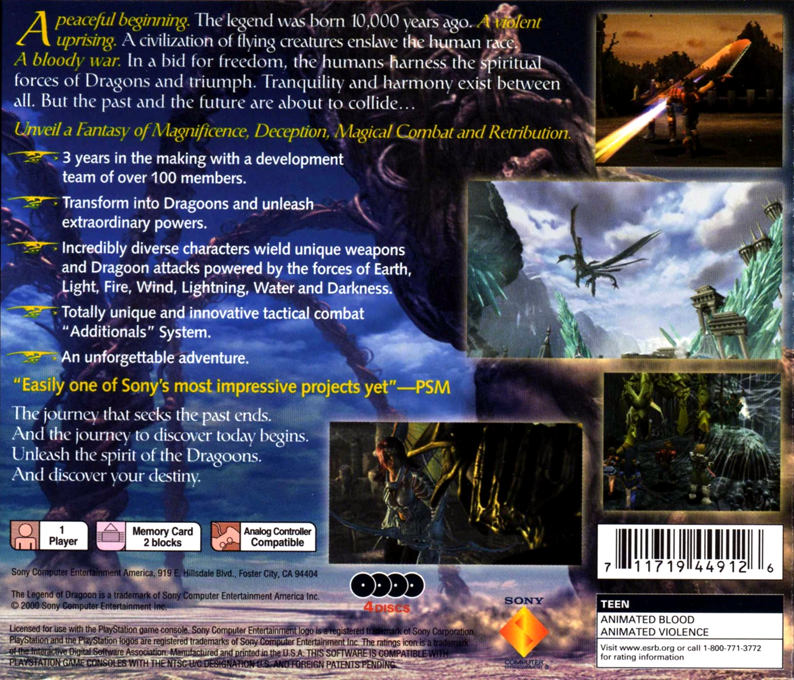
Exploration alternates between pre-rendered locations, a world map and separate battle arenas. Its presentation made extensive use of full-motion video and painted environments, which helps explain the unusually large physical package: the PlayStation original spans four CDs, the maximum Sony’s producer Shuhei Yoshida said the large PSone case could hold. The disc changes are therefore part of the original game’s physical structure and its long-form story, not separate sequels or expansions. They mark progress through one campaign, while save data carries the party, inventory and advancement forward.
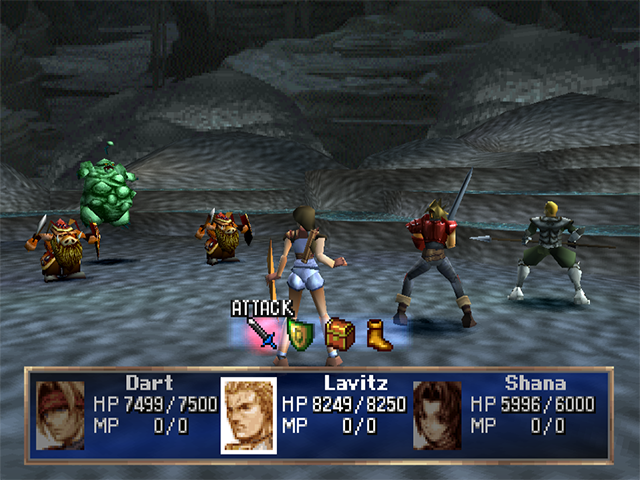
Combat is turn-based but asks for active timing during ordinary attacks. Choosing Attack can start an Addition: a named chain of strikes in which the player presses the displayed button as targeting rings converge. Completing the sequence increases damage and earns Spirit Points, while a mistimed input ends the chain; enemies can also counter an attempted input. Additions give each party member a recognizable rhythm and make basic attacks more involved than selecting a command once. They are especially important because repeated use strengthens a selected chain over time.
Spirit Points power the Dragoon system. Characters who possess a Dragoon Spirit can transform, temporarily gaining armor, a different command set and access to elemental Dragoon magic and powerful attacks. The transformation is not unlimited: its available turns are tied to the character’s accumulated spirit, so the player balances normal Additions, guarding, items and magic against the chance to change form. Elemental affinities, enemy defenses, status effects and party roles add another layer, while Shana and her later counterpart Miranda differ from the others by fighting with bows and magic rather than standard Additions.
Japan Studio adjusted the game after its Japanese launch, rebalancing difficult sections for the North American release; producer Shuhei Yoshida described that overseas version as the complete version the team wanted. Sony later made the PlayStation game available digitally as a PSone Classic in Japan in 2010 and North America in 2012. Those releases preserve the original game rather than introducing a new installment, and their differing availability should not be mistaken for the original regional PlayStation dates.
A further PlayStation 4 and PlayStation 5 release arrived in 2023 through modern PlayStation emulation. That version is still The Legend of Dragoon’s original PlayStation game, presented with contemporary convenience features such as up-rendering, rewind, quick saves and video filters; it is not a remake or a newly developed remaster. For the original release, the defining artifact remains the four-disc PlayStation RPG: Dart’s journey across Endiness, its cinematic presentation and its timing-based Addition system built around the power of the Dragoons.
Gallery
Details
- Developer
- Sony Computer Entertainment
- Publisher
- Sony Computer Entertainment
- Genre
- JRPG
- Players
- 1
- Release Date
- June 11, 2000
- System
- PS1