About
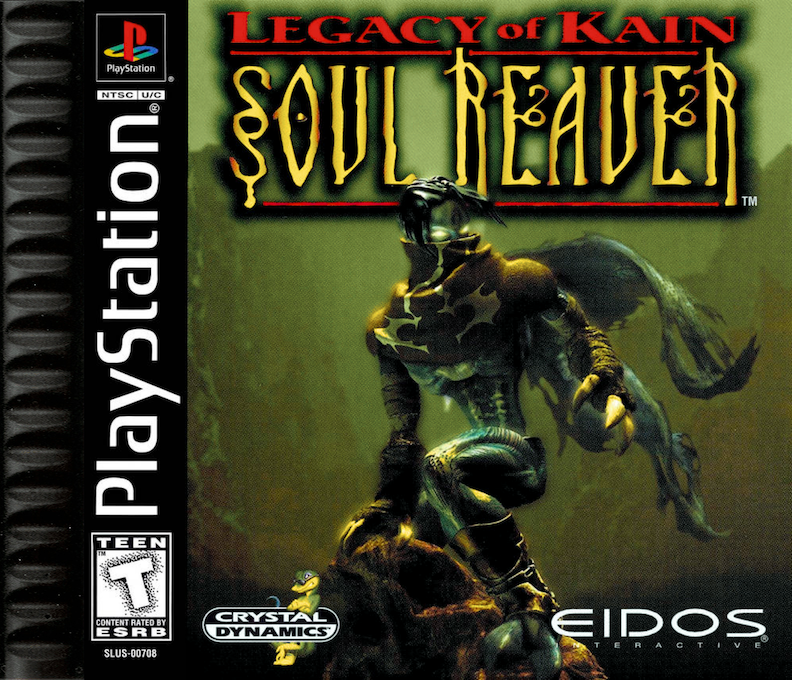
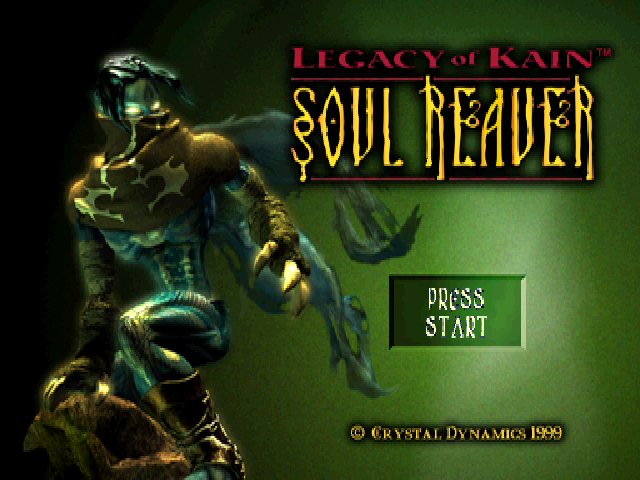
Legacy of Kain: Soul Reaver is a gothic action-adventure developed by Crystal Dynamics and published by Eidos Interactive. Released for the original PlayStation in August 1999, it is the second Legacy of Kain game and continues the story after Blood Omen: Legacy of Kain. Its haunting fantasy setting, dramatic performances and ambitious three-dimensional world made it one of the era’s most distinctive PlayStation adventures.
The story takes place in Nosgoth, a decaying land shaped by ancient powers, failed guardians and vampire rule. Fifteen centuries after Blood Omen, Kain presides over an empire of vampire clans. Raziel, once his favored lieutenant, grows wings before his master does and pays brutally for it: Kain destroys them and casts him into the Abyss. Raziel returns centuries later as a wraith, remade by the Elder God and driven by vengeance against Kain and the brothers who now inhabit Nosgoth’s ruins.
That revenge quest gives Soul Reaver its unusually memorable point of view. Raziel is neither a conventional hero nor a straightforward monster; he is a fallen predator forced to feed on souls while uncovering truths that complicate everything he thinks he knows. His journey leads from crumbling vampire territories and human strongholds to cathedrals, crypts and the ruined Pillars of Nosgoth, with conversations and discoveries gradually widening a personal grudge into a much larger conflict over history and fate.
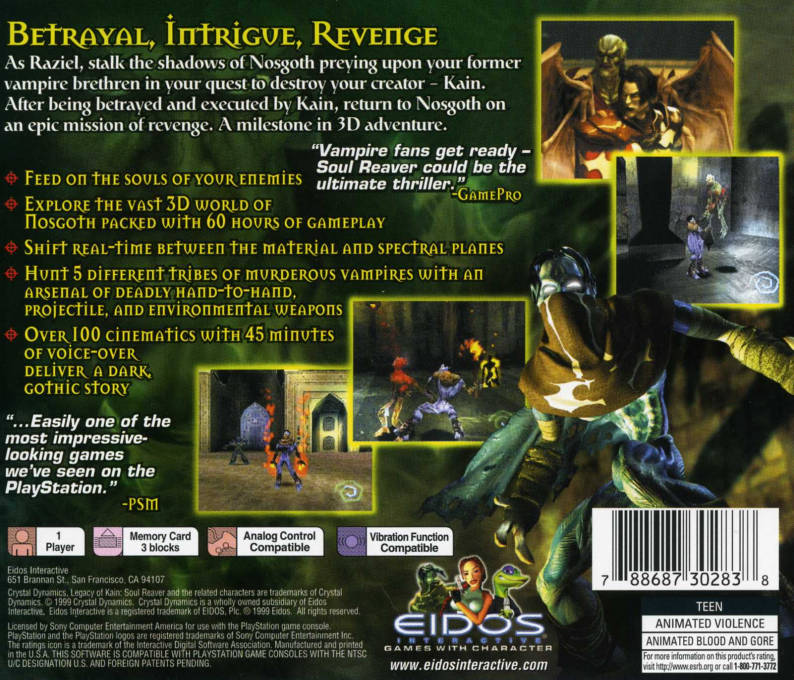
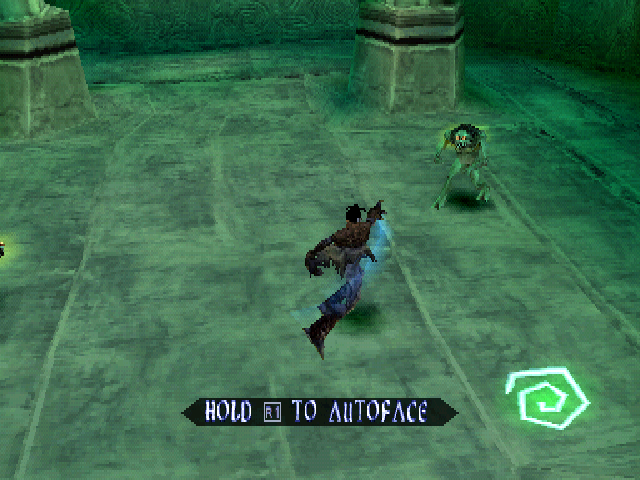
Exploration centers on Raziel’s ability to move between the material and spectral realms. The two planes occupy the same spaces but do not behave alike: architecture twists, barriers lose their force and new routes appear after the shift. Raziel can enter the spectral world freely, but returning to the physical plane requires specific portals, so every change of realm asks the player to reconsider the surrounding environment. This central idea turns rooms, hazards and pathways into layered puzzles instead of mere scenery.
The PlayStation game combines that realm mechanic with broad, interconnected exploration. Raziel can leap, climb ledges and glide on his damaged wings, then revisit earlier regions once newly acquired powers make previously unreachable paths viable. Puzzles often involve moving blocks, operating switches, navigating traps and reading the altered shape of a location across both realms. The result has the structure of an action adventure with a strong sense of place, where progress depends as much on observation and traversal as on defeating the next enemy.
Combat is physical and improvisational before it becomes supernatural. Raziel begins with his claws and can use found weapons such as torches, spears and staffs, but vampires demand more than a simple health-bar finish: they must be stunned and then destroyed with fire, sunlight, water, impalement or another environmental hazard. Defeated foes leave souls that sustain Raziel, especially important because his energy drains in the material realm. Boss victories also expand his movement and combat options, tying character growth directly to the world’s design.
The Soul Reaver blade itself becomes a defining turning point. After Kain’s weapon shatters against Raziel, its spectral form binds to him as a powerful energy weapon, changing both his survivability and his sense of identity. Alongside abilities gained from his former brothers, including greater access to water, walls and sealed routes, it creates a satisfying progression from wounded exile to increasingly formidable hunter. The game’s confrontations are therefore as much about learning Nosgoth’s rules as mastering attacks.
Soul Reaver began life as a PlayStation and Windows release in 1999; a Dreamcast version followed in 2000 with technical and visual improvements. Development ambitions exceeded the final game’s schedule, which helps explain its famous cliffhanger while also setting up the direct continuation in Soul Reaver 2. Its legacy endures through Raziel and Kain’s rivalry, its rich voice cast, the eerie realm-shifting concept and the modern Legacy of Kain: Soul Reaver 1 & 2 Remastered collection, which returned the first two games to newer platforms in 2024.
Gallery
Details
- Developer
- Crystal Dynamics
- Publisher
- Eidos Interactive
- Genre
- Action-Adventure
- Players
- 1
- Release Date
- August 16, 1999
- System
- PS1