About
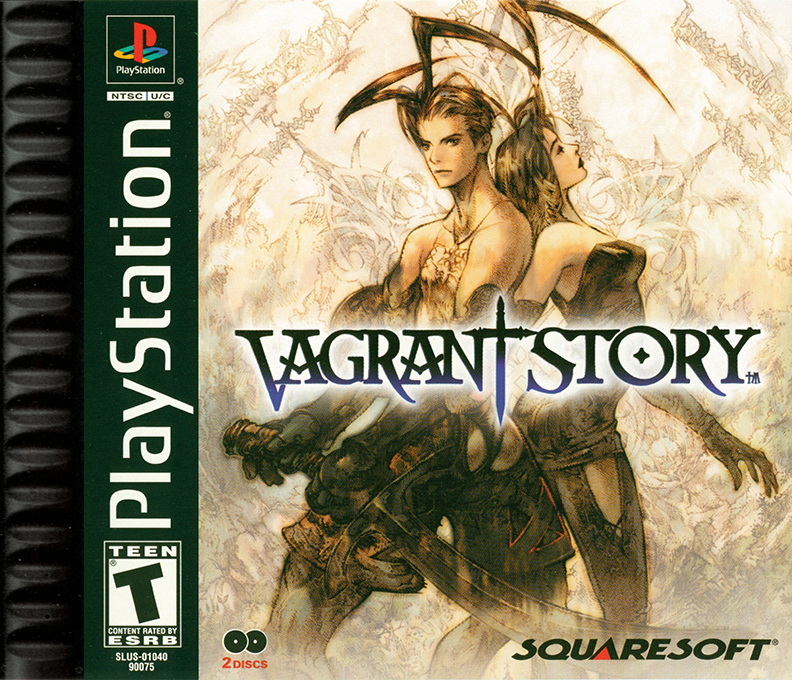
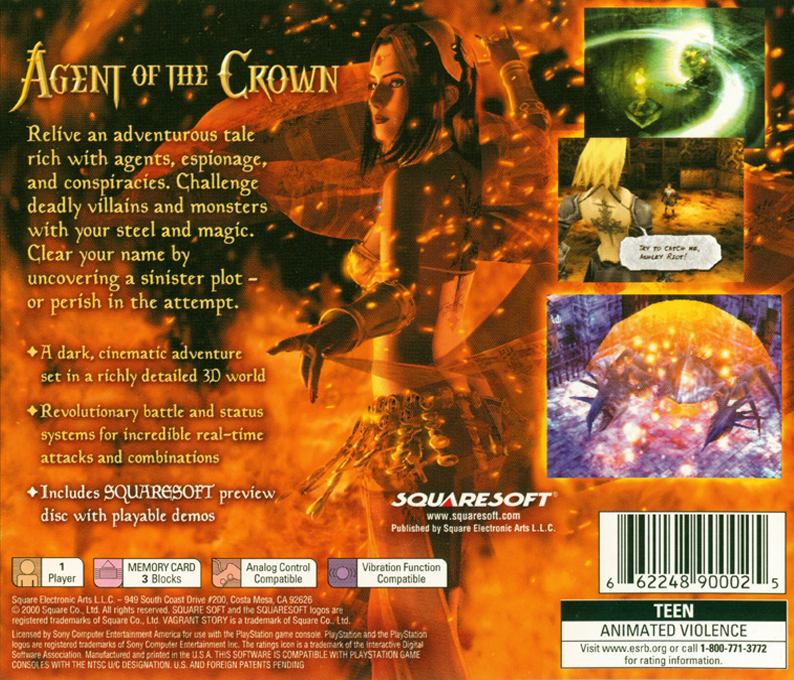
Vagrant Story for PlayStation is a single-player action role-playing game developed and published by Square, released in Japan in February 2000 and in North America that May. Directed and written by Yasumi Matsuno, it follows Ashley Riot, a Riskbreaker for the Valendia Knights of the Peace. The investigation begins at the estate of Duke Bardorba, where Ashley is sent to pursue the cult leader Sydney Losstarot. His trail leads to Leá Monde, a ruined city whose political secrets and supernatural power draw in several competing factions. Rather than building a party around the hero, the game makes Ashley’s solitary mission the focus of both its story and its play.
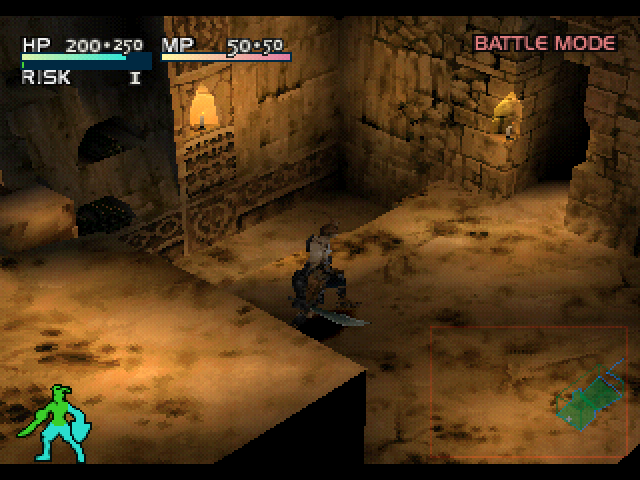
Exploration takes place in connected 3D locations around Leá Monde and beneath it. Ashley can run, jump, move crates, read the environment, and solve block-based obstacles while finding routes through streets, cellars, mines, forests, fortifications, and catacombs. The game’s map records visited areas, but its world is not built around towns full of shops or recruitable companions. Progress comes from pressing farther into the city, surviving hostile creatures and soldiers, solving environmental puzzles, and uncovering the circumstances behind the Graylands incident. Optional revisit challenges can turn certain completed puzzle rooms into timed courses, adding another reason to learn their layouts.
Combat in Vagrant Story uses real-time movement with a tactical pause when Ashley initiates an attack. A spherical targeting display shows the reach of the equipped weapon and lets the player choose individual enemy body parts within range. Weapon reach, damage type, enemy anatomy, affinities, and timing all influence each engagement. Well-timed Chain Abilities can extend an offensive sequence, while Defensive Abilities can reduce or counter damage. Break Arts trade some of Ashley’s health for a stronger technique, and magic learned from collected Grimoires can attack, heal, alter status, or affect affinities. The Risk gauge is equally important: repeated aggressive actions raise Risk, changing Ashley’s accuracy, defenses, damage exposure, and chance of critical results.
Workshops make equipment management a major part of the PS1 game’s progression. Ashley finds blades, staves, maces, crossbows, shields, armor, and accessories, then can disassemble and combine suitable pieces at workshop locations. The resulting gear carries materials, elemental properties, enemy-class affinities, and blunt, edged, or piercing characteristics that can make a weapon better suited to one encounter than another. Using equipment against particular enemies also helps shape its effectiveness, so a favorite weapon is not automatically the best answer to every opponent. This system gives the journey a deliberate rhythm of exploration, battle, and preparation instead of a simple cycle of buying stronger items.
Leá Monde’s collapsed stone architecture, religious imagery, underground passages, and political intrigue give Vagrant Story a distinctive setting for a PlayStation-era RPG. Ashley’s pursuit intersects with the cult Müllenkamp, the Crimson Blades, fellow VKP agents, and figures whose motives become clearer as the case unfolds. Square released the original game only for PlayStation, while later digital re-releases brought it to PlayStation 3, PSP, and PlayStation Vita through PlayStation Network. Completing the story also opens New Game Plus, allowing another run with carried-over equipment and statistics as well as access to additional challenges. For players looking for a focused fantasy adventure built around one investigator, tactical body targeting, deep weapon customization, and puzzle-filled ruins, Vagrant Story remains a singular Square production.
Gallery
Details
- Developer
- Squaresoft
- Publisher
- Squaresoft
- Genre
- JRPG
- Players
- 1
- Release Date
- May 15, 2000
- System
- PS1