About
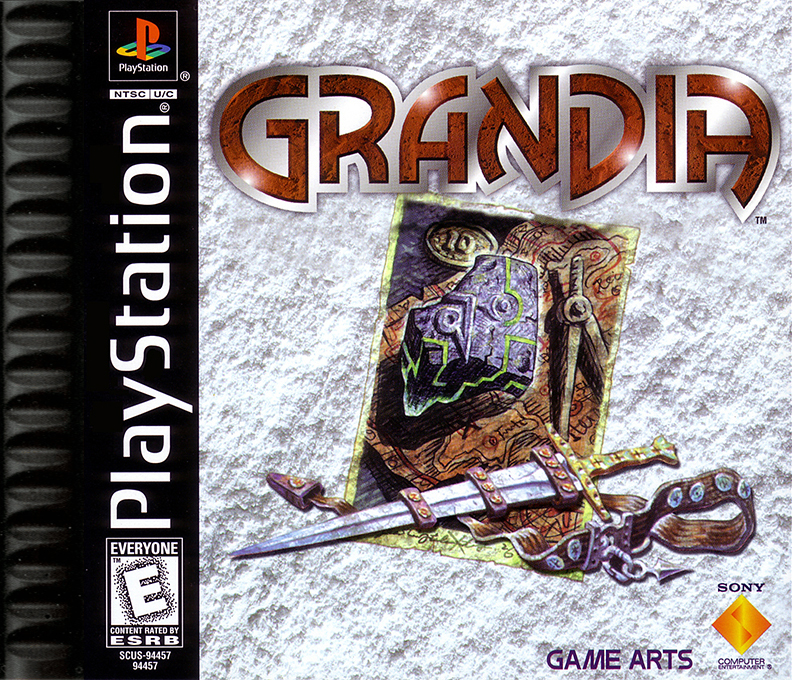
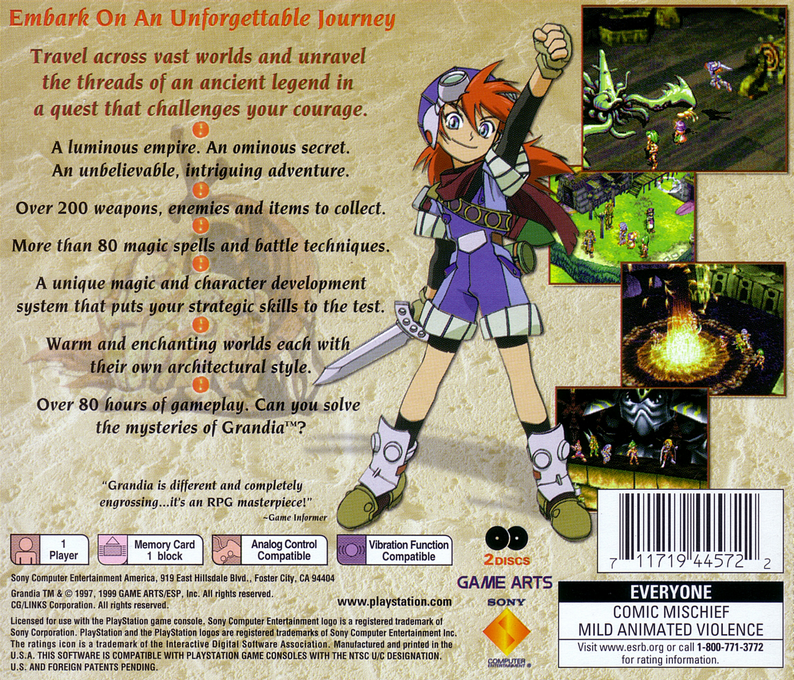
Grandia for PlayStation is a role-playing game from Game Arts, first brought to Sony's console in Japan in 1999 after its 1997 Sega Saturn debut. Sony Computer Entertainment published the English-language North American release later in 1999, while Ubi Soft handled Europe in 2000. It begins the Grandia series with an expansive coming-of-age adventure centered on Justin, a boy from the port town of Parm who dreams of becoming an explorer like his missing father. When he inherits the mysterious Spirit Stone, a relic tied to an ancient civilization, his childhood fascination with the unknown becomes a journey across a changing fantasy world.
Justin leaves home with his young friend Sue and soon meets Feena, an experienced adventurer he greatly admires. Their route leads beyond the familiar Old World and toward ruins, remote settlements, forests, deserts, ships, and the enormous barrier called the End of the World. The party's search for the legendary city of Alent gradually becomes entangled with the Garlyle Forces, a military organization excavating ancient sites for its own purposes. Characters including the warrior Gadwin, the restless Rapp, Milda, and the merchant-chief Guido join at different points, giving the adventure a changing party and a broad view of the world's people and landscapes.
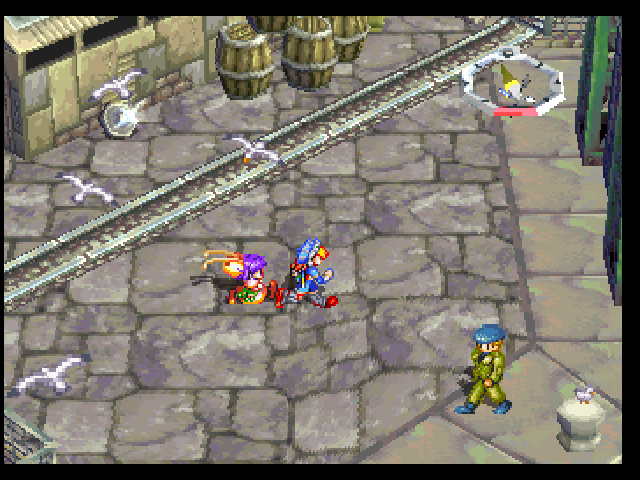
Exploration in Grandia uses animated 2D character sprites on fully navigable 3D maps. Players guide the group through towns and dungeons, rotate the camera to inspect the surroundings, speak with residents, look for treasure, and approach enemies that are visible before battle begins. Contact and positioning matter: reaching a foe first can give the party an opening advantage, while being caught from behind favors the enemy. This makes the PlayStation game's field exploration more directly connected to its combat encounters than an RPG built around unseen random battles.
Battles are built around Grandia's signature Initiative Point, or IP, Gauge. Allies and enemies move along the gauge until they reach a command point, where an action can be chosen; attacks, magic, items, movement, and special techniques each take time. Party members can reposition on the battlefield, and a well-timed hit on an opponent preparing an action can delay or cancel it. The result is a turn-based system with an active sense of timing and spacing, asking players to watch enemy turns as closely as their own rather than simply selecting commands in sequence.
Character development also grows out of what the party actually uses. Winning fights raises normal character experience, but weapon categories and magical elements gain separate levels through repeated use. Raising these proficiencies can improve attributes and opens paths to new techniques or spells, encouraging players to experiment with swords, maces, axes, whips, knives, and elemental magic rather than rely on a single routine. Equipment, recoveries, magic, and skills all support a party whose available members change as the story progresses.
The PlayStation version made the game accessible outside Japan for the first time and added support for the console's DualShock analog controls and vibration; the Japanese release also supported the PocketStation peripheral. Its presentation combines colorful map art, cinematic scenes, and music by Noriyuki Iwadare, whose earlier work with Game Arts included the Lunar games. Grandia later returned as a PlayStation Network release and provided the code base for the modern HD remaster, but this PS1 edition remains the key version that introduced Justin's adventure to English-speaking console players and established the battle ideas carried forward by later Grandia games.
Gallery
Details
- Developer
- Game Arts
- Publisher
- Ubi Soft Entertainment
- Genre
- Action RPG, Action-Adventure
- Players
- 1
- Release Date
- October 26, 1999
- System
- PS1