About
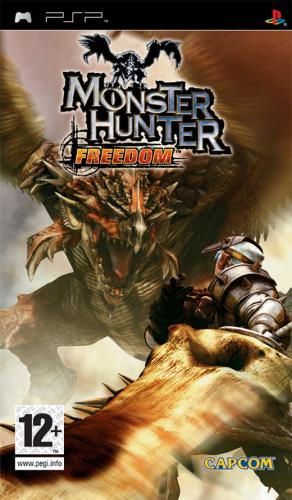
Monster Hunter Freedom PSP is Capcom's hunting action role-playing game for PlayStation Portable, released as Monster Hunter Portable in Japan in 2005 and brought to North America and Europe in 2006. It adapts the foundation of the original PlayStation 2 Monster Hunter while incorporating the expanded content of the Japan-only Monster Hunter G. The result is an early handheld entry in the series built around preparation, observation, and repeated expeditions rather than a conventional linear adventure. A newly created hunter arrives in Kokoto Village, accepts contracts, and gradually earns access to tougher work as their equipment and experience improve.
Each quest sends the hunter to a separate wilderness area with a target and a time limit. Objectives can involve gathering supplies, delivering items, repelling or slaying a large monster, or pursuing smaller creatures. Success depends as much on the preparation screen as on the encounter itself: hunters choose a weapon, pack restorative and support items, study the terrain, and make use of whatever can be collected in the field. Carving defeated monsters, mining ore, catching insects, fishing, and harvesting plants all feed back into the village's crafting economy.
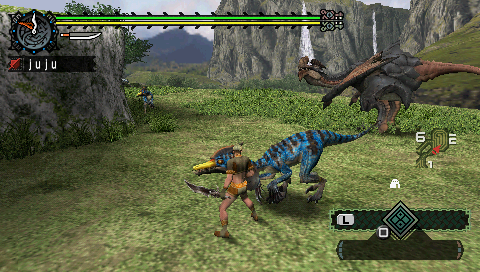
Weapons give Monster Hunter Freedom PSP its deliberate pace and strongly different combat styles. The available choices include Sword and Shield, Great Sword, Dual Blades, Hammer, Lance, Light Bowgun, and Heavy Bowgun. Every type has its own reach, mobility, defensive options, and timing, so learning when to commit to an attack or retreat is central to a hunt. Large monsters are not simply opponents to wear down: they roam, change areas, react to damage, and can force a player to adapt after an ill-timed strike. Limited supplies and the possibility of failing a contract make knowing a target's behavior valuable.
Rewards from successful hunts supply the parts and materials used to forge stronger weapons and armor. That equipment opens the door to more demanding quests, rarer resources, and formidable monster variants, giving the game its steady cycle of hunt, collect, craft, and prepare again. Village Elder quests support solo play, while the Gathering Hall offers a separate set of Guild quests with their own progression. Training School challenges provide prescribed equipment and item sets, asking players to tackle hunts within restrictions instead of relying on a personal inventory.
Kokoto Village also gives the PSP game useful downtime between expeditions. At the farm, players can gather materials through activities such as mining, fishing, bug catching, and cultivation, then improve the facilities to increase what they can obtain. These resources do not replace gathering during a mission, but they help sustain the crafting loop. The village's shops, smithy, quest counter, and storage turn an individual hunt's spoils into the next outing's plan, while the game avoids treating the campaign as something finished by one final story battle.
Monster Hunter Freedom was designed around the PSP's controls, with face-button combinations handling attacks in place of the original game's right-stick actions. It also brought hunters together through local ad hoc multiplayer in the Gathering Hall, where a party can cooperate on Guild quests and exchange Guild Cards. The portable edition does not provide the original PlayStation 2 game's official online service, but its local group hunting was an important early expression of the social play that became closely associated with the series. As the first Monster Hunter release on a handheld, it established the Freedom line before the later, distinct sequels Monster Hunter Freedom 2 and Monster Hunter Freedom Unite.
Gallery

Details
- Developer
- Capcom
- Publisher
- Capcom
- Genre
- Action RPG
- Players
- 1-4
- Release Date
- May 12, 2006
- System
- PSP